
Recent from talks
Glass fusing
Knowledge base stats:
Talk channels stats:
Members stats:
Glass fusing
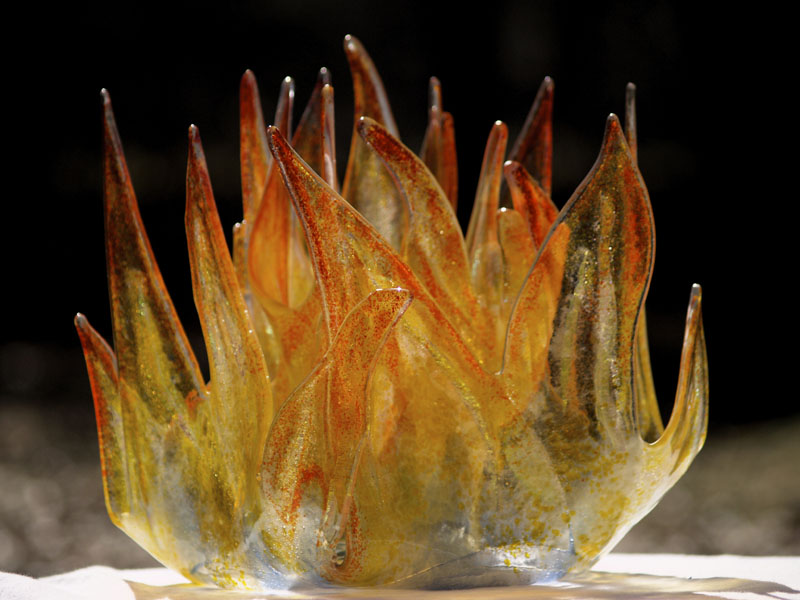
Glass fusing is the joining together of pieces of glass at high temperature, usually in a kiln. This is usually done roughly between 700 °C (1,292 °F) and 820 °C (1,510 °F), and can range from tack fusing at lower temperatures, in which separate pieces of glass stick together but still retain their individual shapes, to full fusing at higher ones, in which separate pieces merge smoothly into one another.
While the precise origins of glass fusing techniques are not known with certainty, there is archeological evidence that the Egyptians were familiar with techniques ca. 2000 BCE. Although this date is generally accepted by researchers, some historians argue that the earliest fusing techniques were first developed by the Romans, who were much more prolific glassworkers. Fusing was the primary method of making small glass objects for approximately 2,000 years, until the development of the glass blowpipe. Glassblowing largely supplanted fusing due to its greater efficiency and utility.
While glass working in general enjoyed a revival during the Renaissance, fusing was largely ignored during this period. Fusing began to regain popularity in the early part of the 20th century, particularly in the U.S. during the 1960s. Modern glass fusing is a widespread hobby but the technique is also gaining popularity in the world of fine art.
Disparate pieces of glass must be compatible in order to ensure they can be fused properly. It is a common misconception that glasses having the same coefficient of expansion (COE) will be compatible. Coefficient of expansion is one indicator that glasses may be compatible, but there are many other factors that determine whether glasses are compatible. If incompatible glasses are fused together, it is unlikely that the fused piece will be able to maintain structural integrity. The piece may shatter during the cooling process, or develop stress originating from the point of contact between the incompatible glasses over time, leading to fractures within the glass, and eventually breakage.
Generally, kiln-glass manufacturers will rate their glasses for compatibility with other glasses they make. In order to be certain that the glasses they use will be compatible, many glass fusers will adopt one manufacturer's glasses to use exclusively.
The stress in two pieces of incompatible glass that were fused can be observed by placing the item between two polarizing filters. This will show areas of tension which will develop stress and fracture over time.
Most contemporary fusing methods involve stacking, or layering thin sheets of glass, often using different colors to create patterns or simple images. The stack is then placed inside the kiln (which is almost always electric, but can be heated by gas or wood) and then heated through a series of ramps (rapid heating) and soaks (holding the temperature at a specific point) until the separate pieces begin to bond together. The longer the kiln is held at the maximum temperature, the more thoroughly the stack will fuse, eventually softening and rounding the edges of the original shape. Once the desired effect has been achieved at the maximum desired temperature, the kiln temperature will be brought down quickly through the temperature range of 815 °C (1,499 °F) to 573 °C (1,063 °F) to avoid devitrification. The glass is then allowed to cool slowly over a specified time, soaking at specified temperature ranges which are essential to the annealing process. This prevents uneven cooling and breakage and produces a strong finished product.
This cooling takes place normally for a period of 10–12 hours in 3 stages.
Hub AI
Glass fusing AI simulator
(@Glass fusing_simulator)
Glass fusing
Glass fusing is the joining together of pieces of glass at high temperature, usually in a kiln. This is usually done roughly between 700 °C (1,292 °F) and 820 °C (1,510 °F), and can range from tack fusing at lower temperatures, in which separate pieces of glass stick together but still retain their individual shapes, to full fusing at higher ones, in which separate pieces merge smoothly into one another.
While the precise origins of glass fusing techniques are not known with certainty, there is archeological evidence that the Egyptians were familiar with techniques ca. 2000 BCE. Although this date is generally accepted by researchers, some historians argue that the earliest fusing techniques were first developed by the Romans, who were much more prolific glassworkers. Fusing was the primary method of making small glass objects for approximately 2,000 years, until the development of the glass blowpipe. Glassblowing largely supplanted fusing due to its greater efficiency and utility.
While glass working in general enjoyed a revival during the Renaissance, fusing was largely ignored during this period. Fusing began to regain popularity in the early part of the 20th century, particularly in the U.S. during the 1960s. Modern glass fusing is a widespread hobby but the technique is also gaining popularity in the world of fine art.
Disparate pieces of glass must be compatible in order to ensure they can be fused properly. It is a common misconception that glasses having the same coefficient of expansion (COE) will be compatible. Coefficient of expansion is one indicator that glasses may be compatible, but there are many other factors that determine whether glasses are compatible. If incompatible glasses are fused together, it is unlikely that the fused piece will be able to maintain structural integrity. The piece may shatter during the cooling process, or develop stress originating from the point of contact between the incompatible glasses over time, leading to fractures within the glass, and eventually breakage.
Generally, kiln-glass manufacturers will rate their glasses for compatibility with other glasses they make. In order to be certain that the glasses they use will be compatible, many glass fusers will adopt one manufacturer's glasses to use exclusively.
The stress in two pieces of incompatible glass that were fused can be observed by placing the item between two polarizing filters. This will show areas of tension which will develop stress and fracture over time.
Most contemporary fusing methods involve stacking, or layering thin sheets of glass, often using different colors to create patterns or simple images. The stack is then placed inside the kiln (which is almost always electric, but can be heated by gas or wood) and then heated through a series of ramps (rapid heating) and soaks (holding the temperature at a specific point) until the separate pieces begin to bond together. The longer the kiln is held at the maximum temperature, the more thoroughly the stack will fuse, eventually softening and rounding the edges of the original shape. Once the desired effect has been achieved at the maximum desired temperature, the kiln temperature will be brought down quickly through the temperature range of 815 °C (1,499 °F) to 573 °C (1,063 °F) to avoid devitrification. The glass is then allowed to cool slowly over a specified time, soaking at specified temperature ranges which are essential to the annealing process. This prevents uneven cooling and breakage and produces a strong finished product.
This cooling takes place normally for a period of 10–12 hours in 3 stages.
Recent media