



Community hub
Recent from talks
Knowledge base stats:
Talk channels stats:
Members stats:
Glass sea creatures
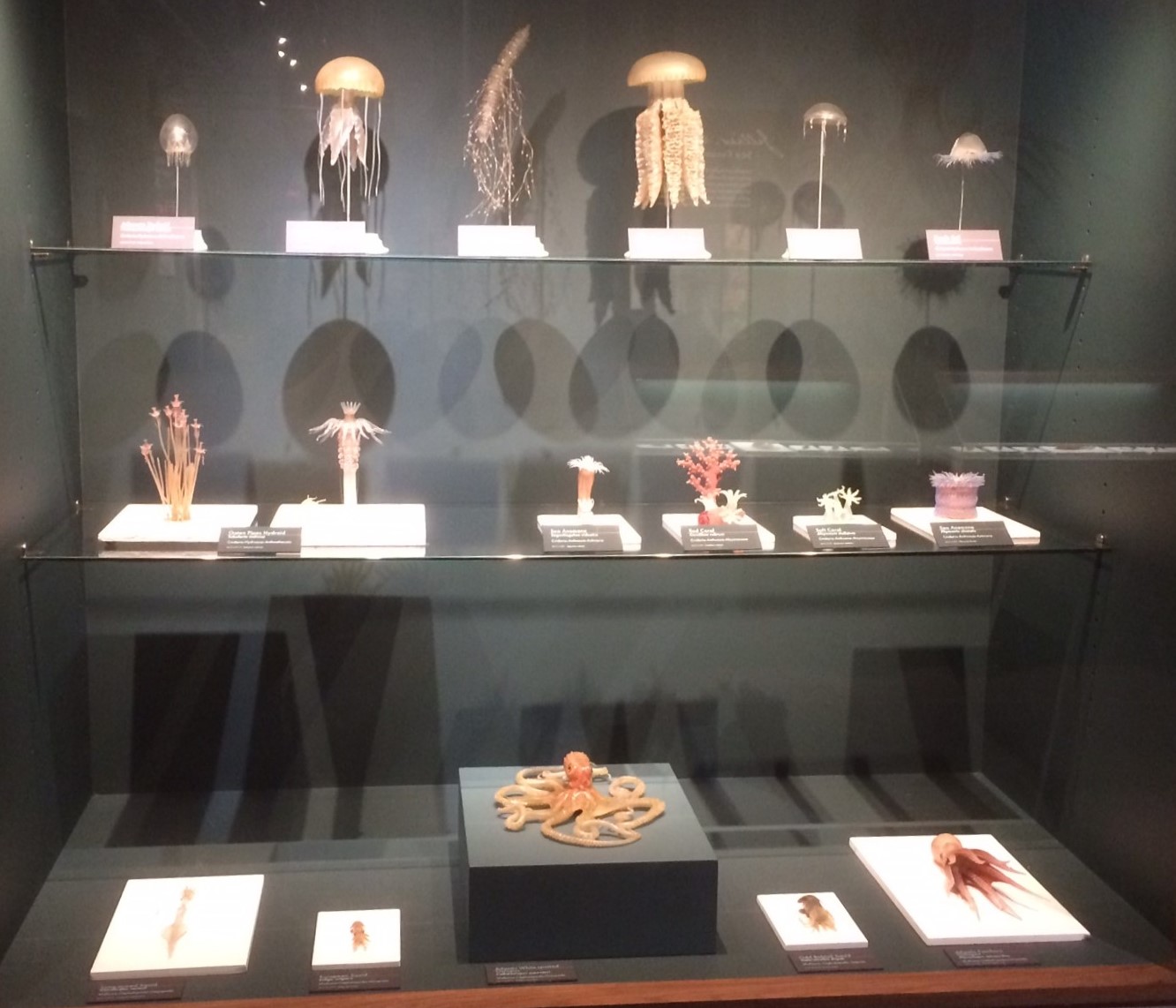
The glass sea creatures (alternately called the Blaschka sea creatures, glass marine invertebrates, Blaschka invertebrate models, and Blaschka glass invertebrates) are works of glass artists Leopold and Rudolf Blaschka. The artistic predecessors of the Glass Flowers, the sea creatures were the output of the Blaschkas' successful mail-order business of supplying museums and private collectors around the world with sets of glass models of marine invertebrates.
Between 1863 and 1880, the Blaschkas – working in Dresden – executed at least 10,000 of these highly detailed glass models, representing some 700 different species.
A number of large collections of the models are held by museums and other academic institutions. Harvard's Museum of Natural History exhibits many of the Blaschka's glass creations, and its Museum of Comparative Zoology hold 430 items in the Blaschka Glass Invertebrate Collection and display about 60 at any given time. Cornell University has about 570 items in its collection and has restored some 170 of these, with many others in its collection stored at the Corning Museum of Glass in Corning, New York. The largest collection in Europe, of 530 pieces, is at Ireland's Natural History Museum. Other holdings include the Boston Museum of Science; the Field Museum of Natural History in Chicago, Natural History Museum in London, Redpath Museum of McGill University in Montreal, Natural History Museum in Geneva, and both Trinity College Dublin and University College Dublin in Ireland; Hancock Museum in Newcastle upon Tyne, England; University Museum in Utrecht;The Grant Museum of Zoology in London, and Aquarium-Museum in Liège, Belgium, the Canterbury Museum, Christchurch in New Zealand and Melbourne Museum, in Melbourne, Australia.
In 1853, shortly after the death of his father and wife Caroline, the latter to a cholera epidemic, Leopold Blaschka – grief stricken and in need of a vacation – traveled to the United States. En route the ship was becalmed and lay still upon the sea for two weeks. During this period of forced idleness, Leopold studied and sketched the local marine invertebrate population, intrigued by the transparency of their bodies similar to the glass his family had long worked.
Leopold felt a sense of quiet, inspirational, wonder at these luminescent ocean dwellers, a sense which he recorded and translated by Henri Reiling: "It is a beautiful night in May. Hopeful, we look out over the darkness of the sea, which is as smooth as a mirror; there emerges all around in various places a flashlike bundle of light beams, as if it is surrounded by thousands of sparks, that form true bundles of fire and of other bright lighting spots, and the seemingly mirrored stars. There emerges close before us a small spot in a sharp greenish light, which becomes ever larger and larger and finally becomes a bright shining sunlike figure."
This sense of wonder would fuel his later work but, in the meantime and upon his return to Dresden, Leopold focused on his family business which was the production the glass eyes, costume ornaments, lab equipment, and other such fancy goods and specialty items that only a master Lampworker could accomplish; plus the task of furthering the training of his son and apprentice (and eventual successor), Rudolf Blaschka. However, like anyone, he did have free time, and his hobby was to make glass models of plants – as opposed to invertebrates. This would, many years later, become a base for the fabled Ware Collection of Blaschka Glass Models of Plants (otherwise known as the Glass Flowers), but, for the moment, such artistry was naught but an amusing and profitless pastime done between his various commissions. Yet, unsurprisingly given their stunning quality, this amusing hobby – itself born out of seeking consolation in nature upon his wife's death – attracted attention. Aristocratic attention, as it turned out, specifically the eyes of Prince Camille de Rohan who, being something of a naturalist himself, commissioned the Blaschkas to craft 100 glass orchids for his private collection. Naturally the Prince was more than a little impressed by the mastery Leopold's work, and "between 1860 and 1862, the prince exhibited about 100 models of orchids and other exotic plants, which he displayed on two artificial tree trunks in his palace in Prague," a fateful act which brought the skill of the Blaschkas to the attention of another man whom the Prince had actually once introduced to Leopold: a certain Ludwig Reichenbach.
Director of the natural history museum in Dresden, Prof. Reichenbach was faced with an annoying yet seemingly unsolvable problem in regards to showing marine life. Land-based flora and fauna was not an issue, for it was a relatively simple matter to exhibit mounted and stuffed creatures such as gorillas and elephants, their lifelike poses attracting and exciting the museum's visitors. Invertebrates, however, by their very nature, posed a problem. In the 19th century the only practiced method of showcasing them was to take a live specimen and place it in a sealed jar of alcohol. This of course killed it but, more importantly, time and their lack of hard parts eventually rendered them into little more than colorless floating blobs of jelly. Neither pretty nor a terribly effective teaching tool, Prof. Reichenbach wanted something more, specifically 3D colored models of marine invertebrates that were both lifelike and able to stand the test of time. By coincidence, in 1863, he "saw an exhibition of highly detailed, realistic glass flowers created by a Bohemian lampworker named Leopold Blaschka."
Enchanted by the botanical models, and positive that Leopold held the key to ending his own showcasing issue, in 1863 Reichenbach convinced and commissioned Leopold to produce twelve model sea anemones. These marine models, hailed as "an artistic marvel in the field of science and a scientific marvel in the field of art," were a great improvement on previous methods of presenting such creatures: drawings, pressing, photographs and papier-mâché or wax models. and exactly what Prof. Reichenbach needed. Moreover they, at last, provided an outlet for the wonder Leopold had felt all those years ago when observing the phosphorescent ocean life.
Hub AI
Glass sea creatures AI simulator
(@Glass sea creatures_simulator)
Glass sea creatures
The glass sea creatures (alternately called the Blaschka sea creatures, glass marine invertebrates, Blaschka invertebrate models, and Blaschka glass invertebrates) are works of glass artists Leopold and Rudolf Blaschka. The artistic predecessors of the Glass Flowers, the sea creatures were the output of the Blaschkas' successful mail-order business of supplying museums and private collectors around the world with sets of glass models of marine invertebrates.
Between 1863 and 1880, the Blaschkas – working in Dresden – executed at least 10,000 of these highly detailed glass models, representing some 700 different species.
A number of large collections of the models are held by museums and other academic institutions. Harvard's Museum of Natural History exhibits many of the Blaschka's glass creations, and its Museum of Comparative Zoology hold 430 items in the Blaschka Glass Invertebrate Collection and display about 60 at any given time. Cornell University has about 570 items in its collection and has restored some 170 of these, with many others in its collection stored at the Corning Museum of Glass in Corning, New York. The largest collection in Europe, of 530 pieces, is at Ireland's Natural History Museum. Other holdings include the Boston Museum of Science; the Field Museum of Natural History in Chicago, Natural History Museum in London, Redpath Museum of McGill University in Montreal, Natural History Museum in Geneva, and both Trinity College Dublin and University College Dublin in Ireland; Hancock Museum in Newcastle upon Tyne, England; University Museum in Utrecht;The Grant Museum of Zoology in London, and Aquarium-Museum in Liège, Belgium, the Canterbury Museum, Christchurch in New Zealand and Melbourne Museum, in Melbourne, Australia.
In 1853, shortly after the death of his father and wife Caroline, the latter to a cholera epidemic, Leopold Blaschka – grief stricken and in need of a vacation – traveled to the United States. En route the ship was becalmed and lay still upon the sea for two weeks. During this period of forced idleness, Leopold studied and sketched the local marine invertebrate population, intrigued by the transparency of their bodies similar to the glass his family had long worked.
Leopold felt a sense of quiet, inspirational, wonder at these luminescent ocean dwellers, a sense which he recorded and translated by Henri Reiling: "It is a beautiful night in May. Hopeful, we look out over the darkness of the sea, which is as smooth as a mirror; there emerges all around in various places a flashlike bundle of light beams, as if it is surrounded by thousands of sparks, that form true bundles of fire and of other bright lighting spots, and the seemingly mirrored stars. There emerges close before us a small spot in a sharp greenish light, which becomes ever larger and larger and finally becomes a bright shining sunlike figure."
This sense of wonder would fuel his later work but, in the meantime and upon his return to Dresden, Leopold focused on his family business which was the production the glass eyes, costume ornaments, lab equipment, and other such fancy goods and specialty items that only a master Lampworker could accomplish; plus the task of furthering the training of his son and apprentice (and eventual successor), Rudolf Blaschka. However, like anyone, he did have free time, and his hobby was to make glass models of plants – as opposed to invertebrates. This would, many years later, become a base for the fabled Ware Collection of Blaschka Glass Models of Plants (otherwise known as the Glass Flowers), but, for the moment, such artistry was naught but an amusing and profitless pastime done between his various commissions. Yet, unsurprisingly given their stunning quality, this amusing hobby – itself born out of seeking consolation in nature upon his wife's death – attracted attention. Aristocratic attention, as it turned out, specifically the eyes of Prince Camille de Rohan who, being something of a naturalist himself, commissioned the Blaschkas to craft 100 glass orchids for his private collection. Naturally the Prince was more than a little impressed by the mastery Leopold's work, and "between 1860 and 1862, the prince exhibited about 100 models of orchids and other exotic plants, which he displayed on two artificial tree trunks in his palace in Prague," a fateful act which brought the skill of the Blaschkas to the attention of another man whom the Prince had actually once introduced to Leopold: a certain Ludwig Reichenbach.
Director of the natural history museum in Dresden, Prof. Reichenbach was faced with an annoying yet seemingly unsolvable problem in regards to showing marine life. Land-based flora and fauna was not an issue, for it was a relatively simple matter to exhibit mounted and stuffed creatures such as gorillas and elephants, their lifelike poses attracting and exciting the museum's visitors. Invertebrates, however, by their very nature, posed a problem. In the 19th century the only practiced method of showcasing them was to take a live specimen and place it in a sealed jar of alcohol. This of course killed it but, more importantly, time and their lack of hard parts eventually rendered them into little more than colorless floating blobs of jelly. Neither pretty nor a terribly effective teaching tool, Prof. Reichenbach wanted something more, specifically 3D colored models of marine invertebrates that were both lifelike and able to stand the test of time. By coincidence, in 1863, he "saw an exhibition of highly detailed, realistic glass flowers created by a Bohemian lampworker named Leopold Blaschka."
Enchanted by the botanical models, and positive that Leopold held the key to ending his own showcasing issue, in 1863 Reichenbach convinced and commissioned Leopold to produce twelve model sea anemones. These marine models, hailed as "an artistic marvel in the field of science and a scientific marvel in the field of art," were a great improvement on previous methods of presenting such creatures: drawings, pressing, photographs and papier-mâché or wax models. and exactly what Prof. Reichenbach needed. Moreover they, at last, provided an outlet for the wonder Leopold had felt all those years ago when observing the phosphorescent ocean life.