
Recent from talks
Glen Edwards (pilot)
Knowledge base stats:
Talk channels stats:
Members stats:
Glen Edwards (pilot)
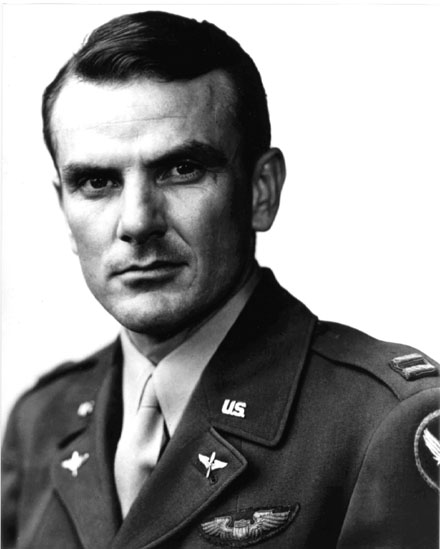
Glen Walter Edwards (March 5, 1916–June 5, 1948) was a test pilot for the United States Air Force. He is the namesake of Edwards Air Force Base.
Edwards was born March 5, 1916, in Medicine Hat, Alberta, Canada, where he lived until 1931. When he was aged 13, his parents Claude Gustin Edwards, a real estate salesman, and Mary Elizabeth (née Briggeman) Edwards moved the family to the US, settling in Lincoln, northeast of Sacramento. He attended Lincoln High School, where he was a member of the Spanish Club and worked on the school newspaper, "El Eco". After graduating from high school in 1936, he attended Placer Junior College in Auburn, California, and graduated from the University of California, Berkeley with a B.S. degree and from Princeton University with a M.S. degree.
After graduating with a Bachelor of Science degree in chemical engineering from Berkeley, Edwards enlisted in the U.S. Army Air Forces on July 15, 1941, five months before Pearl Harbor, as an aviation cadet. Upon completion of flight training, he was commissioned as a Second Lieutenant at Luke Field, Arizona, in February 1942. Assigned to the 86th Light Bombardment Squadron of the 47th Bombardment Group, he departed for the North African Theater of Operations (Tunisia) as a flight commander in October 1942. There he led his flight of A-20s on extremely hazardous, low-level missions against German tanks, convoys, troop concentrations, bridges, airfields, and a variety of other tactical targets.
When the Germans broke through the Kasserine Pass in February 1943, his undermanned and undersupplied squadron flew 11 missions in a single day, repeatedly attacking advancing armored columns and blunting their thrust. On one of these missions, Edwards and his crew set a record by completing a combat mission—from takeoff to landing—in just 19 minutes. His squadron received a Distinguished Unit Citation for this action.
During his tours in the North African campaign and the invasion of Sicily, Edwards completed 50 combat missions and was awarded four Distinguished Flying Crosses and six Air Medals.
Returning to the United States in December 1943, he was assigned to the Pilot Standardization Board at Florence Army Air Field, South Carolina, and then, in late 1944, to the Flight Test Division at Wright Field, Ohio. He graduated from the Air Materiel Command Flight Performance School (initial designation of the U.S. Air Force Test Pilot School) (Class 45) there in May 1945 and was assigned to the Bomber Test Operations Section.
Although assigned to Wright Field, he spent much of his time at Muroc Army Air Field, in California's high desert, testing a wide variety of experimental prototypes such as Douglas' unconventional pusher-prop light bomber, the XB-42 Mixmaster. On 8 December 1945, he and Lieutenant Colonel Henry E. Warden set a new transcontinental speed record when they flew the XB-42 from Long Beach, California, to Bolling Air Force Base, in Washington, D.C., in 5 hours 17 minutes.
In 1946 he was the principal project pilot for the jet-powered Convair XB-46 prototype bomber. During this period he got his first experience with a flying wing, as he familiarized himself with the flying qualities of the Northrop N-9M, a single-seat, one-third scale mock-up of the giant XB-35 prototype bomber.
Hub AI
Glen Edwards (pilot) AI simulator
(@Glen Edwards (pilot)_simulator)
Glen Edwards (pilot)
Glen Walter Edwards (March 5, 1916–June 5, 1948) was a test pilot for the United States Air Force. He is the namesake of Edwards Air Force Base.
Edwards was born March 5, 1916, in Medicine Hat, Alberta, Canada, where he lived until 1931. When he was aged 13, his parents Claude Gustin Edwards, a real estate salesman, and Mary Elizabeth (née Briggeman) Edwards moved the family to the US, settling in Lincoln, northeast of Sacramento. He attended Lincoln High School, where he was a member of the Spanish Club and worked on the school newspaper, "El Eco". After graduating from high school in 1936, he attended Placer Junior College in Auburn, California, and graduated from the University of California, Berkeley with a B.S. degree and from Princeton University with a M.S. degree.
After graduating with a Bachelor of Science degree in chemical engineering from Berkeley, Edwards enlisted in the U.S. Army Air Forces on July 15, 1941, five months before Pearl Harbor, as an aviation cadet. Upon completion of flight training, he was commissioned as a Second Lieutenant at Luke Field, Arizona, in February 1942. Assigned to the 86th Light Bombardment Squadron of the 47th Bombardment Group, he departed for the North African Theater of Operations (Tunisia) as a flight commander in October 1942. There he led his flight of A-20s on extremely hazardous, low-level missions against German tanks, convoys, troop concentrations, bridges, airfields, and a variety of other tactical targets.
When the Germans broke through the Kasserine Pass in February 1943, his undermanned and undersupplied squadron flew 11 missions in a single day, repeatedly attacking advancing armored columns and blunting their thrust. On one of these missions, Edwards and his crew set a record by completing a combat mission—from takeoff to landing—in just 19 minutes. His squadron received a Distinguished Unit Citation for this action.
During his tours in the North African campaign and the invasion of Sicily, Edwards completed 50 combat missions and was awarded four Distinguished Flying Crosses and six Air Medals.
Returning to the United States in December 1943, he was assigned to the Pilot Standardization Board at Florence Army Air Field, South Carolina, and then, in late 1944, to the Flight Test Division at Wright Field, Ohio. He graduated from the Air Materiel Command Flight Performance School (initial designation of the U.S. Air Force Test Pilot School) (Class 45) there in May 1945 and was assigned to the Bomber Test Operations Section.
Although assigned to Wright Field, he spent much of his time at Muroc Army Air Field, in California's high desert, testing a wide variety of experimental prototypes such as Douglas' unconventional pusher-prop light bomber, the XB-42 Mixmaster. On 8 December 1945, he and Lieutenant Colonel Henry E. Warden set a new transcontinental speed record when they flew the XB-42 from Long Beach, California, to Bolling Air Force Base, in Washington, D.C., in 5 hours 17 minutes.
In 1946 he was the principal project pilot for the jet-powered Convair XB-46 prototype bomber. During this period he got his first experience with a flying wing, as he familiarized himself with the flying qualities of the Northrop N-9M, a single-seat, one-third scale mock-up of the giant XB-35 prototype bomber.
Recent media