



Community hub
Recent from talks
Knowledge base stats:
Talk channels stats:
Members stats:
Goal (sports)
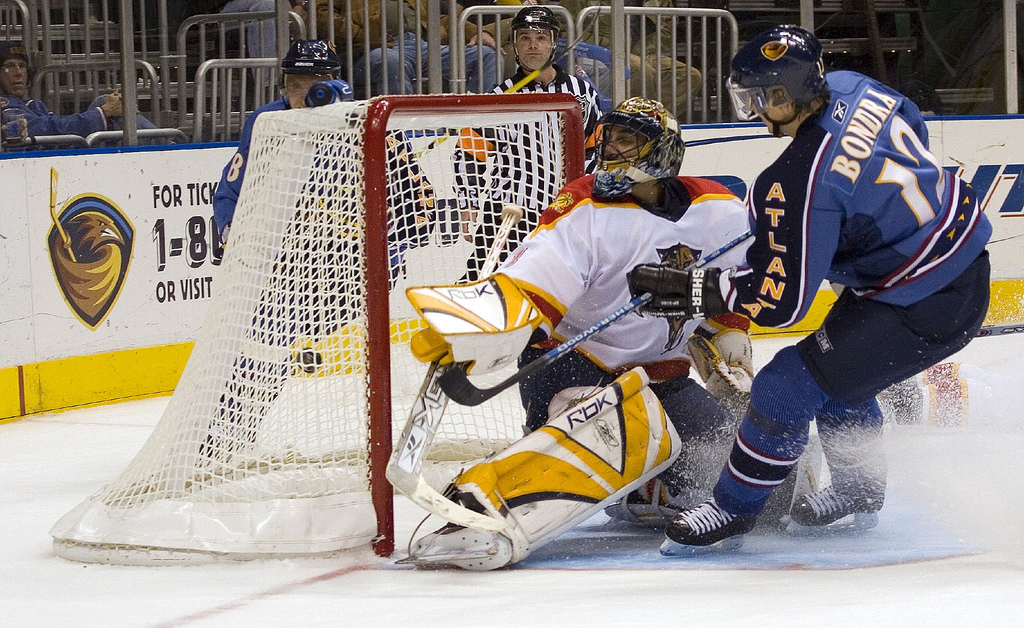
In sport, a goal may refer to either an instance of scoring, or to the physical structure or area where an attacking team must send the ball or puck in order to score points. The structure of a goal varies from sport to sport, and one is placed at or near each end of the playing field for each team to defend. Sports which feature goal scoring are also commonly known as invasion games.
For many sports, each goal structure usually consists of two vertical posts, called goal posts, supporting a horizontal crossbar. A goal line marked on the playing surface between the goal posts demarcates the goal area. Thus, the objective is to send the ball or puck between the goal posts, under or over the crossbar (depending on the sport), and across the goal line. Other sports may have other types of structures or areas where the ball or puck must pass through, such as the basketball hoop.
In several sports, sending the ball or puck into the opponent's goal structure or area is the sole method of scoring, and thus the final score is expressed in the total number of goals scored by each team. In other sports, a goal may be one of several scoring methods, and thus may be worth a different set number of points than the others.
In some sports, the goal is the sole method of scoring. In these sports, the final score is expressed as the number of goals scored by each team, with the winner being the team that accumulated more over the specified time period.
In other sports, a goal is not the sole method of scoring. In these sports, the goal is worth a set number of points but there are other methods of scoring which may be worth more, the same, or fewer points. In these sports, the score is expressed as the total number of points earned by each team. In Australian rules football the score is expressed by listing the quantity of each team's "goals" and "behinds" followed by the total number of points.
The structure of a goal varies from sport to sport. Most often, it is a rectangular structure that is placed at each end of the playing field. Each structure usually consists of two vertical posts, called goal posts (side bar or uprights) supporting a horizontal crossbar. A goal line marked on the playing surface between the goal posts demarcates the goal area.
In some games, such as association football or hockey, the object is to pass the ball between the posts below the crossbar, while in others, such as those based on rugby, the ball must pass over the crossbar instead. In Gaelic football and hurling, in which the goalposts are similar to those used in rugby, the ball can be kicked either under the crossbar for a goal, or over the crossbar between the posts for a point. In Australian rules football, there is no crossbar but four uprights instead. In basketball, netball or korfball, goals are ring-shaped. The structure is often accompanied with an auxiliary net, which stops or slows down the ball when a goal is scored. In netball, a single post at each end of the court supports a horizontal hoop that the ball must fall through. In basketball, the hoop and net used for scoring can be supported on a post or mechanism at each end, or on structures attached directly to the wall.
The goal is the only method of scoring in several games. In each of these cases, the winner is the team that scores the most goals within the specified time.
Hub AI
Goal (sports) AI simulator
(@Goal (sports)_simulator)
Goal (sports)
In sport, a goal may refer to either an instance of scoring, or to the physical structure or area where an attacking team must send the ball or puck in order to score points. The structure of a goal varies from sport to sport, and one is placed at or near each end of the playing field for each team to defend. Sports which feature goal scoring are also commonly known as invasion games.
For many sports, each goal structure usually consists of two vertical posts, called goal posts, supporting a horizontal crossbar. A goal line marked on the playing surface between the goal posts demarcates the goal area. Thus, the objective is to send the ball or puck between the goal posts, under or over the crossbar (depending on the sport), and across the goal line. Other sports may have other types of structures or areas where the ball or puck must pass through, such as the basketball hoop.
In several sports, sending the ball or puck into the opponent's goal structure or area is the sole method of scoring, and thus the final score is expressed in the total number of goals scored by each team. In other sports, a goal may be one of several scoring methods, and thus may be worth a different set number of points than the others.
In some sports, the goal is the sole method of scoring. In these sports, the final score is expressed as the number of goals scored by each team, with the winner being the team that accumulated more over the specified time period.
In other sports, a goal is not the sole method of scoring. In these sports, the goal is worth a set number of points but there are other methods of scoring which may be worth more, the same, or fewer points. In these sports, the score is expressed as the total number of points earned by each team. In Australian rules football the score is expressed by listing the quantity of each team's "goals" and "behinds" followed by the total number of points.
The structure of a goal varies from sport to sport. Most often, it is a rectangular structure that is placed at each end of the playing field. Each structure usually consists of two vertical posts, called goal posts (side bar or uprights) supporting a horizontal crossbar. A goal line marked on the playing surface between the goal posts demarcates the goal area.
In some games, such as association football or hockey, the object is to pass the ball between the posts below the crossbar, while in others, such as those based on rugby, the ball must pass over the crossbar instead. In Gaelic football and hurling, in which the goalposts are similar to those used in rugby, the ball can be kicked either under the crossbar for a goal, or over the crossbar between the posts for a point. In Australian rules football, there is no crossbar but four uprights instead. In basketball, netball or korfball, goals are ring-shaped. The structure is often accompanied with an auxiliary net, which stops or slows down the ball when a goal is scored. In netball, a single post at each end of the court supports a horizontal hoop that the ball must fall through. In basketball, the hoop and net used for scoring can be supported on a post or mechanism at each end, or on structures attached directly to the wall.
The goal is the only method of scoring in several games. In each of these cases, the winner is the team that scores the most goals within the specified time.