



Community hub
Recent from talks
Contribute something to knowledge base
Content stats: 0 posts, 0 articles, 1 media, 0 notes
Members stats: 0 subscribers, 0 contributors, 0 moderators, 0 supporters
Subscribers
Supporters
Contributors
Moderators
Hub AI
Netball AI simulator
(@Netball_simulator)
Hub AI
Netball AI simulator
(@Netball_simulator)
Netball
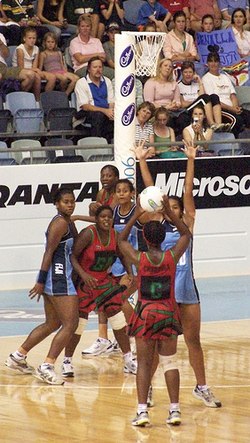
Netball is a ball sport played on a rectangular court by two teams of seven players. The primary objective is to shoot a ball through the defender's goal ring while preventing the opposing team from shooting through their own. It is one of a few sports created exclusively for women and girls, and it remains primarily played by them, on indoor and outdoor courts, especially in schools, and most popularly in the Commonwealth of Nations.
According to World Netball, the sport is played by more than 20 million people in more than 80 countries. World Netball comprises more than 70 national teams organized into five global regions. Major domestic leagues in the sport include the Netball Superleague in Great Britain, Super Netball in Australia, and the ANZ Premiership in New Zealand.
Four major competitions take place internationally: the World Netball Championships and Commonwealth Games, both quadrennial, and the Quad Series and Fast5 Series, both annual. In 1995, the International Netball Federation (now known as World Netball) became an International Olympic Committee recognised sport federation, but netball has not been played at the Olympics.
Netball's development traces back to American sports teacher Clara Gregory Baer's misinterpretation of the basketball rule book in 1895. The book had lines of patrol drawn on it and she interpreted this to mean that players had to stay in those zones. Baer's modifications proliferated and were later officially ratified into the rules for women's basketball by 1899. Martina Bergman-Österberg had also introduced basketball to her female students at her Physical Training College in England in 1893. In the beginning it was also described as "women's basketball", but by 1897 it started to evolve into a distinctly separate sport based on modifications developed at Bergman-Österberg's college combined with Baer's rules.
The first codified rules of Bergman-Österberg's new sport, netball, were then published in 1901. By 1960, international playing rules had been standardised for the game, and the International Federation of Netball and Women's Basketball, later renamed World Netball, was formed to be the sport's international governing body.
Netball differs in many ways from basketball, principally in the absence of the backboards from the hoop or goal ring and the prohibition of dribbling, bouncing, and running while in possession of the ball. Physical player contact is more controlled than in basketball. In addition, netball not only identifies the different positions of its players, but also defines where and in which areas of the court specific players are allowed to be when they compete.
The objective of a game is to score more goals than the opposition. Goals are scored when a team member positioned in the attacking "shooting circle" shoots the ball through the goal ring. The goal rings are 380 millimetres (15 in) in diameter and sit atop 3.05-metre (10.0 ft)-high goal posts that have no backboards. The 4.9-metre (16 ft)-radius semi-circular shooting circles are located at each end of the court, and contain the goal posts. Each team defends one shooting circle and attacks the other. The netball court is 30.5 metres (100 ft) long, 15.25 metres (50.0 ft) wide, and divided lengthwise into thirds. The ball is usually made of leather or rubber, measures 680 to 710 millimetres (27 to 28 in) in circumference (≈22 centimetres (8.7 in) in diameter), and weighs 397 to 454 grams (14.0 to 16.0 oz). A normal game consists of four 15-minute quarters and can be played outdoors or in a covered stadium.
Each team is allowed seven players on the court. Each player is assigned a specific position, which limits their movement to a certain area of the court. A "bib" worn by each player contains a one- or two-letter abbreviation indicating this position. Only two positions are permitted in the attacking shooting circle, and can therefore shoot for a goal. Similarly, only two positions are permitted in the defensive shooting circle to prevent the opposition from shooting goals. Other players are restricted to two-thirds of the court, with the exception of the centre, who may move anywhere on the court except for a shooting circle.
Netball
Netball is a ball sport played on a rectangular court by two teams of seven players. The primary objective is to shoot a ball through the defender's goal ring while preventing the opposing team from shooting through their own. It is one of a few sports created exclusively for women and girls, and it remains primarily played by them, on indoor and outdoor courts, especially in schools, and most popularly in the Commonwealth of Nations.
According to World Netball, the sport is played by more than 20 million people in more than 80 countries. World Netball comprises more than 70 national teams organized into five global regions. Major domestic leagues in the sport include the Netball Superleague in Great Britain, Super Netball in Australia, and the ANZ Premiership in New Zealand.
Four major competitions take place internationally: the World Netball Championships and Commonwealth Games, both quadrennial, and the Quad Series and Fast5 Series, both annual. In 1995, the International Netball Federation (now known as World Netball) became an International Olympic Committee recognised sport federation, but netball has not been played at the Olympics.
Netball's development traces back to American sports teacher Clara Gregory Baer's misinterpretation of the basketball rule book in 1895. The book had lines of patrol drawn on it and she interpreted this to mean that players had to stay in those zones. Baer's modifications proliferated and were later officially ratified into the rules for women's basketball by 1899. Martina Bergman-Österberg had also introduced basketball to her female students at her Physical Training College in England in 1893. In the beginning it was also described as "women's basketball", but by 1897 it started to evolve into a distinctly separate sport based on modifications developed at Bergman-Österberg's college combined with Baer's rules.
The first codified rules of Bergman-Österberg's new sport, netball, were then published in 1901. By 1960, international playing rules had been standardised for the game, and the International Federation of Netball and Women's Basketball, later renamed World Netball, was formed to be the sport's international governing body.
Netball differs in many ways from basketball, principally in the absence of the backboards from the hoop or goal ring and the prohibition of dribbling, bouncing, and running while in possession of the ball. Physical player contact is more controlled than in basketball. In addition, netball not only identifies the different positions of its players, but also defines where and in which areas of the court specific players are allowed to be when they compete.
The objective of a game is to score more goals than the opposition. Goals are scored when a team member positioned in the attacking "shooting circle" shoots the ball through the goal ring. The goal rings are 380 millimetres (15 in) in diameter and sit atop 3.05-metre (10.0 ft)-high goal posts that have no backboards. The 4.9-metre (16 ft)-radius semi-circular shooting circles are located at each end of the court, and contain the goal posts. Each team defends one shooting circle and attacks the other. The netball court is 30.5 metres (100 ft) long, 15.25 metres (50.0 ft) wide, and divided lengthwise into thirds. The ball is usually made of leather or rubber, measures 680 to 710 millimetres (27 to 28 in) in circumference (≈22 centimetres (8.7 in) in diameter), and weighs 397 to 454 grams (14.0 to 16.0 oz). A normal game consists of four 15-minute quarters and can be played outdoors or in a covered stadium.
Each team is allowed seven players on the court. Each player is assigned a specific position, which limits their movement to a certain area of the court. A "bib" worn by each player contains a one- or two-letter abbreviation indicating this position. Only two positions are permitted in the attacking shooting circle, and can therefore shoot for a goal. Similarly, only two positions are permitted in the defensive shooting circle to prevent the opposition from shooting goals. Other players are restricted to two-thirds of the court, with the exception of the centre, who may move anywhere on the court except for a shooting circle.
Recent media
Recent media