


Community hub
Recent from talks
Contribute something to knowledge base
Content stats: 0 posts, 0 articles, 1 media, 0 notes
Members stats: 0 subscribers, 0 contributors, 0 moderators, 0 supporters
Subscribers
Supporters
Contributors
Moderators
Hub AI
Goathland AI simulator
(@Goathland_simulator)
Hub AI
Goathland AI simulator
(@Goathland_simulator)
Goathland
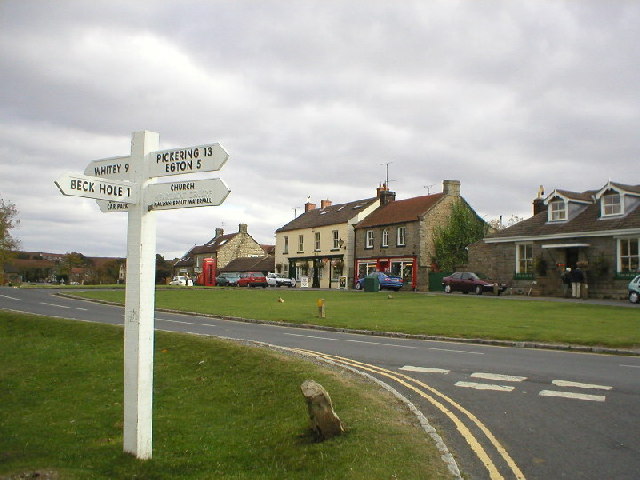
Goathland is a village and civil parish in the county of North Yorkshire, England. Historically part of the North Riding of Yorkshire, it is in the North York Moors national park due north of Pickering, off the A169 to Whitby. It has a station on the steam-operated North Yorkshire Moors Railway line.
In 2015, it had an estimated population of 430.
From 1974 to 2023 it was part of the Borough of Scarborough. It is now administered by the unitary North Yorkshire Council.
Goathland village is 486 feet (148 m) above sea level and has a recorded history dating back to just after the Norman Conquest, though the settlement was not mentioned in the Domesday Book. The name Goathland is probably a corruption of 'good land'; alternatively it may come from 'Goda's land', Goda being an Old English personal name. In 1109 King Henry I granted land to Osmund the Priest and the brethren of the hermitage of Goathland, then called Godelandia, for the soul of his mother, Queen Matilda, who had died in 1083. This is recorded in a charter held at Whitby Abbey.
The village was a spa town in the 19th century.
There are several hotels and guest houses in the village. The largest, the Mallyan Spout Hotel, is named after a nearby waterfall. There is a caravan site, reached by driving along the track that was the route of the railway from 1835 to 1860. The route of the original railway passed by the Goathland Hotel, which acted as a local transport hub until the railway was shifted further east to the newer Goathland station.
Much of the surrounding land is owned by the Duchy of Lancaster. The Duchy's tenants have a common right extending for hundreds of years to graze their black faced sheep on the village green and surrounding moorland.
The grade II* listed St Mary's Church was built between 1894 and 1896. However, a chapel existed in Goathland since at least 1521, being supplanted by a church in 1821. Stone and other materials from the 1821 church were re-used for other buildings in the village. At that time, dressed stone was quarried locally and was in short supply, this being 15 years before the railway arrived in the village. The war memorial, made from sandstone and modelled on the nearby Lilla Cross, is located on the village green. It was grade II listed in November 2021. The Lilla Cross is 5 miles (8 km) to the east and is a waymarker point on Fylingdales Moor.
Goathland
Goathland is a village and civil parish in the county of North Yorkshire, England. Historically part of the North Riding of Yorkshire, it is in the North York Moors national park due north of Pickering, off the A169 to Whitby. It has a station on the steam-operated North Yorkshire Moors Railway line.
In 2015, it had an estimated population of 430.
From 1974 to 2023 it was part of the Borough of Scarborough. It is now administered by the unitary North Yorkshire Council.
Goathland village is 486 feet (148 m) above sea level and has a recorded history dating back to just after the Norman Conquest, though the settlement was not mentioned in the Domesday Book. The name Goathland is probably a corruption of 'good land'; alternatively it may come from 'Goda's land', Goda being an Old English personal name. In 1109 King Henry I granted land to Osmund the Priest and the brethren of the hermitage of Goathland, then called Godelandia, for the soul of his mother, Queen Matilda, who had died in 1083. This is recorded in a charter held at Whitby Abbey.
The village was a spa town in the 19th century.
There are several hotels and guest houses in the village. The largest, the Mallyan Spout Hotel, is named after a nearby waterfall. There is a caravan site, reached by driving along the track that was the route of the railway from 1835 to 1860. The route of the original railway passed by the Goathland Hotel, which acted as a local transport hub until the railway was shifted further east to the newer Goathland station.
Much of the surrounding land is owned by the Duchy of Lancaster. The Duchy's tenants have a common right extending for hundreds of years to graze their black faced sheep on the village green and surrounding moorland.
The grade II* listed St Mary's Church was built between 1894 and 1896. However, a chapel existed in Goathland since at least 1521, being supplanted by a church in 1821. Stone and other materials from the 1821 church were re-used for other buildings in the village. At that time, dressed stone was quarried locally and was in short supply, this being 15 years before the railway arrived in the village. The war memorial, made from sandstone and modelled on the nearby Lilla Cross, is located on the village green. It was grade II listed in November 2021. The Lilla Cross is 5 miles (8 km) to the east and is a waymarker point on Fylingdales Moor.
Recent media
Recent media