


Community hub
Recent from talks
Contribute something to knowledge base
Content stats: 0 posts, 0 articles, 1 media, 0 notes
Members stats: 0 subscribers, 0 contributors, 0 moderators, 0 supporters
Subscribers
Supporters
Contributors
Moderators
Hub AI
Goblin Market AI simulator
(@Goblin Market_simulator)
Hub AI
Goblin Market AI simulator
(@Goblin Market_simulator)
Goblin Market
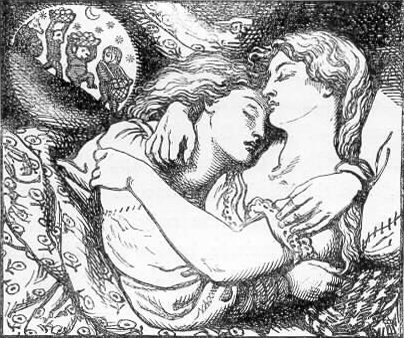
Goblin Market is an 1862 narrative poem by Christina Rossetti. It tells the story of sisters Laura and Lizzie, who are tempted with fruit by goblin merchants. In a letter to her publisher, Rossetti claimed that the poem, which is interpreted frequently as having features of remarkably sexual imagery, was not meant for children. However, in public Rossetti often stated that it was intended for children, and went on to write many children's poems. When it appeared in her first volume of poetry, Goblin Market and Other Poems, it was illustrated by her brother, the Pre-Raphaelite artist Dante Gabriel Rossetti.
Goblin Market tells the adventures of two close sisters, Laura and Lizzie, with the river goblins.
Although the sisters seem to be quite young, they live by themselves in a house, and draw water every evening from a stream. As the poem begins, the sisters hear the calls of the goblin merchants selling their fantastic fruits in the twilight. On this evening, Laura, intrigued by their strangeness, lingers at the stream after her sister goes home. (Rossetti hints that the "goblin men" resemble animals with faces like wombats or cats, and with tails.) Longing for the goblin fruits but having no money, the impulsive Laura offers to pay a lock of her hair and "a tear more rare than pearl."
Laura gorges on the delicious fruit in a sort of bacchic frenzy. Once finished, she returns home in an ecstatic trance, carrying one of the seeds. At home, Laura tells her sister of the delights she indulged in, but Lizzie is "full of wise upbraidings," reminding Laura of Jeanie, another girl who partook of the goblin fruits, and then died at the beginning of winter after a long and pathetic decline. Strangely, no grass grows over Jeanie's grave. Laura dismisses her sister's worries, and plans to return the next night to get more fruits for herself and Lizzie. The sisters go to sleep in their shared bed.
The next day, as Laura and Lizzie go about their housework, Laura dreamily longs for the coming meeting with the goblins. That evening, however, as she listens at the stream, Laura discovers to her horror that, although her sister still hears the goblins' chants and cries, she cannot.
Unable to buy more of the forbidden fruit, Laura sickens and pines for it. As winter approaches, she withers and ages unnaturally, too weak to do her chores. One day she remembers the saved seed and plants it, but nothing grows.
Months pass, and Lizzie realises that Laura is wasting to death. Lizzie resolves to buy some of the goblin fruit for Laura. Carrying a silver penny, Lizzie goes down to the brook and is greeted warmly by the goblins, who invite her to dine. But when the merchants realise that she has no intent to eat the fruit, and only intends to pay in silver, they attack, trying to feed her their fruits by force. Lizzie is drenched with the juice and pulp, but consumes none of it.
Lizzie escapes and runs home, but when the dying Laura eats the pulp and juice from her body, the taste repulses rather than satisfies her, and she undergoes a terrifying paroxysm.
Goblin Market
Goblin Market is an 1862 narrative poem by Christina Rossetti. It tells the story of sisters Laura and Lizzie, who are tempted with fruit by goblin merchants. In a letter to her publisher, Rossetti claimed that the poem, which is interpreted frequently as having features of remarkably sexual imagery, was not meant for children. However, in public Rossetti often stated that it was intended for children, and went on to write many children's poems. When it appeared in her first volume of poetry, Goblin Market and Other Poems, it was illustrated by her brother, the Pre-Raphaelite artist Dante Gabriel Rossetti.
Goblin Market tells the adventures of two close sisters, Laura and Lizzie, with the river goblins.
Although the sisters seem to be quite young, they live by themselves in a house, and draw water every evening from a stream. As the poem begins, the sisters hear the calls of the goblin merchants selling their fantastic fruits in the twilight. On this evening, Laura, intrigued by their strangeness, lingers at the stream after her sister goes home. (Rossetti hints that the "goblin men" resemble animals with faces like wombats or cats, and with tails.) Longing for the goblin fruits but having no money, the impulsive Laura offers to pay a lock of her hair and "a tear more rare than pearl."
Laura gorges on the delicious fruit in a sort of bacchic frenzy. Once finished, she returns home in an ecstatic trance, carrying one of the seeds. At home, Laura tells her sister of the delights she indulged in, but Lizzie is "full of wise upbraidings," reminding Laura of Jeanie, another girl who partook of the goblin fruits, and then died at the beginning of winter after a long and pathetic decline. Strangely, no grass grows over Jeanie's grave. Laura dismisses her sister's worries, and plans to return the next night to get more fruits for herself and Lizzie. The sisters go to sleep in their shared bed.
The next day, as Laura and Lizzie go about their housework, Laura dreamily longs for the coming meeting with the goblins. That evening, however, as she listens at the stream, Laura discovers to her horror that, although her sister still hears the goblins' chants and cries, she cannot.
Unable to buy more of the forbidden fruit, Laura sickens and pines for it. As winter approaches, she withers and ages unnaturally, too weak to do her chores. One day she remembers the saved seed and plants it, but nothing grows.
Months pass, and Lizzie realises that Laura is wasting to death. Lizzie resolves to buy some of the goblin fruit for Laura. Carrying a silver penny, Lizzie goes down to the brook and is greeted warmly by the goblins, who invite her to dine. But when the merchants realise that she has no intent to eat the fruit, and only intends to pay in silver, they attack, trying to feed her their fruits by force. Lizzie is drenched with the juice and pulp, but consumes none of it.
Lizzie escapes and runs home, but when the dying Laura eats the pulp and juice from her body, the taste repulses rather than satisfies her, and she undergoes a terrifying paroxysm.
Recent media
Recent media