



Community hub
Recent from talks
Knowledge base stats:
Talk channels stats:
Members stats:
Goffstown, New Hampshire
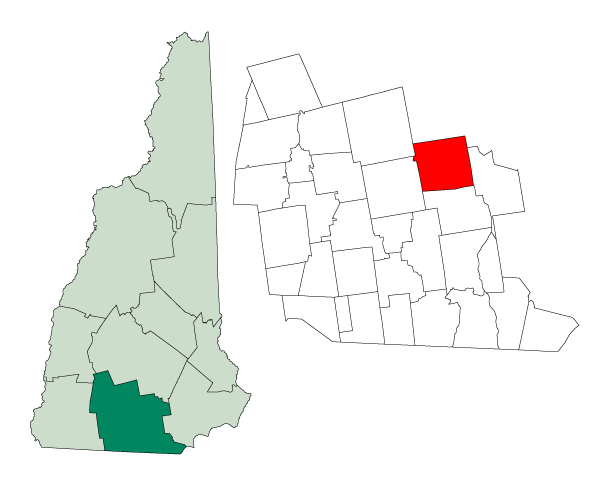
Goffstown is a town in Hillsborough County, New Hampshire, United States. The population was 18,577 at the 2020 census. The compact center of town, where 3,366 people resided at the 2020 census, is defined by the U.S. Census Bureau as the Goffstown census-designated place and is located at the junctions of New Hampshire routes 114 and 13. Goffstown also includes the villages of Grasmere and Pinardville. The town is home to Saint Anselm College (and its New Hampshire Institute of Politics), the Goffstown Giant Pumpkin Regatta, and was the location of the New Hampshire State Prison for Women, prior to the prison's relocation to Concord in 2018.
Prior to the arrival of English colonists, the area had seasonally been inhabited for thousands of years by succeeding cultures of Native Americans; its waterways had numerous fish, and the area had game.
The town was first granted as "Narragansett No. 4" in 1734 by New Hampshire and Massachusetts colonial Governor Jonathan Belcher as a Massachusetts township (the area then being disputed between the two provinces). It was one of seven townships intended for soldiers (or their heirs) who had fought in the "Narragansett War" of 1675, also known as King Philip's War. In 1735, however, some grantees "found it so poor and barren as to be altogether incapable of making settlements," and were instead granted a tract in Greenwich, Massachusetts.
The community was called "Piscataquog Village" and "Shovestown" before being regranted by Masonian proprietor Governor Benning Wentworth in 1748 to new settlers. These included Rev. Thomas Parker of Dracut and Colonel John Goffe, for whom the town was named. He was for several years a resident of neighboring Bedford, and he was the first judge of probate in the county of Hillsborough. Goffstown was incorporated June 16, 1761. A large part of the town was originally covered with valuable timber. Lumbering and fishing were the main occupations of the early settlers. The village of Grasmere was named for Grasmere, England, home of the poets William Wordsworth and Samuel Taylor Coleridge.
A Congregational church was organized about October 30, 1771, and the town made annual small appropriations for preaching. The majority of residents were Congregationalists; residents in the south part were of Scots-Irish descent and were Presbyterian. A meeting-house was erected in 1768; but it was not completed for several years. The first minister was Joseph Currier, appointed in 1771; he was dismissed August 29, 1774, for intemperance, according to the town records. In 1781, the Congregationalists and the Presbyterians organized separately; the former called Rev. Cornelius Waters, who became their pastor, and continued till 1795. The next minister was David L. Morril, who began March 3, 1802. He was supported by both congregations under the name of the Congregational Presbyterian church. Morril was elected as a representative of the town to the state house, as a U.S. senator for the state, and in 1824, as governor of the state, serving until 1827.
The Piscataquog River, which bisects the main village of Goffstown and was spanned by a covered bridge, provided water power for industry. In 1817, Goffstown had 20 sawmills, seven grain mills, two textile mills, two carding machines, and a cotton factory. Its textile industry was an example of the economic ties between New England and the American South, which was dependent on slave labor for production of its lucrative cotton commodity crop.
The town was described in 1859 by the following:
The surface is comparatively level, the only elevations of note being two in the southwest part, called by the natives Uncanoonuck. There are considerable tracts of valuable interval[e], as well as extensive plains, which are generally productive. Piscataquog river is the principal stream, which furnishes quite a number of valuable mill privileges. It passes through in a central direction. Large quantities of lumber were formerly floated down this stream to the Merrimack, and the forests at one time supplied a large number of masts for the English navy. The New Hampshire Central Railroad passes through Goffstown. Then; are three villages — Goffstown, Goffstown Centre, and Parker's Mills; three church edifices — Baptist, Congregational, and Methodist; sixteen school districts; and two post-offices — Goffstown and Goffstown Centre: also, four stores, four saw-mills, two grist-mills, and one sash and blind factory. Population, 2,270; valuation, $599,615.
Hub AI
Goffstown, New Hampshire AI simulator
(@Goffstown, New Hampshire_simulator)
Goffstown, New Hampshire
Goffstown is a town in Hillsborough County, New Hampshire, United States. The population was 18,577 at the 2020 census. The compact center of town, where 3,366 people resided at the 2020 census, is defined by the U.S. Census Bureau as the Goffstown census-designated place and is located at the junctions of New Hampshire routes 114 and 13. Goffstown also includes the villages of Grasmere and Pinardville. The town is home to Saint Anselm College (and its New Hampshire Institute of Politics), the Goffstown Giant Pumpkin Regatta, and was the location of the New Hampshire State Prison for Women, prior to the prison's relocation to Concord in 2018.
Prior to the arrival of English colonists, the area had seasonally been inhabited for thousands of years by succeeding cultures of Native Americans; its waterways had numerous fish, and the area had game.
The town was first granted as "Narragansett No. 4" in 1734 by New Hampshire and Massachusetts colonial Governor Jonathan Belcher as a Massachusetts township (the area then being disputed between the two provinces). It was one of seven townships intended for soldiers (or their heirs) who had fought in the "Narragansett War" of 1675, also known as King Philip's War. In 1735, however, some grantees "found it so poor and barren as to be altogether incapable of making settlements," and were instead granted a tract in Greenwich, Massachusetts.
The community was called "Piscataquog Village" and "Shovestown" before being regranted by Masonian proprietor Governor Benning Wentworth in 1748 to new settlers. These included Rev. Thomas Parker of Dracut and Colonel John Goffe, for whom the town was named. He was for several years a resident of neighboring Bedford, and he was the first judge of probate in the county of Hillsborough. Goffstown was incorporated June 16, 1761. A large part of the town was originally covered with valuable timber. Lumbering and fishing were the main occupations of the early settlers. The village of Grasmere was named for Grasmere, England, home of the poets William Wordsworth and Samuel Taylor Coleridge.
A Congregational church was organized about October 30, 1771, and the town made annual small appropriations for preaching. The majority of residents were Congregationalists; residents in the south part were of Scots-Irish descent and were Presbyterian. A meeting-house was erected in 1768; but it was not completed for several years. The first minister was Joseph Currier, appointed in 1771; he was dismissed August 29, 1774, for intemperance, according to the town records. In 1781, the Congregationalists and the Presbyterians organized separately; the former called Rev. Cornelius Waters, who became their pastor, and continued till 1795. The next minister was David L. Morril, who began March 3, 1802. He was supported by both congregations under the name of the Congregational Presbyterian church. Morril was elected as a representative of the town to the state house, as a U.S. senator for the state, and in 1824, as governor of the state, serving until 1827.
The Piscataquog River, which bisects the main village of Goffstown and was spanned by a covered bridge, provided water power for industry. In 1817, Goffstown had 20 sawmills, seven grain mills, two textile mills, two carding machines, and a cotton factory. Its textile industry was an example of the economic ties between New England and the American South, which was dependent on slave labor for production of its lucrative cotton commodity crop.
The town was described in 1859 by the following:
The surface is comparatively level, the only elevations of note being two in the southwest part, called by the natives Uncanoonuck. There are considerable tracts of valuable interval[e], as well as extensive plains, which are generally productive. Piscataquog river is the principal stream, which furnishes quite a number of valuable mill privileges. It passes through in a central direction. Large quantities of lumber were formerly floated down this stream to the Merrimack, and the forests at one time supplied a large number of masts for the English navy. The New Hampshire Central Railroad passes through Goffstown. Then; are three villages — Goffstown, Goffstown Centre, and Parker's Mills; three church edifices — Baptist, Congregational, and Methodist; sixteen school districts; and two post-offices — Goffstown and Goffstown Centre: also, four stores, four saw-mills, two grist-mills, and one sash and blind factory. Population, 2,270; valuation, $599,615.