
Recent from talks
New England town
Knowledge base stats:
Talk channels stats:
Members stats:
New England town
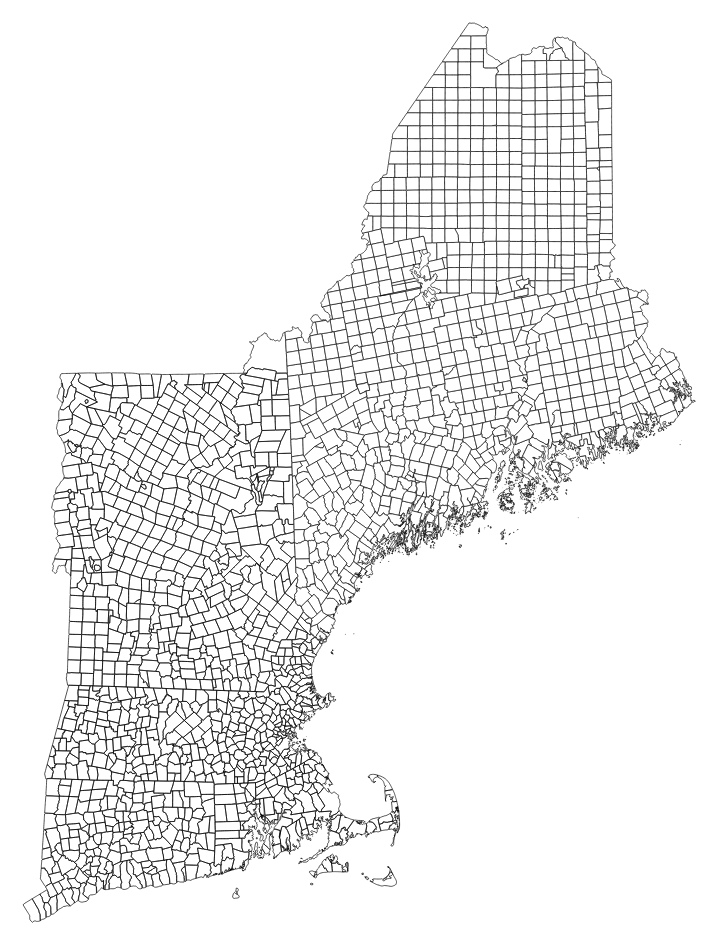
The town is the basic unit of local government and local division of state authority in the six New England states. Most other U.S. states lack a direct counterpart to the New England town. New England towns overlie the entire area of a state, similar to civil townships in other states where they exist, but they are fully functioning municipal corporations, possessing powers similar to cities and counties in other states. In the United States, New Jersey's system of equally powerful townships, boroughs, towns, and cities is the system which is most similar to that of New England; internationally, local government systems comparable to the New England town exist in much of Western Europe, such as the Gemeinden of Germany, the communes of France, and the freguesias of Portugal.
New England towns are often governed by a town meeting, an assembly of eligible town residents. The great majority of municipal corporations in New England are based on the town model; there, statutory forms based on the concept of a compact populated place are uncommon, though elsewhere in the U.S. they are prevalent. County government in New England states is typically weak, and in some states nonexistent. Connecticut, for example, has no county governments, nor does Rhode Island.
Both Connecticut and Rhode Island retain counties only as geographic subdivisions with no governmental authority, while Massachusetts has abolished eight of fourteen county governments so far. Counties serve mostly as dividing lines for the states' judicial systems and some other state services in the southern New England states while providing varying (but generally limited) services in the more sparsely populated three northern New England states.
Towns date back to the time of the earliest English colonial settlement, which predominated in New England, and they pre-date the development of counties in the region. Areas were organized as towns as they were settled, throughout the 17th, 18th, and 19th centuries. Town boundaries were not usually laid out on any kind of regular grid, but were drawn to reflect local settlement and transportation patterns, often affected by natural features. In early colonial times, recognition of towns was very informal, generally connected to local church divisions.
By 1700, colonial governments had become more involved in the official establishment of new towns. Towns were typically governed by a town meeting form of government, as many still are today. Towns originally were the only form of incorporated municipality in New England. The city form of government was not introduced until much later. Boston, for instance, was a town for the first two centuries of its existence.
The entire land areas of Connecticut and Rhode Island had been divided into towns by the late 18th century, and Massachusetts was almost completely covered early in the 19th century. By 1850, the only New England state that still had large unincorporated areas was Maine; by the end of the 19th century, most areas in Maine that could realistically be settled had been organized into towns.
Early town organization in Vermont and much of New Hampshire proceeded in a somewhat different manner from that of the other New England states. In these areas, towns were often "chartered" long before any settlers moved into a particular area. This was very common in the mid to late 18th century—although there were towns which predated that period and were not part of this process in southeastern New Hampshire, such as Exeter. Once there were enough residents in a town to formally organize a town government, no further action was necessary to incorporate. This practice can lead to inconsistencies in the dates of incorporation for towns in this region. Dates given in reference sources sometimes reflect the date when the town was chartered, which may have been long before it was settled, and not the date when its town government became active. In other parts of New England, some "future towns" were laid out along these lines, but such areas would not be formally incorporated as towns until they were sufficiently settled to organize a town government.
A typical town in the northern three states was laid out in a 6-by-6-mile (9.7 by 9.7 km) square. Each contained 36 sections, 1 mile (1.6 km) squares or 640 acres (260 ha). One section was reserved for the support of public schools. This was copied when the Continental Congress laid out Ohio in 1785–87.
Hub AI
New England town AI simulator
(@New England town_simulator)
New England town
The town is the basic unit of local government and local division of state authority in the six New England states. Most other U.S. states lack a direct counterpart to the New England town. New England towns overlie the entire area of a state, similar to civil townships in other states where they exist, but they are fully functioning municipal corporations, possessing powers similar to cities and counties in other states. In the United States, New Jersey's system of equally powerful townships, boroughs, towns, and cities is the system which is most similar to that of New England; internationally, local government systems comparable to the New England town exist in much of Western Europe, such as the Gemeinden of Germany, the communes of France, and the freguesias of Portugal.
New England towns are often governed by a town meeting, an assembly of eligible town residents. The great majority of municipal corporations in New England are based on the town model; there, statutory forms based on the concept of a compact populated place are uncommon, though elsewhere in the U.S. they are prevalent. County government in New England states is typically weak, and in some states nonexistent. Connecticut, for example, has no county governments, nor does Rhode Island.
Both Connecticut and Rhode Island retain counties only as geographic subdivisions with no governmental authority, while Massachusetts has abolished eight of fourteen county governments so far. Counties serve mostly as dividing lines for the states' judicial systems and some other state services in the southern New England states while providing varying (but generally limited) services in the more sparsely populated three northern New England states.
Towns date back to the time of the earliest English colonial settlement, which predominated in New England, and they pre-date the development of counties in the region. Areas were organized as towns as they were settled, throughout the 17th, 18th, and 19th centuries. Town boundaries were not usually laid out on any kind of regular grid, but were drawn to reflect local settlement and transportation patterns, often affected by natural features. In early colonial times, recognition of towns was very informal, generally connected to local church divisions.
By 1700, colonial governments had become more involved in the official establishment of new towns. Towns were typically governed by a town meeting form of government, as many still are today. Towns originally were the only form of incorporated municipality in New England. The city form of government was not introduced until much later. Boston, for instance, was a town for the first two centuries of its existence.
The entire land areas of Connecticut and Rhode Island had been divided into towns by the late 18th century, and Massachusetts was almost completely covered early in the 19th century. By 1850, the only New England state that still had large unincorporated areas was Maine; by the end of the 19th century, most areas in Maine that could realistically be settled had been organized into towns.
Early town organization in Vermont and much of New Hampshire proceeded in a somewhat different manner from that of the other New England states. In these areas, towns were often "chartered" long before any settlers moved into a particular area. This was very common in the mid to late 18th century—although there were towns which predated that period and were not part of this process in southeastern New Hampshire, such as Exeter. Once there were enough residents in a town to formally organize a town government, no further action was necessary to incorporate. This practice can lead to inconsistencies in the dates of incorporation for towns in this region. Dates given in reference sources sometimes reflect the date when the town was chartered, which may have been long before it was settled, and not the date when its town government became active. In other parts of New England, some "future towns" were laid out along these lines, but such areas would not be formally incorporated as towns until they were sufficiently settled to organize a town government.
A typical town in the northern three states was laid out in a 6-by-6-mile (9.7 by 9.7 km) square. Each contained 36 sections, 1 mile (1.6 km) squares or 640 acres (260 ha). One section was reserved for the support of public schools. This was copied when the Continental Congress laid out Ohio in 1785–87.
Recent media