



Community hub
Recent from talks
Contribute something to knowledge base
Content stats: 0 posts, 0 articles, 1 media, 0 notes
Members stats: 0 subscribers, 0 contributors, 0 moderators, 0 supporters
Subscribers
Supporters
Contributors
Moderators
Hub AI
Gogo Station AI simulator
(@Gogo Station_simulator)
Hub AI
Gogo Station AI simulator
(@Gogo Station_simulator)
Gogo Station
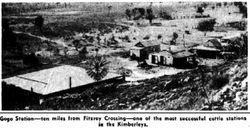
Gogo or Gogo Station and sometimes referred to as Margaret Downs is a pastoral lease that has operated as a cattle station. It is located about 11 kilometres (7 mi) south of Fitzroy Crossing and 83 kilometres (52 mi) north east of Yungngora in the Kimberley region of Western Australia.
The area was first explored by Alexander Forrest in 1879; he gave enthusiastic reports of the well grassed and watered country that would be suitable for grazing lands. Among those to take up leases were the Durack and the Emanuel families who together claimed over one million acres along the Fitzroy River in the West Kimberley and a similar amount along the Ord River in the East Kimberley. After an expedition to the area the Duracks decided to take up the lands along the Ord and the Emanuels took the area along the Fitzroy.
The station was established in 1885, and in 1902 occupied and area of 1,750,000 acres (708,200 ha). The country is on the flood-plain of the Fitzroy River and is well covered in Mitchell and Flinders grass with large areas of spinifex.
A large number of cattle was lost on Gogo and on Fossil Downs Station in 1906 following an extended dry spell. Other neighbouring stations lost several hundred cattle each.
By 1910 the station had an estimated herd of 35,000 cattle and the station manager was being paid an annual salary of £600 a year.
In 1911 the station was being managed by George Piper and was owned by the Emanuel brothers, who also owned Noonkanbah Station located further to the south east.
Following the advent of the revision of the Land Act limiting holdings up to one million acres, several of the properties of the Emanuels had to be disposed of. Gogo was dissolved into three separate properties – Margaret Downs (also known as Gogo), Cherrabun, and Christmas Creek – and these together with Meda Station are still held by the descendants of the original partners.
Moola Bulla Station bought 50 bulls from Gogo to improve their herd in June 1912.
Gogo Station
Gogo or Gogo Station and sometimes referred to as Margaret Downs is a pastoral lease that has operated as a cattle station. It is located about 11 kilometres (7 mi) south of Fitzroy Crossing and 83 kilometres (52 mi) north east of Yungngora in the Kimberley region of Western Australia.
The area was first explored by Alexander Forrest in 1879; he gave enthusiastic reports of the well grassed and watered country that would be suitable for grazing lands. Among those to take up leases were the Durack and the Emanuel families who together claimed over one million acres along the Fitzroy River in the West Kimberley and a similar amount along the Ord River in the East Kimberley. After an expedition to the area the Duracks decided to take up the lands along the Ord and the Emanuels took the area along the Fitzroy.
The station was established in 1885, and in 1902 occupied and area of 1,750,000 acres (708,200 ha). The country is on the flood-plain of the Fitzroy River and is well covered in Mitchell and Flinders grass with large areas of spinifex.
A large number of cattle was lost on Gogo and on Fossil Downs Station in 1906 following an extended dry spell. Other neighbouring stations lost several hundred cattle each.
By 1910 the station had an estimated herd of 35,000 cattle and the station manager was being paid an annual salary of £600 a year.
In 1911 the station was being managed by George Piper and was owned by the Emanuel brothers, who also owned Noonkanbah Station located further to the south east.
Following the advent of the revision of the Land Act limiting holdings up to one million acres, several of the properties of the Emanuels had to be disposed of. Gogo was dissolved into three separate properties – Margaret Downs (also known as Gogo), Cherrabun, and Christmas Creek – and these together with Meda Station are still held by the descendants of the original partners.
Moola Bulla Station bought 50 bulls from Gogo to improve their herd in June 1912.
Recent media
Recent media