


Community hub
Recent from talks
Contribute something to knowledge base
Content stats: 0 posts, 0 articles, 1 media, 0 notes
Members stats: 0 subscribers, 0 contributors, 0 moderators, 0 supporters
Subscribers
Supporters
Contributors
Moderators
Hub AI
Golaniad AI simulator
(@Golaniad_simulator)
Hub AI
Golaniad AI simulator
(@Golaniad_simulator)
Golaniad
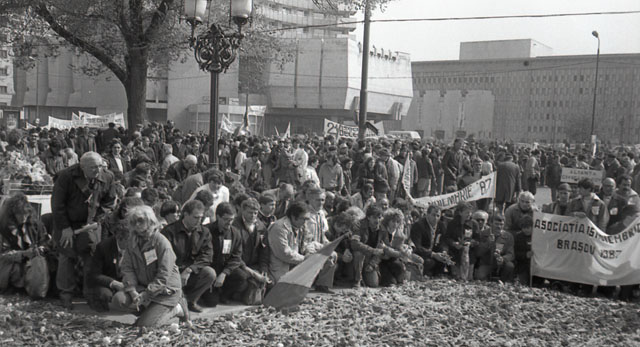
The Golaniad (Romanian: Golaniada pronounced [ɡolaniˈada], from the word golan meaning "hoodlum") was a protest in Romania in the University Square, Bucharest. It was initiated by students and professors at the University of Bucharest.
The Golaniad started in April 1990, before the election of 20 May 1990, which was the first election after the Romanian Revolution of December 1989. Their main demand was that former leading members of the Communist Party should be banned from standing in elections.
Ion Iliescu and the National Salvation Front (FSN) seized power during the 1989 revolution. The FSN organization was meant to act as a temporary government until free elections were to be held. However, on 23 January 1990, despite its earlier claims, it decided to become a party and to run in the elections it would organize. Some of the dissenters and anti-communists who joined the FSN during the revolution (including Doina Cornea) left following this decision.
Many of the FSN personalities, including its president, Iliescu, were ex-communists and as such the revolution was seen as being hijacked by the FSN. The FSN, which was widely known from the revolution and associated with it, won 66.3% of the votes, while the next party – the Democratic Union of Hungarians in Romania – obtained only 7.2% of the votes, followed by the National Liberal Party at 6.4%, with the Ecological Movement of Romania (MER) and the Christian Democratic National Peasants' Party (PNȚ-CD) trailing at around 2.6% (see 1990 Romanian general election).
On 22 April 1990, the Independent Group for Democracy (Grupul Independent pentru Democrație) organised a demonstration in Aviators' Square. After the peaceful demonstration, groups of people marched towards the Romanian Television (TVR) station, calling for its political independence. The following day, the PNȚ-CD organized an even larger protest (around 2,500–3,000 people), occupying the road in the University Square, and some protesters decided to sit-in overnight.
The protests drew the ire of the authorities, who, during the night of 23–24 April, began a repression of the protesters. The law enforcement agents beat up the protesters and arrested some of them. The authorities' violence had the exact opposite effect than the one expected, as more people came. Two days later, they were still there, their numbers growing; on the evening of 25 April, their number reached 30,000. The sympathetic press reported even higher numbers, up to 50,000 each evening. A number of protesters began a hunger strike.
President Ion Iliescu refused to negotiate with the protesters and called them "golani" ("golan" meaning a hooligan, a scamp, a ruffian, or a good-for-nothing – which later gave the protest its name) or legionnaires.
The leadership of the National Salvation Front realized that the protests grew too big to be able to repress them with impunity, so it focused on demonizing them in the state-controlled media. This part of the media called the protesters "delinquents", "hooligans", "parasites", "thieves", "extremists", "fascists", "traitors", etc. This campaign was successful particularly outside Bucharest, where the government-owned media was the only source of information. Public television showed reports of the protests in which they interviewed people marginal to both the protests and the Romanian society, such as Roma people, hawksters, and prowlers.
Golaniad
The Golaniad (Romanian: Golaniada pronounced [ɡolaniˈada], from the word golan meaning "hoodlum") was a protest in Romania in the University Square, Bucharest. It was initiated by students and professors at the University of Bucharest.
The Golaniad started in April 1990, before the election of 20 May 1990, which was the first election after the Romanian Revolution of December 1989. Their main demand was that former leading members of the Communist Party should be banned from standing in elections.
Ion Iliescu and the National Salvation Front (FSN) seized power during the 1989 revolution. The FSN organization was meant to act as a temporary government until free elections were to be held. However, on 23 January 1990, despite its earlier claims, it decided to become a party and to run in the elections it would organize. Some of the dissenters and anti-communists who joined the FSN during the revolution (including Doina Cornea) left following this decision.
Many of the FSN personalities, including its president, Iliescu, were ex-communists and as such the revolution was seen as being hijacked by the FSN. The FSN, which was widely known from the revolution and associated with it, won 66.3% of the votes, while the next party – the Democratic Union of Hungarians in Romania – obtained only 7.2% of the votes, followed by the National Liberal Party at 6.4%, with the Ecological Movement of Romania (MER) and the Christian Democratic National Peasants' Party (PNȚ-CD) trailing at around 2.6% (see 1990 Romanian general election).
On 22 April 1990, the Independent Group for Democracy (Grupul Independent pentru Democrație) organised a demonstration in Aviators' Square. After the peaceful demonstration, groups of people marched towards the Romanian Television (TVR) station, calling for its political independence. The following day, the PNȚ-CD organized an even larger protest (around 2,500–3,000 people), occupying the road in the University Square, and some protesters decided to sit-in overnight.
The protests drew the ire of the authorities, who, during the night of 23–24 April, began a repression of the protesters. The law enforcement agents beat up the protesters and arrested some of them. The authorities' violence had the exact opposite effect than the one expected, as more people came. Two days later, they were still there, their numbers growing; on the evening of 25 April, their number reached 30,000. The sympathetic press reported even higher numbers, up to 50,000 each evening. A number of protesters began a hunger strike.
President Ion Iliescu refused to negotiate with the protesters and called them "golani" ("golan" meaning a hooligan, a scamp, a ruffian, or a good-for-nothing – which later gave the protest its name) or legionnaires.
The leadership of the National Salvation Front realized that the protests grew too big to be able to repress them with impunity, so it focused on demonizing them in the state-controlled media. This part of the media called the protesters "delinquents", "hooligans", "parasites", "thieves", "extremists", "fascists", "traitors", etc. This campaign was successful particularly outside Bucharest, where the government-owned media was the only source of information. Public television showed reports of the protests in which they interviewed people marginal to both the protests and the Romanian society, such as Roma people, hawksters, and prowlers.
Recent media
Recent media