
Recent from talks
Goldenhar syndrome
Knowledge base stats:
Talk channels stats:
Members stats:
Goldenhar syndrome
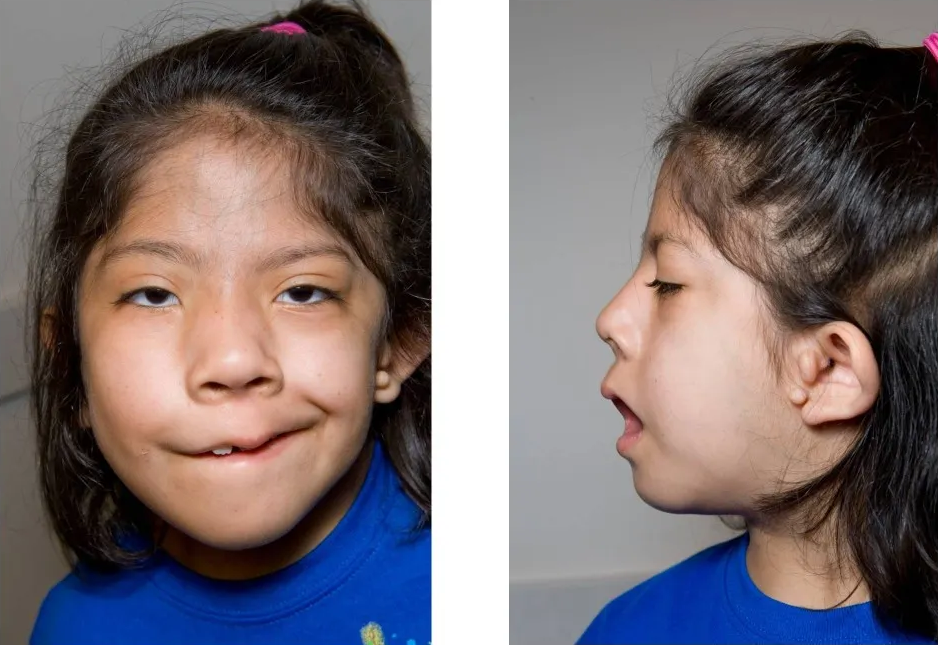
Goldenhar syndrome is a rare congenital defect characterized by incomplete development of the ear, nose, soft palate, lip and mandible on usually one side of the body. Common clinical manifestations include limbal dermoids, preauricular skin tags and strabismus. It is associated with anomalous development of the first branchial arch and second branchial arch.
The term is sometimes used interchangeably with hemifacial microsomia, although this definition is usually reserved for cases without internal organ and vertebrae disruption.
It affects between 1 in 3,500 and 1 in 5,600 live births, with a male-to-female ratio of 3:2.
Chief markers of Goldenhar syndrome are incomplete development of the ear, nose, soft palate, lip, and mandible on usually one side of the body. Additionally, some patients will have growing issues with internal organs, especially heart, kidneys and lungs. Typically, the organ will either not be present on one side or will be underdeveloped. While it is more usual for there to be problems on only one side, it has been known for defects to occur bilaterally (approximate incidence 10% of confirmed GS cases).[citation needed]
Other problems can include severe scoliosis (twisting of the vertebrae), limbal dermoids and hearing loss (see hearing loss with craniofacial syndromes), and deafness or blindness in one or both ears/eyes. Granulosa cell tumors may be associated as well.[citation needed]
The cause of Goldenhar syndrome is largely unknown. However, it is thought to be multifactorial, although there may be a genetic component, which would account for certain familial patterns. It has been suggested that there is a branchial arch development issue late in the first trimester.[citation needed]
An increase in Goldenhar syndrome in the children of Gulf War veterans has been suggested, but the difference was shown to be statistically insignificant.
No general consensus on the minimal diagnostic criteria exists. The syndrome is characterized by hemifacial microsomia due to underdevelopment of structures derived from the 1st and 2nd branchial arches such as eyes, ears, palate, mandible. However, the presentation of the syndrome is highly variable. Some of its features may include:
Hub AI
Goldenhar syndrome AI simulator
(@Goldenhar syndrome_simulator)
Goldenhar syndrome
Goldenhar syndrome is a rare congenital defect characterized by incomplete development of the ear, nose, soft palate, lip and mandible on usually one side of the body. Common clinical manifestations include limbal dermoids, preauricular skin tags and strabismus. It is associated with anomalous development of the first branchial arch and second branchial arch.
The term is sometimes used interchangeably with hemifacial microsomia, although this definition is usually reserved for cases without internal organ and vertebrae disruption.
It affects between 1 in 3,500 and 1 in 5,600 live births, with a male-to-female ratio of 3:2.
Chief markers of Goldenhar syndrome are incomplete development of the ear, nose, soft palate, lip, and mandible on usually one side of the body. Additionally, some patients will have growing issues with internal organs, especially heart, kidneys and lungs. Typically, the organ will either not be present on one side or will be underdeveloped. While it is more usual for there to be problems on only one side, it has been known for defects to occur bilaterally (approximate incidence 10% of confirmed GS cases).[citation needed]
Other problems can include severe scoliosis (twisting of the vertebrae), limbal dermoids and hearing loss (see hearing loss with craniofacial syndromes), and deafness or blindness in one or both ears/eyes. Granulosa cell tumors may be associated as well.[citation needed]
The cause of Goldenhar syndrome is largely unknown. However, it is thought to be multifactorial, although there may be a genetic component, which would account for certain familial patterns. It has been suggested that there is a branchial arch development issue late in the first trimester.[citation needed]
An increase in Goldenhar syndrome in the children of Gulf War veterans has been suggested, but the difference was shown to be statistically insignificant.
No general consensus on the minimal diagnostic criteria exists. The syndrome is characterized by hemifacial microsomia due to underdevelopment of structures derived from the 1st and 2nd branchial arches such as eyes, ears, palate, mandible. However, the presentation of the syndrome is highly variable. Some of its features may include:
Recent media