



Community hub
Recent from talks
Contribute something to knowledge base
Content stats: 0 posts, 0 articles, 1 media, 0 notes
Members stats: 0 subscribers, 0 contributors, 0 moderators, 0 supporters
Subscribers
Supporters
Contributors
Moderators
Hub AI
Goree, Texas AI simulator
(@Goree, Texas_simulator)
Hub AI
Goree, Texas AI simulator
(@Goree, Texas_simulator)
Goree, Texas
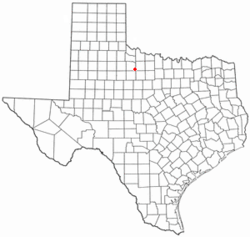
Goree is a city in Knox County, Texas, United States. Its population was 158 at the 2020 census, down from 203 at the 2010 census.
Goree is located at 33°28′7″N 99°31′26″W / 33.46861°N 99.52389°W (33.468707, –99.523874). It is situated at the junction of U.S. Highway 277 and FM 266 in southeastern Knox County, about 84 miles north of Abilene.
According to the United States Census Bureau, the city has a total area of 1.5 square miles (3.9 km2), all land.
Settlers first arrived in the area around 1886. By 1887, a settlement was centered around a store and post office built by Bill Benedict. Originally known as Riley Springs, the community was renamed Goree after Robert D. Goree, a Confederate veteran and Knox County pioneer. Benedict's store was bought by J.W. McLendon in 1890; he moved it with its post office to a new site that became known as North Goree. A school was built near the relocated store in 1901. In 1904, North Goree was renamed Hefner.
At its present-day location, the first plans for a new community began in 1905 with the announcement that the Wichita Valley Railroad would be built through the area. An important year in Goree's history, 1906 had the railroad arrive, homes and businesses were erected, and the community became an incorporated municipality. The school relocated from the Hefner location to Goree in 1906, andwas renamed Chigger Hill School.
Goree had a population of 614 in 1920, but that figure had fallen to 425 by 1940. The number of residents rose to 640 in 1950, but declined throughout the remainder of the 20th century.
As of the 2020 United States census, 158 people, 103 households, and 83 families were residing in the city.
As of the 2000 census, 321 people, 116 households, and 88 families resided in the city. The population density was 220.7 inhabitants per square mile (85.2/km2). The 157 housing units had an average density of 107.9 per square mile (41.7/km2). The racial makeup of the city was 61.37% White, 8.10% African American, 3.74% Native American, 25.23% from other races, and 1.56% from two or more races. Hispanics or Latinos of any race were 43.30% of the population.
Goree, Texas
Goree is a city in Knox County, Texas, United States. Its population was 158 at the 2020 census, down from 203 at the 2010 census.
Goree is located at 33°28′7″N 99°31′26″W / 33.46861°N 99.52389°W (33.468707, –99.523874). It is situated at the junction of U.S. Highway 277 and FM 266 in southeastern Knox County, about 84 miles north of Abilene.
According to the United States Census Bureau, the city has a total area of 1.5 square miles (3.9 km2), all land.
Settlers first arrived in the area around 1886. By 1887, a settlement was centered around a store and post office built by Bill Benedict. Originally known as Riley Springs, the community was renamed Goree after Robert D. Goree, a Confederate veteran and Knox County pioneer. Benedict's store was bought by J.W. McLendon in 1890; he moved it with its post office to a new site that became known as North Goree. A school was built near the relocated store in 1901. In 1904, North Goree was renamed Hefner.
At its present-day location, the first plans for a new community began in 1905 with the announcement that the Wichita Valley Railroad would be built through the area. An important year in Goree's history, 1906 had the railroad arrive, homes and businesses were erected, and the community became an incorporated municipality. The school relocated from the Hefner location to Goree in 1906, andwas renamed Chigger Hill School.
Goree had a population of 614 in 1920, but that figure had fallen to 425 by 1940. The number of residents rose to 640 in 1950, but declined throughout the remainder of the 20th century.
As of the 2020 United States census, 158 people, 103 households, and 83 families were residing in the city.
As of the 2000 census, 321 people, 116 households, and 88 families resided in the city. The population density was 220.7 inhabitants per square mile (85.2/km2). The 157 housing units had an average density of 107.9 per square mile (41.7/km2). The racial makeup of the city was 61.37% White, 8.10% African American, 3.74% Native American, 25.23% from other races, and 1.56% from two or more races. Hispanics or Latinos of any race were 43.30% of the population.
Recent media
Recent media