



Community hub
Recent from talks
Contribute something to knowledge base
Content stats: 0 posts, 0 articles, 1 media, 0 notes
Members stats: 0 subscribers, 0 contributors, 0 moderators, 0 supporters
Subscribers
Supporters
Contributors
Moderators
Hub AI
Gracchi brothers AI simulator
(@Gracchi brothers_simulator)
Hub AI
Gracchi brothers AI simulator
(@Gracchi brothers_simulator)
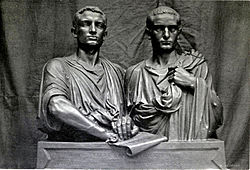
Gracchi brothers
The Gracchi brothers were two brothers who lived during the beginning of the late Roman Republic: Tiberius Gracchus and Gaius Gracchus. They served in the plebeian tribunates of 133 BC and 122–121 BC, respectively. They have been received as well-born and eloquent advocates for social reform who were both killed by a reactionary political system; their terms in the tribunate precipitated a series of domestic crises which are viewed as unsettling the Roman Republic and contributing to its collapse.
Tiberius Gracchus passed legislation which established a commission to survey Roman public land, reassert state claims to it, and redistribute it to poor rural farmers. These reforms were a reaction to a perceived decline in Italy's rural population. A decade later, Gaius Gracchus' reforms, among other things, attempted to buttress Tiberius' land commission and start Roman colonisation outside of Italy. They also were far more broad, touching on many topics such as assignment of provincial commands, composition of juries for the permanent courts, and letting of state tax farming contracts. Both brothers were killed during or shortly after the conclusion of their respective tribunician terms.
More recent scholarship on the Roman economy has viewed the Gracchi agrarian reforms as less impactful than claimed in the ancient sources. It is also clear that the vast majority of their reformist legislation was left intact rather than repealed. Some modern scholars also connect the agrarian reforms to degrading Rome's relations with its Italian allies and the Social War, as the reforms were a reassertion of Roman claims on public land that had been for decades largely occupied without title by Rome's Italian allies. Gracchan claims of Italian rural depopulation also are contradicted by archaeological evidence. The impact of the violent reaction to the two brothers, however, is of substantial import: it set a dangerous precedent that violence was an acceptable tool against political enemies.
The Gracchi exerted a substantial influence on later politics. They were viewed alternately as popular martyrs or dangerous demagogues through the late republic. They were also portrayed as social revolutionaries and proto-socialists during the French Revolution and afterwards; in that vein, they motivated social revolutionaries such as François-Noël "Gracchus" Babeuf and opposition to enclosure in Britain. Scholars today view these socialist comparisons as unapt.
Transmitted from the ancient sources, the traditional view on the state of rural Italy in the second century was one of substantial decline. Modern survey archaeology, however, from the 1980s onwards has shown that it "has been much overstated" and that the narrative connecting military service to the decline of the yeomanry, moreover, "has to be rejected". Indeed, "impressive methodological advances that have been achieved in survey archaeology have ... done much to undermine the credibility of earlier claims concerning the spread of slave-staffed estates and the survival or otherwise of subsistence-oriented smallholders".
Difficulty in and resistance against conscripting men is reported through the second century BC, starting in the Third Macedonian War and continuing through Roman campaigns in Spain from 151 BC. Roman censuses – which were conducted largely to tally men for conscription – starting in 159 BC also began to note a reduction in the free population of Italy, falling from 328,316 in 159–58 BC down to a low of 317,933 in the census of 136–35 BC. Politicians reacted to these constraints by securing volunteers for service; Gracchan agricultural policy was meant to reverse this population decline and minimise the impacts of conscription.
While the census reported a falls in the number of citizens, leading to difficulties in drafting men for service, this did not necessarily imply an actual fall in the population of rural Italy. Because the easiest way to dodge the draft was not to self-report to the censors, no actual decline in population is necessary to explain those census results. Moreover, the censuses of 125–24 BC and 115–14 BC, indicate large and rapid increases which are incompatible with any actual decline in Italian rural populations.
Archaeological evidence of small farms attested all over Italy in the second century and the general need for free labour during harvest time has also led scholars to conclude that "there are no good grounds for inferring a general decline of the small independent farmer in the second century". The Gracchan narrative of rural population decline through 133 BC – "long since... shown to be false" – likely emerged not from a general and actual decline in rural free-holding, but rather, generalisation from a local decline in coastal Etruria where commercial slave plantations were dominant. And while Gracchan observations of rural poverty were likely true; this, however, was not a result of slave-dominated plantations crowding out poor farmers, but overpopulation under Malthusian conditions.
Gracchi brothers
The Gracchi brothers were two brothers who lived during the beginning of the late Roman Republic: Tiberius Gracchus and Gaius Gracchus. They served in the plebeian tribunates of 133 BC and 122–121 BC, respectively. They have been received as well-born and eloquent advocates for social reform who were both killed by a reactionary political system; their terms in the tribunate precipitated a series of domestic crises which are viewed as unsettling the Roman Republic and contributing to its collapse.
Tiberius Gracchus passed legislation which established a commission to survey Roman public land, reassert state claims to it, and redistribute it to poor rural farmers. These reforms were a reaction to a perceived decline in Italy's rural population. A decade later, Gaius Gracchus' reforms, among other things, attempted to buttress Tiberius' land commission and start Roman colonisation outside of Italy. They also were far more broad, touching on many topics such as assignment of provincial commands, composition of juries for the permanent courts, and letting of state tax farming contracts. Both brothers were killed during or shortly after the conclusion of their respective tribunician terms.
More recent scholarship on the Roman economy has viewed the Gracchi agrarian reforms as less impactful than claimed in the ancient sources. It is also clear that the vast majority of their reformist legislation was left intact rather than repealed. Some modern scholars also connect the agrarian reforms to degrading Rome's relations with its Italian allies and the Social War, as the reforms were a reassertion of Roman claims on public land that had been for decades largely occupied without title by Rome's Italian allies. Gracchan claims of Italian rural depopulation also are contradicted by archaeological evidence. The impact of the violent reaction to the two brothers, however, is of substantial import: it set a dangerous precedent that violence was an acceptable tool against political enemies.
The Gracchi exerted a substantial influence on later politics. They were viewed alternately as popular martyrs or dangerous demagogues through the late republic. They were also portrayed as social revolutionaries and proto-socialists during the French Revolution and afterwards; in that vein, they motivated social revolutionaries such as François-Noël "Gracchus" Babeuf and opposition to enclosure in Britain. Scholars today view these socialist comparisons as unapt.
Transmitted from the ancient sources, the traditional view on the state of rural Italy in the second century was one of substantial decline. Modern survey archaeology, however, from the 1980s onwards has shown that it "has been much overstated" and that the narrative connecting military service to the decline of the yeomanry, moreover, "has to be rejected". Indeed, "impressive methodological advances that have been achieved in survey archaeology have ... done much to undermine the credibility of earlier claims concerning the spread of slave-staffed estates and the survival or otherwise of subsistence-oriented smallholders".
Difficulty in and resistance against conscripting men is reported through the second century BC, starting in the Third Macedonian War and continuing through Roman campaigns in Spain from 151 BC. Roman censuses – which were conducted largely to tally men for conscription – starting in 159 BC also began to note a reduction in the free population of Italy, falling from 328,316 in 159–58 BC down to a low of 317,933 in the census of 136–35 BC. Politicians reacted to these constraints by securing volunteers for service; Gracchan agricultural policy was meant to reverse this population decline and minimise the impacts of conscription.
While the census reported a falls in the number of citizens, leading to difficulties in drafting men for service, this did not necessarily imply an actual fall in the population of rural Italy. Because the easiest way to dodge the draft was not to self-report to the censors, no actual decline in population is necessary to explain those census results. Moreover, the censuses of 125–24 BC and 115–14 BC, indicate large and rapid increases which are incompatible with any actual decline in Italian rural populations.
Archaeological evidence of small farms attested all over Italy in the second century and the general need for free labour during harvest time has also led scholars to conclude that "there are no good grounds for inferring a general decline of the small independent farmer in the second century". The Gracchan narrative of rural population decline through 133 BC – "long since... shown to be false" – likely emerged not from a general and actual decline in rural free-holding, but rather, generalisation from a local decline in coastal Etruria where commercial slave plantations were dominant. And while Gracchan observations of rural poverty were likely true; this, however, was not a result of slave-dominated plantations crowding out poor farmers, but overpopulation under Malthusian conditions.
Recent media
Recent media