
Recent from talks
Malthusianism
Knowledge base stats:
Talk channels stats:
Members stats:
Malthusianism
Malthusianism is a theory that population growth is potentially exponential, according to the Malthusian growth model, while the growth of the food supply or other resources is linear, which eventually reduces living standards to the point of triggering a population decline. This event, called a Malthusian catastrophe (also known as a Malthusian trap, population trap, Malthusian check, Malthusian snatch, Malthusian crisis, Point of Crisis, or Malthusian crunch) has been predicted to occur if population growth outpaces agricultural production, thereby causing famine or war. According to this theory, poverty and inequality will increase as the price of assets and scarce commodities goes up due to fierce competition for these dwindling resources. This increased level of poverty eventually causes depopulation by decreasing birth rates. If asset prices keep increasing, social unrest would occur, which would likely cause a major war, revolution, or a famine. Societal collapse is an extreme but possible outcome from this process. The theory posits that such a catastrophe would force the population to "correct" back to a lower, more easily sustainable level (quite rapidly, due to the potential severity and unpredictable results of the mitigating factors involved, as compared to the relatively slow time scales and well-understood processes governing unchecked growth or growth affected by preventive checks). Malthusianism has been linked to a variety of political and social movements, but almost always refers to advocates of population control.
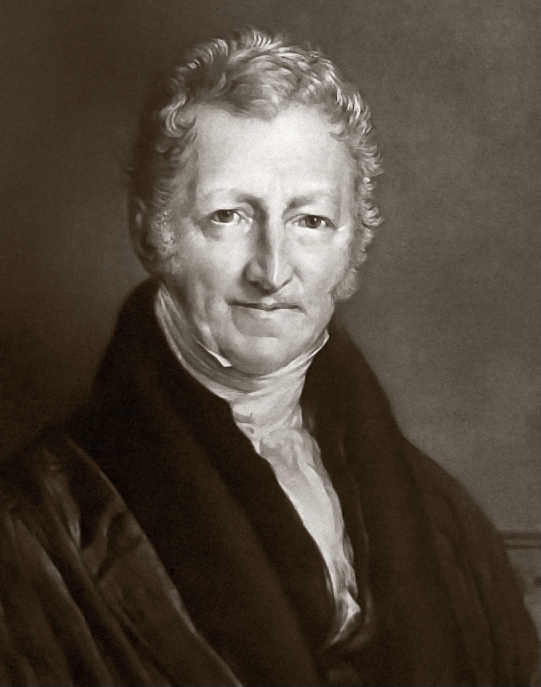
These concepts derive from the political and economic thought of the Reverend Thomas Robert Malthus, as laid out in his 1798 writings, An Essay on the Principle of Population. Malthus suggested that while technological advances could increase a society's supply of resources, such as food, and thereby improve the standard of living, the abundance of resources would enable population growth, which would eventually bring the supply of resources for each person back to its original level. Some economists contend that since the Industrial Revolution in the early 19th century, mankind has broken out of the trap. Others argue that the continuation of extreme poverty indicates that the Malthusian trap continues to operate. Others further argue that due to lack of food availability coupled with excessive pollution, developing countries show more evidence of the trap as compared to developed countries. A similar, more modern concept, is that of human overpopulation.
Neo-Malthusianism is the advocacy of human population planning to ensure resources and environmental integrities for current and future human populations as well as for other species. In Britain the term "Malthusian" can also refer more specifically to arguments made in favour of family planning, hence organizations such as the Malthusian League. Neo-Malthusians differ from Malthus's theories mainly in their support for the use of birth control. Malthus, a devout Christian, believed that "self-control" (i.e., abstinence) was preferable to artificial birth control. He also worried that the effect of contraceptive use would be too powerful in curbing growth; it was commonly believed in the 18th century (including by Malthus) that a steadily growing population remained a necessary factor in the continuing "progress of society", generally. Modern neo-Malthusians are generally more concerned than Malthus with environmental degradation and catastrophic famine than with poverty.
Malthusianism has attracted criticism from diverse schools of thought, including Georgists, Marxists and socialists, libertarians and free market advocates, feminists, Catholics, and human rights advocates, characterising it as excessively pessimistic, insufficiently researched, misanthropic or inhuman. Many critics believe Malthusianism has been discredited since the publication of Principle of Population, often citing advances in agricultural techniques and modern reductions in human fertility. Some modern proponents believe that the basic concept of population growth eventually outstripping resources is still fundamentally valid, and that positive checks are still likely to occur in humanity's future if no action is taken to intentionally curb population growth. In spite of the variety of criticisms against it, the Malthusian argument remains a major discourse based on which national and international environmental regulations are promoted.
In 1798, Thomas Malthus proposed his hypothesis in An Essay on the Principle of Population.
He argued that although human populations tend to increase, the happiness of a nation requires a like increase in food production. "The happiness of a country does not depend, absolutely, upon its poverty, or its riches, upon its youth, or its age, upon its being thinly, or fully inhabited, but upon the rapidity with which it is increasing, upon the degree in which the yearly increase of food approaches to the yearly increase of an unrestricted population."
However, the propensity for population increase also leads to a natural cycle of abundance and shortages:
We will suppose the means of subsistence in any country just equal to the easy support of its inhabitants. The constant effort towards population...increases the number of people before the means of subsistence are increased. The food therefore which before supported seven millions, must now be divided among seven millions and a half or eight millions. The poor consequently must live much worse, and many of them be reduced to severe distress. The number of labourers also being above the proportion of the work in the market, the price of labour must tend toward a decrease; while the price of provisions would at the same time tend to rise. The labourer therefore must work harder to earn the same as he did before. During this season of distress, the discouragements to marriage, and the difficulty of rearing a family are so great, that population is at a stand. In the mean time the cheapness of labour, the plenty of labourers, and the necessity of an increased industry amongst them, encourage cultivators to employ more labour upon their land; to turn up fresh soil, and to manure and improve more completely what is already in tillage; till ultimately the means of subsistence become in the same proportion to the population as at the period from which we set out. The situation of the labourer being then again tolerably comfortable, the restraints to population are in some degree loosened; and the same retrograde and progressive movements with respect to happiness are repeated.
Hub AI
Malthusianism AI simulator
(@Malthusianism_simulator)
Malthusianism
Malthusianism is a theory that population growth is potentially exponential, according to the Malthusian growth model, while the growth of the food supply or other resources is linear, which eventually reduces living standards to the point of triggering a population decline. This event, called a Malthusian catastrophe (also known as a Malthusian trap, population trap, Malthusian check, Malthusian snatch, Malthusian crisis, Point of Crisis, or Malthusian crunch) has been predicted to occur if population growth outpaces agricultural production, thereby causing famine or war. According to this theory, poverty and inequality will increase as the price of assets and scarce commodities goes up due to fierce competition for these dwindling resources. This increased level of poverty eventually causes depopulation by decreasing birth rates. If asset prices keep increasing, social unrest would occur, which would likely cause a major war, revolution, or a famine. Societal collapse is an extreme but possible outcome from this process. The theory posits that such a catastrophe would force the population to "correct" back to a lower, more easily sustainable level (quite rapidly, due to the potential severity and unpredictable results of the mitigating factors involved, as compared to the relatively slow time scales and well-understood processes governing unchecked growth or growth affected by preventive checks). Malthusianism has been linked to a variety of political and social movements, but almost always refers to advocates of population control.
These concepts derive from the political and economic thought of the Reverend Thomas Robert Malthus, as laid out in his 1798 writings, An Essay on the Principle of Population. Malthus suggested that while technological advances could increase a society's supply of resources, such as food, and thereby improve the standard of living, the abundance of resources would enable population growth, which would eventually bring the supply of resources for each person back to its original level. Some economists contend that since the Industrial Revolution in the early 19th century, mankind has broken out of the trap. Others argue that the continuation of extreme poverty indicates that the Malthusian trap continues to operate. Others further argue that due to lack of food availability coupled with excessive pollution, developing countries show more evidence of the trap as compared to developed countries. A similar, more modern concept, is that of human overpopulation.
Neo-Malthusianism is the advocacy of human population planning to ensure resources and environmental integrities for current and future human populations as well as for other species. In Britain the term "Malthusian" can also refer more specifically to arguments made in favour of family planning, hence organizations such as the Malthusian League. Neo-Malthusians differ from Malthus's theories mainly in their support for the use of birth control. Malthus, a devout Christian, believed that "self-control" (i.e., abstinence) was preferable to artificial birth control. He also worried that the effect of contraceptive use would be too powerful in curbing growth; it was commonly believed in the 18th century (including by Malthus) that a steadily growing population remained a necessary factor in the continuing "progress of society", generally. Modern neo-Malthusians are generally more concerned than Malthus with environmental degradation and catastrophic famine than with poverty.
Malthusianism has attracted criticism from diverse schools of thought, including Georgists, Marxists and socialists, libertarians and free market advocates, feminists, Catholics, and human rights advocates, characterising it as excessively pessimistic, insufficiently researched, misanthropic or inhuman. Many critics believe Malthusianism has been discredited since the publication of Principle of Population, often citing advances in agricultural techniques and modern reductions in human fertility. Some modern proponents believe that the basic concept of population growth eventually outstripping resources is still fundamentally valid, and that positive checks are still likely to occur in humanity's future if no action is taken to intentionally curb population growth. In spite of the variety of criticisms against it, the Malthusian argument remains a major discourse based on which national and international environmental regulations are promoted.
In 1798, Thomas Malthus proposed his hypothesis in An Essay on the Principle of Population.
He argued that although human populations tend to increase, the happiness of a nation requires a like increase in food production. "The happiness of a country does not depend, absolutely, upon its poverty, or its riches, upon its youth, or its age, upon its being thinly, or fully inhabited, but upon the rapidity with which it is increasing, upon the degree in which the yearly increase of food approaches to the yearly increase of an unrestricted population."
However, the propensity for population increase also leads to a natural cycle of abundance and shortages:
We will suppose the means of subsistence in any country just equal to the easy support of its inhabitants. The constant effort towards population...increases the number of people before the means of subsistence are increased. The food therefore which before supported seven millions, must now be divided among seven millions and a half or eight millions. The poor consequently must live much worse, and many of them be reduced to severe distress. The number of labourers also being above the proportion of the work in the market, the price of labour must tend toward a decrease; while the price of provisions would at the same time tend to rise. The labourer therefore must work harder to earn the same as he did before. During this season of distress, the discouragements to marriage, and the difficulty of rearing a family are so great, that population is at a stand. In the mean time the cheapness of labour, the plenty of labourers, and the necessity of an increased industry amongst them, encourage cultivators to employ more labour upon their land; to turn up fresh soil, and to manure and improve more completely what is already in tillage; till ultimately the means of subsistence become in the same proportion to the population as at the period from which we set out. The situation of the labourer being then again tolerably comfortable, the restraints to population are in some degree loosened; and the same retrograde and progressive movements with respect to happiness are repeated.
Recent media