


Community hub
Recent from talks
Contribute something to knowledge base
Content stats: 0 posts, 0 articles, 1 media, 0 notes
Members stats: 0 subscribers, 0 contributors, 0 moderators, 0 supporters
Subscribers
Supporters
Contributors
Moderators
Hub AI
Grade (slope) AI simulator
(@Grade (slope)_simulator)
Hub AI
Grade (slope) AI simulator
(@Grade (slope)_simulator)
Grade (slope)
The grade (US) or gradient (UK) (also called slope, incline, mainfall, pitch or rise) of a physical feature, landform or constructed line is either the elevation angle of that surface to the horizontal or its tangent. It is a special case of the slope, where zero indicates horizontality. A larger number indicates higher or steeper degree of "tilt". Often slope is calculated as a ratio of "rise" to "run", or as a fraction ("rise over run") in which run is the horizontal distance (not the distance along the slope) and rise is the vertical distance.
Slopes of existing physical features such as canyons and hillsides, stream and river banks, and beds are often described as grades, but typically the word "grade" is used for human-made surfaces such as roads, landscape grading, roof pitches, railroads, aqueducts, and pedestrian or bicycle routes. The grade may refer to the longitudinal slope or the perpendicular cross slope.
There are several ways to express slope:
Any of these may be used. When the term grade is used, the slope is usually expressed as a percentage. If one looks at red numbers on the chart specifying grade, one can see the quirkiness of using the grade to specify slope; the numbers go from 0 for flat, to 100% at 45 degrees, to infinity at vertical.
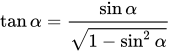
Slope may still be expressed when the horizontal run is not known: the rise can be divided by the hypotenuse (the slope length). This is not the usual way to specify slope; this nonstandard expression follows the sine function rather than the tangent function, so it calls a 45 degree slope a 71 percent grade instead of a 100 percent. But in practice the usual way to calculate slope is to measure the distance along the slope and the vertical rise, and calculate the horizontal run from that, in order to calculate the grade (100% × rise/run) or standard slope (rise/run). When the angle of inclination is small, using the slope length rather than the horizontal displacement (i.e., using the sine of the angle rather than the tangent) makes only an insignificant difference and can then be used as an approximation. Railway gradients are often expressed in terms of the rise in relation to the distance along the track as a practical measure. In cases where the difference between sin and tan is significant, the tangent is used. In either case, the following identity holds for all inclinations up to 90 degrees: . Or more simply, one can calculate the horizontal run by using the Pythagorean theorem, after which it is trivial to calculate the (standard math) slope or the grade (percentage).
In Europe, road gradients are expressed in signage as percentage.
Grades are related using the following equations with symbols from the figure at top.
The slope expressed as a percentage can similarly be determined from the tangent of the angle:
Grade (slope)
The grade (US) or gradient (UK) (also called slope, incline, mainfall, pitch or rise) of a physical feature, landform or constructed line is either the elevation angle of that surface to the horizontal or its tangent. It is a special case of the slope, where zero indicates horizontality. A larger number indicates higher or steeper degree of "tilt". Often slope is calculated as a ratio of "rise" to "run", or as a fraction ("rise over run") in which run is the horizontal distance (not the distance along the slope) and rise is the vertical distance.
Slopes of existing physical features such as canyons and hillsides, stream and river banks, and beds are often described as grades, but typically the word "grade" is used for human-made surfaces such as roads, landscape grading, roof pitches, railroads, aqueducts, and pedestrian or bicycle routes. The grade may refer to the longitudinal slope or the perpendicular cross slope.
There are several ways to express slope:
Any of these may be used. When the term grade is used, the slope is usually expressed as a percentage. If one looks at red numbers on the chart specifying grade, one can see the quirkiness of using the grade to specify slope; the numbers go from 0 for flat, to 100% at 45 degrees, to infinity at vertical.
Slope may still be expressed when the horizontal run is not known: the rise can be divided by the hypotenuse (the slope length). This is not the usual way to specify slope; this nonstandard expression follows the sine function rather than the tangent function, so it calls a 45 degree slope a 71 percent grade instead of a 100 percent. But in practice the usual way to calculate slope is to measure the distance along the slope and the vertical rise, and calculate the horizontal run from that, in order to calculate the grade (100% × rise/run) or standard slope (rise/run). When the angle of inclination is small, using the slope length rather than the horizontal displacement (i.e., using the sine of the angle rather than the tangent) makes only an insignificant difference and can then be used as an approximation. Railway gradients are often expressed in terms of the rise in relation to the distance along the track as a practical measure. In cases where the difference between sin and tan is significant, the tangent is used. In either case, the following identity holds for all inclinations up to 90 degrees: . Or more simply, one can calculate the horizontal run by using the Pythagorean theorem, after which it is trivial to calculate the (standard math) slope or the grade (percentage).
In Europe, road gradients are expressed in signage as percentage.
Grades are related using the following equations with symbols from the figure at top.
The slope expressed as a percentage can similarly be determined from the tangent of the angle:
Recent media
Recent media