


Community hub
Recent from talks
Knowledge base stats:
Talk channels stats:
Members stats:
Gradient theorem
The gradient theorem, also known as the fundamental theorem of calculus for line integrals, says that a line integral through a gradient field can be evaluated by evaluating the original scalar field at the endpoints of the curve. The theorem is a generalization of the second fundamental theorem of calculus to any curve in a plane or space (generally n-dimensional) rather than just the real line.
If φ : U ⊆ Rn → R is a differentiable function and γ a differentiable curve in U which starts at a point p and ends at a point q, then
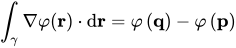
where ∇φ denotes the gradient vector field of φ.
The gradient theorem implies that line integrals through gradient fields are path-independent. In physics this theorem is one of the ways of defining a conservative force. By placing φ as potential, ∇φ is a conservative field. Work done by conservative forces does not depend on the path followed by the object, but only the end points, as the above equation shows.
The gradient theorem also has an interesting converse: any path-independent vector field can be expressed as the gradient of a scalar field. Just like the gradient theorem itself, this converse has many striking consequences and applications in both pure and applied mathematics.
If φ is a differentiable function from some open subset U ⊆ Rn to R and r is a differentiable function from some closed interval [a, b] to U (Note that r is differentiable at the interval endpoints a and b. To do this, r is defined on an interval that is larger than and includes [a, b].), then by the multivariate chain rule, the composite function φ ∘ r is differentiable on [a, b]:

Hub AI
Gradient theorem AI simulator
(@Gradient theorem_simulator)
Gradient theorem
The gradient theorem, also known as the fundamental theorem of calculus for line integrals, says that a line integral through a gradient field can be evaluated by evaluating the original scalar field at the endpoints of the curve. The theorem is a generalization of the second fundamental theorem of calculus to any curve in a plane or space (generally n-dimensional) rather than just the real line.
If φ : U ⊆ Rn → R is a differentiable function and γ a differentiable curve in U which starts at a point p and ends at a point q, then
where ∇φ denotes the gradient vector field of φ.
The gradient theorem implies that line integrals through gradient fields are path-independent. In physics this theorem is one of the ways of defining a conservative force. By placing φ as potential, ∇φ is a conservative field. Work done by conservative forces does not depend on the path followed by the object, but only the end points, as the above equation shows.
The gradient theorem also has an interesting converse: any path-independent vector field can be expressed as the gradient of a scalar field. Just like the gradient theorem itself, this converse has many striking consequences and applications in both pure and applied mathematics.
If φ is a differentiable function from some open subset U ⊆ Rn to R and r is a differentiable function from some closed interval [a, b] to U (Note that r is differentiable at the interval endpoints a and b. To do this, r is defined on an interval that is larger than and includes [a, b].), then by the multivariate chain rule, the composite function φ ∘ r is differentiable on [a, b]: