Hubbry Logo
Gramercy TavernGramercy TavernMain
Open search
Gramercy Tavern
Community hub
Gramercy Tavern
logo
8 pages, 0 posts
0 subscribers
Be the first to start a discussion here.
Gramercy Tavern
Gramercy Tavern
from Wikipedia

Gramercy Tavern is a New American restaurant located at 42 East 20th Street (between Broadway and Park Avenue S.), in the Flatiron District in Manhattan, New York City.[1]

Key Information

It is owned by Danny Meyer (originally co-founded by Meyer and Chef Tom Colicchio), along with Chef/Partner Michael Anthony.[1][2][3][4] The Executive Pastry Chef is Karen Demasco.[5] The General Manager is William Carroll. The restaurant opened in July 1994.[6][7]

[edit]

Chef Michael Anthony's ever-evolving seasonal menu of New American cuisine showcases the restaurant's relationships with local farms and purveyors.

Restaurant

[edit]

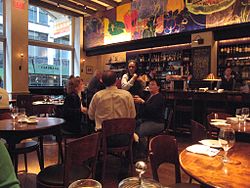
The restaurant was designed by New York-based architecture firm Bentel & Bentel Architects. This was the firm's first foray into hospitality design. The restaurant's neo-Colonial decor is rustic.[1][8][9] The restaurant can seat 130 people, the bar can accommodate 60 people, and a private dining room can seat 12–22 people.[10]

Reviews and accolades

[edit]

In 2003, 2005, 2006, 2007, 2010, 2011, and 2015, voters in the Zagats Survey voted it the most popular restaurant in New York City.[6][7] In 2007, the New York Times gave it three stars.[11]

In 2013, Zagat gave it a food rating of 28, referring to it as “About as perfect as a restaurant can get”.[1] It also rated it Number 1 in New York City for "Dining at the Bar," and the second most popular restaurant in New York City.[12]

Gramercy Tavern was awarded One Star by the Michelin Guide.[13]

The restaurant was named "Outstanding Restaurant of 2008" from the James Beard Foundation.

Wine Spectator awarded Best Of Award of Excellence in 2009, 2010, 2011, 2012, and 2013.

Pete Wells placed Gramercy Tavern in eleventh place in his 2023 ranking of the hundred best restaurants in New York City.[14]

Notable people

[edit]

See also

[edit]

References

[edit]

Further reading

[edit]
[edit]
Revisions and contributorsEdit on WikipediaRead on Wikipedia
from Grokipedia
Gramercy Tavern is a celebrated New American restaurant located at 42 East 20th Street in the of , . Opened in July 1994 by restaurateur and chef , it was envisioned as a blend of European standards and the rustic comfort of an American tavern, emphasizing warm hospitality and seasonal ingredients. Housed in a historic landmark building north of Union Square and owned by Meyer's Union Square Hospitality Group, the restaurant features two distinct areas: the casual Tavern room offering seasonal dishes and the more formal Dining Room with multi-course tasting menus. Since 2006, executive chef and partner Michael Anthony has led the kitchen, focusing on sourced from local farms and producers. Gramercy Tavern has earned widespread acclaim, including nine James Beard Foundation Awards—such as Outstanding Restaurant in 2008 and Outstanding Chef for Anthony in 2015—as well as one Michelin star continuously since 2006 and three stars from The New York Times in 2007 and 2016.

History

Founding

Gramercy Tavern was established in July 1994 by restaurateur Danny Meyer as his second New York City venture, following the success of Union Square Cafe, which he opened in 1985. Meyer co-founded the restaurant with chef Tom Colicchio, who served as the opening executive chef and brought his experience from high-profile kitchens to shape its early culinary direction. The partnership aimed to create a welcoming space that extended Meyer's philosophy of enlightened hospitality, prioritizing guest experience alongside quality food. The initial concept for Gramercy Tavern envisioned a casual American tavern that blended the rustic comfort of traditional pub fare with refined European fine-dining techniques, all while emphasizing seasonal, ingredients sourced from local purveyors. This approach sought to foster a in a relaxed yet elegant setting, distinguishing it from more formal establishments of the era and reflecting a commitment to fresh, regionally inspired cuisine that changed with the seasons. From its inception, the restaurant was designed to serve as a neighborhood gathering place, with a bustling room for dining and a more structured for prix-fixe meals, promoting and warmth. The site at 42 East 20th Street in Manhattan's , just north of Union Square, was selected for its location in a historic building that evoked the tavern's namesake heritage. This early 20th-century structure provided an ideal backdrop for the restaurant's homespun aesthetic, with preserved architectural details enhancing the inviting atmosphere without extensive renovations. The choice of location built on the momentum from Union Square Cafe's proximity to the Union Square Greenmarket, allowing easy access to fresh produce and aligning with the ethos. Opening Gramercy Tavern presented early challenges, particularly in building anticipation amid the high expectations set by Meyer's prior success and a concurrent cover story in New York magazine profiling his expanding empire. The article, which hit newsstands on the day of the July 11 debut, amplified scrutiny and pressure, positioning the restaurant as a bullseye for critics and diners eager to see if it could match the hype. Despite these hurdles, the operational setup proceeded with a focus on seamless service and ingredient-driven menus, laying the foundation for its enduring reputation.

Key Milestones

In 2006, founding chef departed Gramercy Tavern after 12 years, having helped establish its reputation for innovative , to focus on expanding his restaurant group. Michael Anthony was appointed executive chef that September, shifting the kitchen toward sustainable, practices with an emphasis on seasonal, locally sourced ingredients from partners like Dancing Eels Farm. Under Anthony's leadership, the restaurant earned a three-star review from in 2007 and multiple Awards, solidifying its commitment to environmental responsibility. Gramercy Tavern has maintained stable ownership since its inception under restaurateur through the Union Square Hospitality Group (USHG), which he founded and continues to lead as executive chairman, ensuring consistent oversight amid the group's expansion to other acclaimed New York venues. The restaurant marked its 20th anniversary in 2014 with events reflecting its influence on New York City's casual fine-dining scene, including tributes to its role in elevating American tavern-style hospitality. In 2019, for its 25th anniversary, Gramercy Tavern highlighted its enduring homespun style through special menus and retrospectives on its cultural impact. The 30th anniversary in 2024 featured the "Tavern Takeovers" alumni series, reuniting past chefs for collaborative dinners, alongside interviews with Meyer and Colicchio discussing the restaurant's legacy as a cornerstone of NYC dining. During the , Gramercy Tavern temporarily closed in March 2020 as part of USHG's response to citywide restrictions, later pivoting to setups and reduced-capacity operations in 2020 and 2021 to comply with guidelines while sustaining its workforce through furloughs and support programs. As of November 2025, Gramercy Tavern continues operations without major structural changes, welcoming a new in and earning recognition as a New York Times reader favorite for its consistent hospitality and cuisine. In September 2025, the restaurant's , Aretah Ettarh, was named one of Food & Wine's Best New Chefs.

Location and Facilities

Address and Building

Gramercy Tavern is situated at 42 East 20th Street, New York, NY 10003, in the of . This address places the restaurant between Park Avenue South and Broadway, in a neighborhood renowned for its blend of historic architecture and modern commerce. The building housing Gramercy Tavern, known as the Bullmoose, is a Beaux Arts-style structure constructed in the and recognized as a local landmark. Originally developed during a period of rapid urban growth in , it features preserved elements of its early design, including ornate facades and structural integrity, which have been thoughtfully integrated with contemporary modifications to accommodate the restaurant's operations. The Bullmoose's name derives from its proximity to the birthplace of , leader of the Progressive "Bull Moose" Party, underscoring the site's ties to American history. Positioned just north of Union Square, the location enhances Gramercy Tavern's accessibility via multiple subway lines and its connections to the bustling public market and green space at Union Square, fostering strong community ties in the area. This strategic placement in the allows the restaurant to draw from the neighborhood's energetic foot traffic while offering a welcoming respite from the surrounding urban intensity. The site was selected by founder for its inherent warmth and inviting character, ideal for evoking the casual, communal spirit of a traditional American tavern amid the city's dynamic pace. The historic building's preserved architectural details contribute to this atmosphere, creating a sense of timeless hospitality that aligns with the restaurant's identity.

Interior Design

Gramercy Tavern features two distinct interior spaces that create a welcoming and versatile atmosphere, blending casual warmth with refined elegance. The front Tavern Room serves as a lively, casual bar area designed for walk-ins, offering an open wood-burning grill that infuses the space with a rustic, communal vibe. In contrast, the rear provides formal seating primarily for reservations, evoking a more intimate and polished setting with its timeless design elements. These dual areas allow the restaurant to accommodate different dining experiences while maintaining an overall homespun American aesthetic. Key decorative features enhance the cozy and inviting ambiance throughout both spaces. Wood-paneled walls contribute to a rustic, comforting feel, complemented by soft, warm lighting that fosters relaxation. In the Tavern Room, a prominent vegetable-themed titled Cornucopia by artist Robert Kushner adorns the walls, featuring twenty panels of vibrant, organic motifs commissioned specifically for the restaurant. Seasonal floral arrangements, crafted by designer Roberta Bendavid, add bursts of color and freshness, rotating with the calendar to reflect the restaurant's ethos. The originated in 1994 under architects Bentel & Bentel, emphasizing a balance of refined rusticity and urbane comfort that has defined the space since opening. Over the years, minor updates have focused on enhancing comfort, such as subtle artwork changes, without significantly altering the core homespun style. Housed within a historic building, the interior's warm materials and thoughtful layout preserve a sense of enduring . In terms of scale, the Tavern Room accommodates approximately 100 seats, supporting its role as a bustling social hub, while holds about 60 seats for more structured meals.

Culinary Offerings

Gramercy Tavern operates two distinct dining areas with differing menu formats and service styles, allowing guests to choose between casual and more formal experiences. The Tavern Room offers an menu focused on casual lunches and dinners, emphasizing approachable, soulful American fare prepared on an open wood-burning grill, and it welcomes walk-ins alongside reservations. In contrast, provides prix-fixe tasting menus that highlight a multi-course progression of seasonal dishes, with a vegetarian option available to accommodate dietary preferences. Service times are structured to support both midday and evening dining, with the Tavern Room open daily from 11:30 a.m. to 10:30 p.m. for meals, including on weekends. serves lunch daily from 11:30 a.m. to 2:30 p.m., featuring or an optional four-course menu, while runs through Thursday from 5:00 p.m. to 9:30 p.m. and Friday through Saturday from 5:00 p.m. to 10:00 p.m., centered on a five-course . Pricing reflects the rooms' respective atmospheres, making it accessible for bar-focused gatherings with seasonal small plates in the Tavern Room. Dining Room tasting menus start at $168 per person as of 2025, underscoring the emphasis on curated, progressive courses. The beverage program complements both areas with an extensive wine list spanning an 81-page selection, curated to pair with seasonal ingredients, alongside craft cocktails and local beers.

Signature Dishes and Ingredients

Gramercy Tavern's culinary philosophy centers on a approach, emphasizing direct relationships with local farms and purveyors to ensure fresh, seasonal ingredients that highlight simplicity and natural flavors. Under Executive Chef Michael Anthony, the restaurant prioritizes vegetable-forward dishes and practices, including whole-animal butchery to minimize waste and support ethical sourcing from farms like Norwich Meadows Farm in . This commitment to extends to in-house processing of heritage pork and other proteins, allowing the kitchen to utilize every part of the animal in various preparations. Signature dishes exemplify this ethos, such as the , delicate -based dumplings that have become a longstanding staple, often paired with seasonal elements like or peas to evoke rustic Italian influences while adapting to available produce. Roasted chicken, another highlight, is prepared simply with seasonal vegetables, showcasing the bird's quality alongside autumnal sides like roasted or grapes. Autumn dishes, including hay-smoked with , cashews, and Swiss chard, or a buttery with and , further demonstrate the focus on foraged and local fungi during peak harvest. The menu evolves continuously with the seasons, drawing from greenmarket produce to incorporate innovations like foraged elements and , ensuring quarterly shifts align with ingredient availability rather than fixed structures. Anthony's leadership has made the offerings increasingly vegetarian-forward, with a dedicated vegetarian available in that reimagines courses around while maintaining the restaurant's hospitality-driven adaptations. Dietary accommodations, including gluten-free options, are seamlessly integrated upon request, reflecting the team's emphasis on inclusive, guest-centered service across both the Tavern and .

Leadership and Staff

Owners and Chefs

Gramercy Tavern is owned by Danny Meyer through his Union Square Hospitality Group (USHG), which he founded in 1985 after opening his first restaurant, Union Square Cafe, at the age of 27. Meyer, a pioneering figure in the hospitality industry, developed the philosophy of "enlightened hospitality," which prioritizes genuine care for employees, guests, community, and suppliers as the foundation for exceptional service and business success. Under his leadership, USHG has maintained a stable ownership structure for Gramercy Tavern since its inception, with no major changes in partnerships beyond key culinary roles. The restaurant was co-founded in 1994 by Meyer and chef Tom Colicchio, who served as its inaugural executive chef from 1994 to 2001. Colicchio, drawing from his experience at acclaimed kitchens like Rakel, shaped Gramercy Tavern's early culinary identity with a menu emphasizing high-quality, simply prepared American dishes that highlighted seasonal ingredients and craftsmanship. His tenure established the restaurant's reputation for approachable yet refined tavern fare, influencing its enduring focus on ingredient-driven cooking. Colicchio later gained widespread recognition as the head judge and executive producer of the Bravo series Top Chef, which premiered in 2006. Since 2006, Michael Anthony has served as executive chef and partner at Gramercy Tavern, bringing nearly 20 years of tenure to the role (as of 2025) and becoming the longest-serving chef in its history. In July 2025, Anthony took on an additional role as Chef Partner at Lex Yard, the signature restaurant at the , while continuing to lead Gramercy Tavern. Anthony's background includes classical in French and American techniques, honed through stints in and , where he developed a deep appreciation for precise, flavor-forward cooking. He has elevated the restaurant's menu with a strong emphasis on , sourcing from local greenmarkets and farms to create vibrant, vegetable-centric dishes that reflect contemporary . In 2015, Anthony received the Award for Outstanding Chef, recognizing his contributions to innovative, environmentally conscious .

Hospitality Approach

Gramercy Tavern's hospitality approach is rooted in the concept of "enlightened hospitality," a philosophy developed by founder Danny Meyer that prioritizes the well-being and happiness of staff as the foundation for exceptional guest experiences. This model posits that by fostering a supportive environment for employees—starting with mutual care among colleagues and extending to guests, community, suppliers, and investors—a virtuous cycle emerges where satisfied staff deliver genuine, warm service. The approach emphasizes emotional intelligence and constant curiosity in interactions, ensuring service feels personal and unpretentious rather than scripted or overly formal. Key practices include extensive staff training through Union Square Hospitality Group's Hospitality Quotient, which offers workshops, digital learning modules, and leadership development programs focused on embodying enlightened principles. These initiatives equip team members with skills in hiring for hospitality traits, creating memorable experiences, and building inclusive teams, drawing from Meyer's decades of experience. Additionally, in 2015, Gramercy Tavern implemented a no-tipping under the "Hospitality Included" model, raising menu prices by approximately 20-30% to fund higher base wages and benefits for all staff, aiming to reduce wage disparities between front- and back-of-house roles; this was reversed in 2020 amid economic pressures from the , with tips reinstated but shared more equitably across the team. The service style at Gramercy Tavern is characterized by attentive, welcoming interactions that avoid stiff formality, with staff trained to anticipate needs through small, thoughtful gestures such as customizing celebrations for special occasions like birthdays. The Tavern room promotes inclusivity by operating on a walk-in basis, allowing spontaneous visits in its casual, lively atmosphere, while the more structured accommodates personalized experiences through advance planning. Capacity is managed via reservations, available 28 days in advance through for the Dining Room and by phone or online for select Tavern slots, balancing accessibility with controlled flow to maintain a hospitable environment.

Reception

Critical Reviews

Upon its opening in 1994, Gramercy Tavern received praise from critics for its innovative approach to , blending casual tavern fare with a more formal dining room while emphasizing seasonal ingredients and a welcoming atmosphere. New York Times critic awarded it two stars, describing it as a "grand attempt to reinvent the American luxury restaurant" despite some initial service inconsistencies and menu missteps. Subsequent early reviews highlighted its role in elevating New York City's dining scene, with acclaim building steadily for its homespun style and commitment to fresh, farm-sourced produce. In 2007, under chef Michael Anthony, who had taken over in 2006, of bestowed three stars upon Gramercy Tavern, lauding it as a "soothing, warm, rewarding" establishment beloved for its consistent excellence rather than flashy innovation. reaffirmed this in 2016 with another three-star review, praising the restaurant's vital imagination and seasonal bounty from farmers' markets. More recently, in his 2023 ranking of the 100 best restaurants in , of placed Gramercy Tavern at number 11, commending its enduring appeal through refined seasonal menus and impeccable service. In the 2025 edition of the list, the restaurant was included and named the top reader favorite. User-generated platforms reflect similar sustained praise, with showing a 4.6 out of 5 rating based on over 3,850 reviews as of late 2025, often highlighting the restaurant's approachable elegance. Critics consistently acclaim Gramercy Tavern for its masterful use of , drawing from local farms to create vibrant, ingredient-driven dishes, alongside Danny Meyer's signature hospitality that fosters a . Post-pandemic reviews have included minor critiques on elevated pricing, such as the $175 prix-fixe menu in the dining room as of 2025, which some view as steep amid rising costs, though this has not diminished its overall high regard. The Michelin Guide has awarded Gramercy Tavern one star annually since 2006, a distinction it retained as of the 2025 edition for its high-quality cooking and consistent performance.

Awards and Recognitions

Gramercy Tavern has received numerous accolades that underscore its enduring influence in American fine dining and hospitality. Since opening in 1994, the restaurant has earned nine James Beard Awards, recognizing excellence across culinary, service, and design categories. These honors, beginning in the late 1990s and peaking in the 2000s and 2010s, highlight the establishment's commitment to innovative yet approachable cuisine under successive chefs like Tom Colicchio and Michael Anthony. In 2025, Gramercy Tavern's chef de cuisine Aretah Ettarh was named a semifinalist for the James Beard Award for Best Chef: New York State. The has bestowed the following awards on Gramercy Tavern:
YearAwardRecipient
1995Outstanding Restaurant GraphicsBow & Arrow Press, Gramercy Tavern
2000Best Chef:
2000Outstanding Pastry ChefClaudia Fleming
2001Outstanding ServiceGramercy Tavern
2002Outstanding Wine ServiceGramercy Tavern
2008Outstanding RestaurantGramercy Tavern
2012Best Chef: Michael Anthony
2015Outstanding ChefMichael Anthony
2015Best Vegetable-Focused Michael Anthony
In addition to James Beard recognitions, Gramercy Tavern has held a One Star since 2006, signifying high-quality cooking, precise execution, and consistent performance, which it retains as of 2025. The restaurant's wine program has been honored annually by , receiving the Award of Excellence from 1995 to 2005 and the Best of Award of Excellence from 2006 through 2025, for its extensive and well-chosen selection of wines. Historically, surveys ranked it as New York City's #1 Most Popular Restaurant in 2003, 2005, 2006, 2007, 2010, 2011, and 2015, and #2 in several other years through 2019, reflecting strong diner approval. These awards collectively affirm Gramercy Tavern's leadership in sustainable, seasonal and exceptional hospitality.

Cultural Impact

Notable Visitors

Gramercy Tavern has attracted a range of high-profile diners, including celebrities. The venue's private dining rooms, which accommodate up to 40 guests, have also hosted exclusive events for prominent figures, emphasizing its role as a discreet gathering spot in New York City. In the culinary world, Gramercy Tavern garnered early praise from chef and author Anthony Bourdain, who in his 2000 book Kitchen Confidential highlighted co-founder Tom Colicchio's work there as among the most interesting food being made at the time. Bourdain's endorsement underscored the restaurant's influence on peers in the industry. Politically, both Barack Obama and Michelle Obama have dined at the establishment; Michelle Obama enjoyed a light seasonal lunch there in 2009, aligning with the restaurant's focus on local ingredients, while Barack Obama was spotted having lunch in a private room during a 2017 visit to New York. Tom Colicchio remains a co-founder and maintains ties to Gramercy Tavern from his time as executive chef, having helped establish it in 1994 alongside restaurateur . The restaurant frequently hosts events for New York City's elite, leveraging its intimate spaces for gatherings that blend culinary excellence with privacy. Celebrity sightings at Gramercy Tavern are typically low-key, owing to the staff's discreet service, which prioritizes guest privacy without a formal no-paparazzi policy but through attentive, unobtrusive hospitality. This approach allows high-profile visitors to enjoy meals without disruption, as evidenced by accounts of unassuming encounters during regular service.

Influence on Dining

Gramercy Tavern, opened in 1994 by restaurateur and chef , pioneered the concept of casual in 1990s by blending upscale with an accessible, -like atmosphere that eschewed rigid formality. The restaurant's dual-room structure—a bustling, walk-in tavern for meals and a more refined dining room for prix-fixe menus—made high-quality dining spontaneous and inclusive, influencing a wave of bistros that prioritized comfort alongside sophistication. This approach contrasted with the era's often stuffy fine-dining establishments, setting a template for venues that balanced excellence with approachability. Simultaneously, Gramercy Tavern advanced the movement in New York by sourcing 90% of its ingredients from the nearby Union Square Greenmarket, emphasizing seasonal, locally grown produce in an era when such practices were nascent in urban . Under Colicchio and later executive chef Michael Anthony since 2006, the restaurant's wood-burning grill highlighted fresh, ingredient-driven dishes, earning it three stars from by 1996 and establishing it as a leader in sustainable . Meyer's "enlightened " philosophy, which prioritized staff well-being and community ties, further shaped the venue's ethos, fostering a family-like environment that became a model for industry-wide service standards. The restaurant's innovations extended to labor practices, as Meyer implemented a no-tipping policy in 2016 at Gramercy Tavern and other Union Square Hospitality Group outlets, raising menu prices to ensure equitable wages across front- and back-of-house staff. This "Hospitality Included" model, though abandoned in 2020 amid the crisis due to financial pressures, sparked widespread debate and adoption by other New York restaurateurs like Andrew Tarlow and Gabe Stulman, prompting citywide discussions on fair compensation in . Gramercy's success also inspired Meyer's subsequent expansions, such as North End Grill in 2012, which carried forward its casual grill-focused format and commitment to local sourcing, extending the tavern's influence to new neighborhoods. As a cultural symbol of New York's enduring restaurant institutions, Gramercy Tavern has been credited with transforming the city's dining landscape, as noted in a 2014 Eater feature declaring it a venue that "forever changed NYC dining" through its talent pipeline and approachable elegance. Marking its 30th anniversary in 2024 with celebrations highlighting its role in fueling a bistro renaissance, the restaurant continues to serve as a benchmark for seasonal American cuisine as of 2025, offering reliable, self-assured meals that adapt to evolving trends while upholding its foundational principles of warmth and quality.

References

Add your contribution
Related Hubs
User Avatar
No comments yet.