



Community hub
Recent from talks
Knowledge base stats:
Talk channels stats:
Members stats:
Grangemouth Refinery
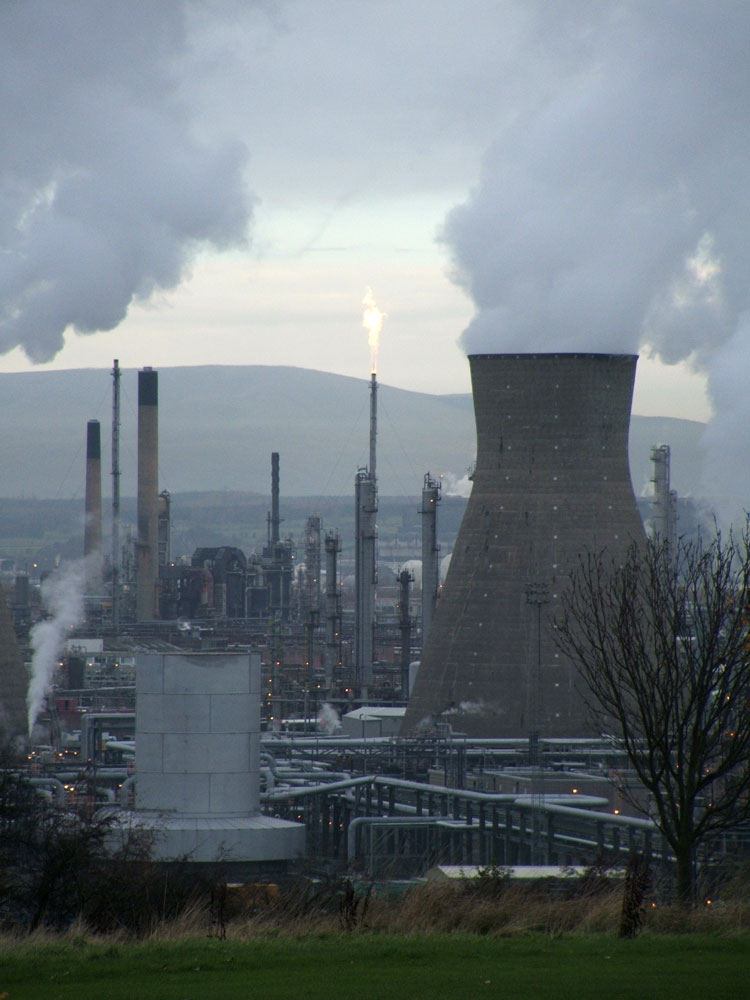
Grangemouth Refinery was an oil refinery complex located on the Firth of Forth in Grangemouth, Scotland, built by BP but latterly operated by Petroineos. It was the only operating crude oil refinery in Scotland, and with its closure left five remaining refineries in the UK. Grangemouth until that point was the oldest refinery in the UK and supplied 65% of Scotland's oil products, including petrol and diesel. The refinery processed its last crude in April 2025, and is slated to fully convert to a fuels terminal from July 2025 onwards.
Grangemouth Refinery commenced operation in 1924 as Scottish Oils. Its location at Grangemouth was selected due to the adjacent Grangemouth Docks which supported the import by ship of Middle East crude oils for feedstock, plus the cheap availability of large areas of reclaimed flat land. Another important factor was the abundant availability of skilled labour in shale oil refining: the first oil works in the world, 'Young's Paraffin Light and Mineral Oil Company Limited', had opened in 1851 at Boghead near Bathgate, to produce oil from shale or coal using the process patented in 1850 by Glasgow scientist Dr James Young (known as "Paraffin" Young), for "treating bituminous coals to obtain paraffine therefrom".
With the world's first oil wells coming on-line in 1854 in Poland, the global price of oil dropped and many Scottish shale oil works became uneconomical and had to either close or concentrate production on other materials. By 1910 only five major Scottish shale oil companies remained, fighting to remain competitive against cheaper imported American oil.
During the First World War the British government helped to develop new fields in Arabia to provide cheap oil to sustain the war effort. This drove prices even lower to a point where the shale oil industry was unable to compete, and as a result in 1919 the six surviving companies (including Youngs) came together under the management of the newly formed Scottish Oils. That same year Scottish Oils was purchased by the Anglo-Persian Oil Company, a forerunner of the British Petroleum Company (later known as BP)
The refinery operated from 1924 to 1939 at a throughput of 360,000 tonnes per year. It was then forced to shut down between 1939 and 1946 by World War II and the resulting drying up of crude feedstock imports. When operations recommenced in 1946, the refinery underwent several major expansion programmes.
In the 1940s the Distiller's Company Ltd were investigating synthetic processes for the production of alcohol, to replace the traditional fermentation process using molasses and so resolve issues with unreliability of supply and the associated cost fluctuations. This business need combined with BP's interest in petrochemical development resulted in 1947 in the formation of a joint company, British Hydrocarbon Chemicals Ltd. The new company located its site adjacent the existing BP Grangemouth Refinery, using available feedstock from the refinery byproduct streams. This petrochemical plant was commissioned in 1951, the first in Europe, marking the beginnings of the INEOS Grangemouth petrochemical complex.
In the 1950s the refinery was connected to the Finnart Oil Terminal on Loch Long on the west coast of Scotland by a 58-mile (93 km) pipeline, to allow the import of crudes via deep-water jetty, which supported the use of larger oil tankers. The first crude oil import from Finnart was in 1952.
In the 1990s, a second line was also installed, to allow the direct supply of finished refinery products to the Finnart terminal, primarily for export to markets in Ireland.
Hub AI
Grangemouth Refinery AI simulator
(@Grangemouth Refinery_simulator)
Grangemouth Refinery
Grangemouth Refinery was an oil refinery complex located on the Firth of Forth in Grangemouth, Scotland, built by BP but latterly operated by Petroineos. It was the only operating crude oil refinery in Scotland, and with its closure left five remaining refineries in the UK. Grangemouth until that point was the oldest refinery in the UK and supplied 65% of Scotland's oil products, including petrol and diesel. The refinery processed its last crude in April 2025, and is slated to fully convert to a fuels terminal from July 2025 onwards.
Grangemouth Refinery commenced operation in 1924 as Scottish Oils. Its location at Grangemouth was selected due to the adjacent Grangemouth Docks which supported the import by ship of Middle East crude oils for feedstock, plus the cheap availability of large areas of reclaimed flat land. Another important factor was the abundant availability of skilled labour in shale oil refining: the first oil works in the world, 'Young's Paraffin Light and Mineral Oil Company Limited', had opened in 1851 at Boghead near Bathgate, to produce oil from shale or coal using the process patented in 1850 by Glasgow scientist Dr James Young (known as "Paraffin" Young), for "treating bituminous coals to obtain paraffine therefrom".
With the world's first oil wells coming on-line in 1854 in Poland, the global price of oil dropped and many Scottish shale oil works became uneconomical and had to either close or concentrate production on other materials. By 1910 only five major Scottish shale oil companies remained, fighting to remain competitive against cheaper imported American oil.
During the First World War the British government helped to develop new fields in Arabia to provide cheap oil to sustain the war effort. This drove prices even lower to a point where the shale oil industry was unable to compete, and as a result in 1919 the six surviving companies (including Youngs) came together under the management of the newly formed Scottish Oils. That same year Scottish Oils was purchased by the Anglo-Persian Oil Company, a forerunner of the British Petroleum Company (later known as BP)
The refinery operated from 1924 to 1939 at a throughput of 360,000 tonnes per year. It was then forced to shut down between 1939 and 1946 by World War II and the resulting drying up of crude feedstock imports. When operations recommenced in 1946, the refinery underwent several major expansion programmes.
In the 1940s the Distiller's Company Ltd were investigating synthetic processes for the production of alcohol, to replace the traditional fermentation process using molasses and so resolve issues with unreliability of supply and the associated cost fluctuations. This business need combined with BP's interest in petrochemical development resulted in 1947 in the formation of a joint company, British Hydrocarbon Chemicals Ltd. The new company located its site adjacent the existing BP Grangemouth Refinery, using available feedstock from the refinery byproduct streams. This petrochemical plant was commissioned in 1951, the first in Europe, marking the beginnings of the INEOS Grangemouth petrochemical complex.
In the 1950s the refinery was connected to the Finnart Oil Terminal on Loch Long on the west coast of Scotland by a 58-mile (93 km) pipeline, to allow the import of crudes via deep-water jetty, which supported the use of larger oil tankers. The first crude oil import from Finnart was in 1952.
In the 1990s, a second line was also installed, to allow the direct supply of finished refinery products to the Finnart terminal, primarily for export to markets in Ireland.