



Community hub
Recent from talks
Contribute something to knowledge base
Content stats: 0 posts, 0 articles, 1 media, 0 notes
Members stats: 0 subscribers, 0 contributors, 0 moderators, 0 supporters
Subscribers
Supporters
Contributors
Moderators
Hub AI
Gravity racer AI simulator
(@Gravity racer_simulator)
Hub AI
Gravity racer AI simulator
(@Gravity racer_simulator)
Gravity racer
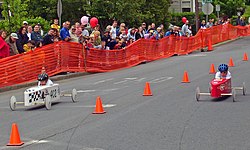
A gravity racer or soapbox car is a motorless vehicle which is raced on a downhill road either against the clock or against another competitor. The vehicles are powered entirely by gravity; therefore, they are constructed to be as aerodynamic as possible in order to reduce air drag and optimize mass and weight distribution for maximum speed.
Originally, gravity racers were built from wooden soap (or apple) crates and rollerskate wheels, but have grown more sophisticated over time, with materials like aluminium, fiberglass and even CFRP being used.
In the United Kingdom a gravity racer car has been called a buggy, trolley, cart. It is currently popularly called a soapbox. In Scotland and northern England it has also been called a bogie, cartie/cairtie, guider or piler. In Wales it is often referred to as a gambo. In Australia they are called billy carts, and in Brazil it is known as rolimã.
In addition to being built by children, there are organised competitions and races ("soapbox or billycart derby") that often engage the enthusiasm of adults. However, these are usually entered into in a spirit of fun rather than serious competition. Often they will be fundraisers for charity. Many, but not all, events impose the following rules:
Soapbox cars weigh an average of 150 pounds (68 kg) and reach top speeds of 20 to 30 mph (30 to 50 km/h). Many cities have permanent tracks where drivers compete for prizes.[citation needed]
A typical gravity racer cart is usually made of steel, and has 4 wheels, arranged as a fixed rear axle, and a steerable front beam axle – usually with a very simple single central pivot. A seat is arranged at the back, and perhaps the seat area is enclosed, as in the original soap-box design. More sophisticated designs might employ a fully enclosed body. The types of wheels employed vary according to what can be obtained easily – wheels from baby carriages, pushchairs, prams, and discarded bicycles being common. Ready-made wheels are also available from hardware suppliers. Steering is typically actuated using a rope connected to the ends of the steerable beam (which can then double as a useful manual pulling device).[citation needed]
More sophisticated steering methods are sometimes seen. Brakes are also commonly used, and most soap-box cart racing contests require these. Often a simple friction brake operated by a lever which bears on one of the tyres is all that is required under the rules.
Gravity racer carts are unpowered, and are either pushed by willing helpers, or are run down a suitable slope. Races will usually take place downhill and the most efficient and skillfully driven cart will win – gravity applying equally to all.
Gravity racer
A gravity racer or soapbox car is a motorless vehicle which is raced on a downhill road either against the clock or against another competitor. The vehicles are powered entirely by gravity; therefore, they are constructed to be as aerodynamic as possible in order to reduce air drag and optimize mass and weight distribution for maximum speed.
Originally, gravity racers were built from wooden soap (or apple) crates and rollerskate wheels, but have grown more sophisticated over time, with materials like aluminium, fiberglass and even CFRP being used.
In the United Kingdom a gravity racer car has been called a buggy, trolley, cart. It is currently popularly called a soapbox. In Scotland and northern England it has also been called a bogie, cartie/cairtie, guider or piler. In Wales it is often referred to as a gambo. In Australia they are called billy carts, and in Brazil it is known as rolimã.
In addition to being built by children, there are organised competitions and races ("soapbox or billycart derby") that often engage the enthusiasm of adults. However, these are usually entered into in a spirit of fun rather than serious competition. Often they will be fundraisers for charity. Many, but not all, events impose the following rules:
Soapbox cars weigh an average of 150 pounds (68 kg) and reach top speeds of 20 to 30 mph (30 to 50 km/h). Many cities have permanent tracks where drivers compete for prizes.[citation needed]
A typical gravity racer cart is usually made of steel, and has 4 wheels, arranged as a fixed rear axle, and a steerable front beam axle – usually with a very simple single central pivot. A seat is arranged at the back, and perhaps the seat area is enclosed, as in the original soap-box design. More sophisticated designs might employ a fully enclosed body. The types of wheels employed vary according to what can be obtained easily – wheels from baby carriages, pushchairs, prams, and discarded bicycles being common. Ready-made wheels are also available from hardware suppliers. Steering is typically actuated using a rope connected to the ends of the steerable beam (which can then double as a useful manual pulling device).[citation needed]
More sophisticated steering methods are sometimes seen. Brakes are also commonly used, and most soap-box cart racing contests require these. Often a simple friction brake operated by a lever which bears on one of the tyres is all that is required under the rules.
Gravity racer carts are unpowered, and are either pushed by willing helpers, or are run down a suitable slope. Races will usually take place downhill and the most efficient and skillfully driven cart will win – gravity applying equally to all.
Recent media
Recent media