



Community hub
Recent from talks
Knowledge base stats:
Talk channels stats:
Members stats:
Great Famine of Mount Lebanon
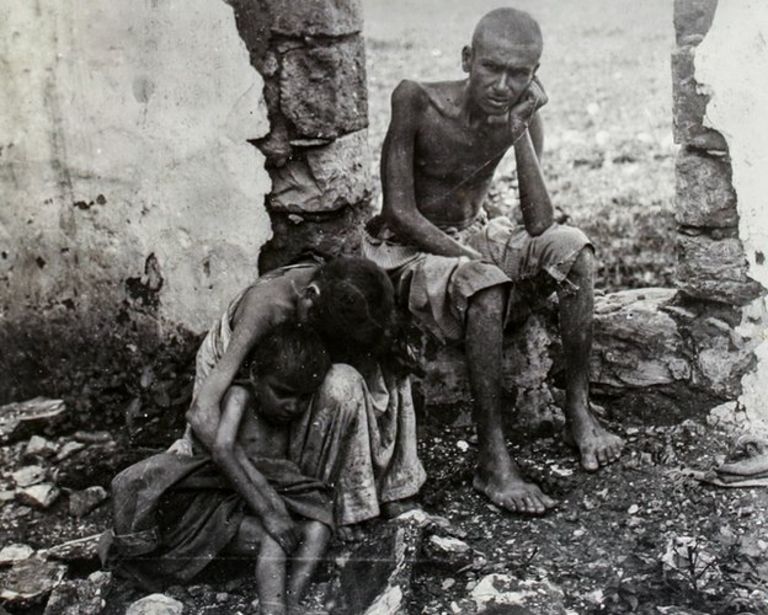
The Great Famine of Mount Lebanon (Arabic: مجاعة جبل لبنان, romanized: Majā'at Jabal Lubnān; Ottoman Turkish: Cebel-i Lübnan Kıtlığı جَبَلِ لُبْنَان قِیتْلِیࢰِی), also known as Kafno (Classical Syriac: ܟܦܢܐ, romanized: Kafno, lit. 'Starvation'), was a period of mass starvation on Mount Lebanon during World War I – between 1915 and 1918 – that resulted in the deaths of about 200,000 people, most of whom were Maronite Christians.
There were many reasons for the famine in Mount Lebanon. Natural as well as man-made factors both played a role. Allied forces (Great Britain and France) blockaded the Eastern Mediterranean, as they had done with the German Empire and Austro-Hungarian Empire in Europe, in order to strangle the economy and weaken the Ottoman war effort. The situation was exacerbated by Jamal Pasha, commander of the Fourth Army of the Ottoman Empire, who deliberately barred crops from neighbouring Syria from entering Mount Lebanon, in response to the Allied blockade. Additionally, a swarm of locusts devoured the remaining crops, creating a famine that led to the deaths of half of the population of the Mount Lebanon Mutasarrifate, a semi-autonomous subdivision of the Ottoman Empire and the precursor of modern-day Lebanon. Ottoman Mount Lebanon had the highest per capita fatality rate of any 'bounded' territory during the First World War.
Other areas in modern-day Lebanon, according to multiple sources, were also famine-stricken. However, due to poor documentation, casualties were never recorded. Some of the areas hit with no documentation include Tyre, Zahle, Akkar and Bint Jbeil.
Mount Lebanon Mutasarrifate was one of four entities in Greater Syria or 'Bilad al-Asham' under Ottoman control, including the Damascus, Aleppo, and Beirut Vilayets. Mount Lebanon's economy relied heavily on sericulture; raw silk was processed in looms and finished goods were shipped to the European market and to Damascene manufacturers. While sericulture constituted 32.9% of Mount Lebanon's income in 1914, 45.6% of the region's economy was dependent on remittances from the diaspora in the Americas, making them the 'largest' source of income by the onset of the war.
Famine is not characterised by a dearth of food but rather by the inability of people to access it. Multiple factors compounded to create an environment that worsened the pre-existing food shortages caused by the First World War.
Pressure within a community occurs when external factors weaken ongoing food shortages. The impact of WWI acted as the primary example of pressure in Mount Lebanon: the Ottoman war effort that prioritised food for soldiers on the front lines when the Empire neared collapse and the Entente naval blockade impacted the economy.
The movement of Ottoman troops to the front following the 1915 Suez Canal campaign caused a 'bottleneck' in the transportation system of Greater Syria. While there was ample grain and wheat in Damascus, moving it to the mountainous region of Mount Lebanon when the price of hiring a railway carriage had tripled became almost impossible. The Ottoman requisition of transport animals further plagued any efforts at moving aid to the mountainous region.
The 'hold' in a famine system applies when something keeps or 'holds' pressure in place for a prolonged period without release.
Hub AI
Great Famine of Mount Lebanon AI simulator
(@Great Famine of Mount Lebanon_simulator)
Great Famine of Mount Lebanon
The Great Famine of Mount Lebanon (Arabic: مجاعة جبل لبنان, romanized: Majā'at Jabal Lubnān; Ottoman Turkish: Cebel-i Lübnan Kıtlığı جَبَلِ لُبْنَان قِیتْلِیࢰِی), also known as Kafno (Classical Syriac: ܟܦܢܐ, romanized: Kafno, lit. 'Starvation'), was a period of mass starvation on Mount Lebanon during World War I – between 1915 and 1918 – that resulted in the deaths of about 200,000 people, most of whom were Maronite Christians.
There were many reasons for the famine in Mount Lebanon. Natural as well as man-made factors both played a role. Allied forces (Great Britain and France) blockaded the Eastern Mediterranean, as they had done with the German Empire and Austro-Hungarian Empire in Europe, in order to strangle the economy and weaken the Ottoman war effort. The situation was exacerbated by Jamal Pasha, commander of the Fourth Army of the Ottoman Empire, who deliberately barred crops from neighbouring Syria from entering Mount Lebanon, in response to the Allied blockade. Additionally, a swarm of locusts devoured the remaining crops, creating a famine that led to the deaths of half of the population of the Mount Lebanon Mutasarrifate, a semi-autonomous subdivision of the Ottoman Empire and the precursor of modern-day Lebanon. Ottoman Mount Lebanon had the highest per capita fatality rate of any 'bounded' territory during the First World War.
Other areas in modern-day Lebanon, according to multiple sources, were also famine-stricken. However, due to poor documentation, casualties were never recorded. Some of the areas hit with no documentation include Tyre, Zahle, Akkar and Bint Jbeil.
Mount Lebanon Mutasarrifate was one of four entities in Greater Syria or 'Bilad al-Asham' under Ottoman control, including the Damascus, Aleppo, and Beirut Vilayets. Mount Lebanon's economy relied heavily on sericulture; raw silk was processed in looms and finished goods were shipped to the European market and to Damascene manufacturers. While sericulture constituted 32.9% of Mount Lebanon's income in 1914, 45.6% of the region's economy was dependent on remittances from the diaspora in the Americas, making them the 'largest' source of income by the onset of the war.
Famine is not characterised by a dearth of food but rather by the inability of people to access it. Multiple factors compounded to create an environment that worsened the pre-existing food shortages caused by the First World War.
Pressure within a community occurs when external factors weaken ongoing food shortages. The impact of WWI acted as the primary example of pressure in Mount Lebanon: the Ottoman war effort that prioritised food for soldiers on the front lines when the Empire neared collapse and the Entente naval blockade impacted the economy.
The movement of Ottoman troops to the front following the 1915 Suez Canal campaign caused a 'bottleneck' in the transportation system of Greater Syria. While there was ample grain and wheat in Damascus, moving it to the mountainous region of Mount Lebanon when the price of hiring a railway carriage had tripled became almost impossible. The Ottoman requisition of transport animals further plagued any efforts at moving aid to the mountainous region.
The 'hold' in a famine system applies when something keeps or 'holds' pressure in place for a prolonged period without release.