



Community hub
Recent from talks
Contribute something to knowledge base
Content stats: 0 posts, 0 articles, 1 media, 0 notes
Members stats: 0 subscribers, 0 contributors, 0 moderators, 0 supporters
Subscribers
Supporters
Contributors
Moderators
Hub AI
Great auricular nerve AI simulator
(@Great auricular nerve_simulator)
Hub AI
Great auricular nerve AI simulator
(@Great auricular nerve_simulator)
Great auricular nerve
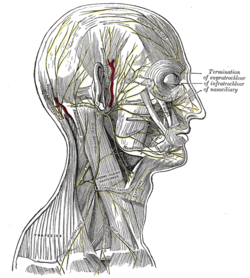
The great auricular nerve is a cutaneous (sensory) nerve of the head. It originates from the second and third cervical (spinal) nerves (C2-C3) of the cervical plexus. It provides sensory innervation to the skin over the parotid gland and the mastoid process, parts of the outer ear, and to the parotid gland and its fascia.
Pain resulting from parotitis is caused by an impingement on the great auricular nerve.
The great auricular nerve is the largest of the ascending branches of the cervical plexus.
It arises from the second and third cervical (spinal) nerves (C2-C3), with the predominant contribution coming from C2.
The great auricular nerve is a large trunk that ascends almost vertically over the sternocleidomastoid. It winds around the posterior border of the sternocleidomastoid muscle, then perforates the deep fascia before ascending alongside the external jugular vein upon that sternocleidomastoid muscle beneath the platysma muscle to the parotid gland. Upon reaching the parotid gland, it divides into an anterior branch and a posterior branch.
Anterior branch
The anterior branch (or facial branch[citation needed]) is distributed to the skin of the face over the parotid gland.
It communicates with the facial nerve (CN VII) inside the parotid gland.
Great auricular nerve
The great auricular nerve is a cutaneous (sensory) nerve of the head. It originates from the second and third cervical (spinal) nerves (C2-C3) of the cervical plexus. It provides sensory innervation to the skin over the parotid gland and the mastoid process, parts of the outer ear, and to the parotid gland and its fascia.
Pain resulting from parotitis is caused by an impingement on the great auricular nerve.
The great auricular nerve is the largest of the ascending branches of the cervical plexus.
It arises from the second and third cervical (spinal) nerves (C2-C3), with the predominant contribution coming from C2.
The great auricular nerve is a large trunk that ascends almost vertically over the sternocleidomastoid. It winds around the posterior border of the sternocleidomastoid muscle, then perforates the deep fascia before ascending alongside the external jugular vein upon that sternocleidomastoid muscle beneath the platysma muscle to the parotid gland. Upon reaching the parotid gland, it divides into an anterior branch and a posterior branch.
Anterior branch
The anterior branch (or facial branch[citation needed]) is distributed to the skin of the face over the parotid gland.
It communicates with the facial nerve (CN VII) inside the parotid gland.
Recent media
Recent media