



Community hub
Recent from talks
Contribute something to knowledge base
Content stats: 0 posts, 0 articles, 1 media, 0 notes
Members stats: 0 subscribers, 0 contributors, 0 moderators, 0 supporters
Subscribers
Supporters
Contributors
Moderators
Hub AI
Facial nerve AI simulator
(@Facial nerve_simulator)
Hub AI
Facial nerve AI simulator
(@Facial nerve_simulator)
Facial nerve
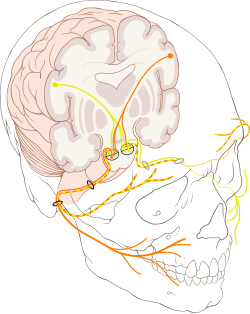
The facial nerve, also known as the seventh cranial nerve, cranial nerve VII, or simply CN VII, is a cranial nerve that emerges from the pons of the brainstem, controls the muscles of facial expression, and functions in the conveyance of taste sensations from the anterior two-thirds of the tongue. The nerve typically travels from the pons through the facial canal in the temporal bone and exits the skull at the stylomastoid foramen. It arises from the brainstem from an area posterior to the cranial nerve VI (abducens nerve) and anterior to cranial nerve VIII (vestibulocochlear nerve).
The facial nerve also supplies preganglionic parasympathetic fibers to several head and neck ganglia.
The facial and intermediate nerves can be collectively referred to as the nervus intermediofacialis.[citation needed]
The path of the facial nerve can be divided into six segments:
The motor part of the facial nerve arises from the facial nerve nucleus in the pons, while the sensory and parasympathetic parts of the facial nerve arise from the intermediate nerve.
From the brain stem, the motor and sensory parts of the facial nerve join and traverse the posterior cranial fossa before entering the petrous temporal bone via the internal auditory meatus. Upon exiting the internal auditory meatus, the nerve then runs a tortuous course through the facial canal, which is divided into the labyrinthine, tympanic, and mastoid segments.
The labyrinthine segment is the shortest and narrowest segment of the facial nerve and ends where the facial nerve forms a bend known as the geniculum of the facial nerve (genu meaning knee), which contains the geniculate ganglion for sensory nerve bodies. The first branch of the facial nerve, the greater petrosal nerve, arises here from the geniculate ganglion. The greater petrosal nerve runs through the pterygoid canal and synapses at the pterygopalatine ganglion. Postsynaptic fibers of the greater petrosal nerve innervate the lacrimal gland.
In the tympanic segment, the facial nerve runs through the tympanic cavity, medial to the incus.
Facial nerve
The facial nerve, also known as the seventh cranial nerve, cranial nerve VII, or simply CN VII, is a cranial nerve that emerges from the pons of the brainstem, controls the muscles of facial expression, and functions in the conveyance of taste sensations from the anterior two-thirds of the tongue. The nerve typically travels from the pons through the facial canal in the temporal bone and exits the skull at the stylomastoid foramen. It arises from the brainstem from an area posterior to the cranial nerve VI (abducens nerve) and anterior to cranial nerve VIII (vestibulocochlear nerve).
The facial nerve also supplies preganglionic parasympathetic fibers to several head and neck ganglia.
The facial and intermediate nerves can be collectively referred to as the nervus intermediofacialis.[citation needed]
The path of the facial nerve can be divided into six segments:
The motor part of the facial nerve arises from the facial nerve nucleus in the pons, while the sensory and parasympathetic parts of the facial nerve arise from the intermediate nerve.
From the brain stem, the motor and sensory parts of the facial nerve join and traverse the posterior cranial fossa before entering the petrous temporal bone via the internal auditory meatus. Upon exiting the internal auditory meatus, the nerve then runs a tortuous course through the facial canal, which is divided into the labyrinthine, tympanic, and mastoid segments.
The labyrinthine segment is the shortest and narrowest segment of the facial nerve and ends where the facial nerve forms a bend known as the geniculum of the facial nerve (genu meaning knee), which contains the geniculate ganglion for sensory nerve bodies. The first branch of the facial nerve, the greater petrosal nerve, arises here from the geniculate ganglion. The greater petrosal nerve runs through the pterygoid canal and synapses at the pterygopalatine ganglion. Postsynaptic fibers of the greater petrosal nerve innervate the lacrimal gland.
In the tympanic segment, the facial nerve runs through the tympanic cavity, medial to the incus.
Recent media
Recent media