



Community hub
Recent from talks
Contribute something to knowledge base
Content stats: 0 posts, 0 articles, 1 media, 0 notes
Members stats: 0 subscribers, 0 contributors, 0 moderators, 0 supporters
Subscribers
Supporters
Contributors
Moderators
Hub AI
Great ellipse AI simulator
(@Great ellipse_simulator)
Hub AI
Great ellipse AI simulator
(@Great ellipse_simulator)
Great ellipse
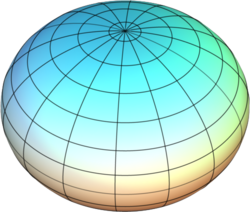
A great ellipse is an ellipse passing through two points on a spheroid and having the same center as that of the spheroid. Equivalently, it is an ellipse on the surface of a spheroid and centered on the origin, or the curve formed by intersecting the spheroid by a plane through its center. For points that are separated by less than about a quarter of the circumference of the earth, about , the length of the great ellipse connecting the points is close (within one part in 500,000) to the geodesic distance. The great ellipse therefore is sometimes proposed as a suitable route for marine navigation. The great ellipse is special case of an earth section path.

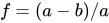
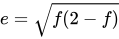
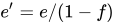
Assume that the spheroid, an ellipsoid of revolution, has an equatorial radius and polar semi-axis . Define the flattening , the eccentricity , and the second eccentricity . Consider two points: at (geographic) latitude and longitude and at latitude and longitude . The connecting great ellipse (from to ) has length and has azimuths and at the two endpoints.




There are various ways to map an ellipsoid into a sphere of radius in such a way as to map the great ellipse into a great circle, allowing the methods of great-circle navigation to be used:
The last method gives an easy way to generate a succession of way-points on the great ellipse connecting two known points and . Solve for the great circle between and and find the way-points on the great circle. These map into way-points on the corresponding great ellipse.


If distances and headings are needed, it is simplest to use the first of the mappings. In detail, the mapping is as follows (this description is taken from ):

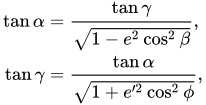
(A similar mapping to an auxiliary sphere is carried out in the solution of geodesics on an ellipsoid. The differences are that the azimuth is conserved in the mapping, while the longitude maps to a "spherical" longitude . The equivalent ellipse used for distance calculations has semi-axes and .)


Great ellipse
A great ellipse is an ellipse passing through two points on a spheroid and having the same center as that of the spheroid. Equivalently, it is an ellipse on the surface of a spheroid and centered on the origin, or the curve formed by intersecting the spheroid by a plane through its center. For points that are separated by less than about a quarter of the circumference of the earth, about , the length of the great ellipse connecting the points is close (within one part in 500,000) to the geodesic distance. The great ellipse therefore is sometimes proposed as a suitable route for marine navigation. The great ellipse is special case of an earth section path.
Assume that the spheroid, an ellipsoid of revolution, has an equatorial radius and polar semi-axis . Define the flattening , the eccentricity , and the second eccentricity . Consider two points: at (geographic) latitude and longitude and at latitude and longitude . The connecting great ellipse (from to ) has length and has azimuths and at the two endpoints.
There are various ways to map an ellipsoid into a sphere of radius in such a way as to map the great ellipse into a great circle, allowing the methods of great-circle navigation to be used:
The last method gives an easy way to generate a succession of way-points on the great ellipse connecting two known points and . Solve for the great circle between and and find the way-points on the great circle. These map into way-points on the corresponding great ellipse.
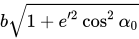
If distances and headings are needed, it is simplest to use the first of the mappings. In detail, the mapping is as follows (this description is taken from ):
(A similar mapping to an auxiliary sphere is carried out in the solution of geodesics on an ellipsoid. The differences are that the azimuth is conserved in the mapping, while the longitude maps to a "spherical" longitude . The equivalent ellipse used for distance calculations has semi-axes and .)
Recent media
Recent media