



Community hub
Recent from talks
Contribute something to knowledge base
Content stats: 0 posts, 0 articles, 1 media, 0 notes
Members stats: 0 subscribers, 0 contributors, 0 moderators, 0 supporters
Subscribers
Supporters
Contributors
Moderators
Hub AI
Great raft spider AI simulator
(@Great raft spider_simulator)
Hub AI
Great raft spider AI simulator
(@Great raft spider_simulator)
Great raft spider
The great raft spider or fen raft spider (Dolomedes plantarius) is a European species of spider in the family Dolomedidae. Like other Dolomedes spiders, it is semiaquatic, hunting its prey on the surface of water. It occurs mainly in neutral to alkaline, unpolluted water of fens and grazing marsh.
The species was first described by arachnologist Carl Alexander Clerck in 1757 as Araneus plantarius. Its genus was reclassified by Pierre André Latreille in 1804 to Dolomedes. The species has also been described under the name Aranea viridata by Müller and as Dolomedes riparius by Hahn. The species is currently recognised as Dolomedes plantarius and has two widely recognised common names: the great raft spider and the fen raft spider.
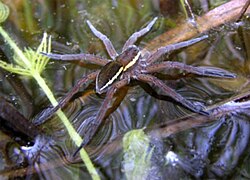
D. plantarius is a large species within its range. Adult females can have bodies of slightly over 20mm in length with a span of 70mm including their legs. It is typically black or brown in colouration with white or cream stripes along the sides of the body. It is very similar in appearance to the closely related raft spider Dolomedes fimbriatus with which it is often misidentified.
The great raft spider, as with most other Dolomedes species, is a semi-aquatic spider. It inhabits lowland fen and grazing marsh areas and is dependent on the presence of standing or slow moving neutral to alkaline water. Within these areas it can be found on the margins of pools or ditches. Emergent vegetation is highly important for use as perches for hunting and basking and to support nursery webs. As a warmth loving species they avoid areas where water surfaces are shaded.
Great raft spiders are predatory and hunt from perches at the water's edge. They primarily feed on aquatic invertebrates such as pond skaters, dragonfly larvae and smaller aquatic spiders, as well as small fish. They will also feed on drowning terrestrial invertebrates and have been known to catch small vertebrates such as sticklebacks and tadpoles. To hunt aquatic prey they have developed a sensory system of chaetae, a covering of sensory hairs on its legs. These are used to detect the vibrations made as prey hits the surface or moves through the water. It will typically position itself with the back legs on a plant stem and the front legs on the water surface to be able to detect any prey. When prey is found the spider is able to run across the surface of the water to reach it by use of surface tension. They are also known to hunt underwater by running down the stems of plants to reach prey, this can also be used to avoid capture by predators.
Water is essential to the whole life cycle of the great raft spider. The spiders will live for two and a half years. As juveniles they will hibernate over the winter and will mature into adults during their final spring. In the UK, adults will usually have two breeding attempts between July and September.
The chaetae sensory system is used to help find a mate and courtship is carried out on the water. The male will slowly and carefully approach the female while tapping the water surface with its legs. When they are close they perform a slow bobbing of the body. If accepted the mating is brief and over in seconds.
The female will lay several hundred eggs in a silk sac, about 10mm across, which they carry under their bodies for around three weeks. During this time she will periodically dip the sac into water to prevent the eggs from drying out. She will also locate a suitable nest site amongst the emergent vegetation, this will usually be between 10 and 100 cm above the water. Shortly prior to hatching she will construct a tent-like nursery web within which she can guard the young until they disperse into the surroundings, usually five to nine days after hatching.
Great raft spider
The great raft spider or fen raft spider (Dolomedes plantarius) is a European species of spider in the family Dolomedidae. Like other Dolomedes spiders, it is semiaquatic, hunting its prey on the surface of water. It occurs mainly in neutral to alkaline, unpolluted water of fens and grazing marsh.
The species was first described by arachnologist Carl Alexander Clerck in 1757 as Araneus plantarius. Its genus was reclassified by Pierre André Latreille in 1804 to Dolomedes. The species has also been described under the name Aranea viridata by Müller and as Dolomedes riparius by Hahn. The species is currently recognised as Dolomedes plantarius and has two widely recognised common names: the great raft spider and the fen raft spider.
D. plantarius is a large species within its range. Adult females can have bodies of slightly over 20mm in length with a span of 70mm including their legs. It is typically black or brown in colouration with white or cream stripes along the sides of the body. It is very similar in appearance to the closely related raft spider Dolomedes fimbriatus with which it is often misidentified.
The great raft spider, as with most other Dolomedes species, is a semi-aquatic spider. It inhabits lowland fen and grazing marsh areas and is dependent on the presence of standing or slow moving neutral to alkaline water. Within these areas it can be found on the margins of pools or ditches. Emergent vegetation is highly important for use as perches for hunting and basking and to support nursery webs. As a warmth loving species they avoid areas where water surfaces are shaded.
Great raft spiders are predatory and hunt from perches at the water's edge. They primarily feed on aquatic invertebrates such as pond skaters, dragonfly larvae and smaller aquatic spiders, as well as small fish. They will also feed on drowning terrestrial invertebrates and have been known to catch small vertebrates such as sticklebacks and tadpoles. To hunt aquatic prey they have developed a sensory system of chaetae, a covering of sensory hairs on its legs. These are used to detect the vibrations made as prey hits the surface or moves through the water. It will typically position itself with the back legs on a plant stem and the front legs on the water surface to be able to detect any prey. When prey is found the spider is able to run across the surface of the water to reach it by use of surface tension. They are also known to hunt underwater by running down the stems of plants to reach prey, this can also be used to avoid capture by predators.
Water is essential to the whole life cycle of the great raft spider. The spiders will live for two and a half years. As juveniles they will hibernate over the winter and will mature into adults during their final spring. In the UK, adults will usually have two breeding attempts between July and September.
The chaetae sensory system is used to help find a mate and courtship is carried out on the water. The male will slowly and carefully approach the female while tapping the water surface with its legs. When they are close they perform a slow bobbing of the body. If accepted the mating is brief and over in seconds.
The female will lay several hundred eggs in a silk sac, about 10mm across, which they carry under their bodies for around three weeks. During this time she will periodically dip the sac into water to prevent the eggs from drying out. She will also locate a suitable nest site amongst the emergent vegetation, this will usually be between 10 and 100 cm above the water. Shortly prior to hatching she will construct a tent-like nursery web within which she can guard the young until they disperse into the surroundings, usually five to nine days after hatching.
Recent media
Recent media