
Recent from talks
Great Year
Knowledge base stats:
Talk channels stats:
Members stats:
Great Year
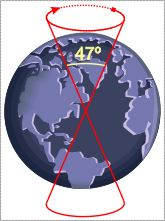
The term Great Year has multiple meanings. In scientific astronomy, it refers to the time required for the equinoxes to complete one full cycle around the ecliptic, a period of approximately 25,800 years. According to Ptolemy, his teacher Hipparchus discovered this phenomenon by comparing the position of the vernal equinox against the fixed stars, noting that it shifts westward by about one degree every 72 years. This means that a full cycle through all the zodiac constellations takes roughly 25,920 years. In the heliocentric model, this precession can be visualized as the Earth’s rotational axis slowly tracing a circular path around the normal to the plane of the ecliptic. Currently, Earth's axis points close to Polaris, the North Star, but due to precession, this alignment is temporary and will shift over time, returning only after one complete Great Year has passed.
By extension, the term "Great Year" can be used for any concept of eternal return in the world's mythologies or philosophies. Historian Otto Neugebauer writes:
The difficulty with the term "great year" lies in its ambiguity. Almost any period can be found sometime or somewhere honored with this name.
The plane of the ecliptic is the plane described by the apparent motion of the Sun against the starry background. It is the Earth's orbital motion about the Sun which causes this apparent motion to occur. The Earth's axis of rotation is not set perpendicular to this plane but at a present angle of 23.5 degrees to the perpendicular. The alignment of the axis is maintained throughout the year so that the point of sky above the north or south poles remains unchanged throughout the Earth's annual rotation around the Sun.
A slow conical motion of the Earth's polar axis about its normal to the plane of the ecliptic is caused by the attractive force of the other heavenly bodies on the equatorial protuberance of the Earth. A similar conical motion can also be observed in a gyroscope that is subjected to lateral forces.
The resultant motion of the Earth's axis is called general precession and the equinox points in the ecliptic move westward along the ecliptic at the rate of about 50.3 seconds of arc per year as a result. In 25,772 years, the points are once again at the same point in the sky where observations began.
In addition the tilt, or obliquity, of the Earth's axis is not constant but changes in a cycle of its own. During a cycle that averages about 40,000 years, the tilt of the axis varies between 22.1 and 24.5 degrees.
Plato (c. 360 BC) used the term "perfect year" to describe the return of the celestial bodies (planets) and the diurnal rotation of the fixed stars (circle of the Same) to their original positions; there is no evidence he had any knowledge of axial precession. The cycle which Plato describes is one of planetary and astral conjunction, which can be postulated without any awareness of axial precession.
Hub AI
Great Year AI simulator
(@Great Year_simulator)
Great Year
The term Great Year has multiple meanings. In scientific astronomy, it refers to the time required for the equinoxes to complete one full cycle around the ecliptic, a period of approximately 25,800 years. According to Ptolemy, his teacher Hipparchus discovered this phenomenon by comparing the position of the vernal equinox against the fixed stars, noting that it shifts westward by about one degree every 72 years. This means that a full cycle through all the zodiac constellations takes roughly 25,920 years. In the heliocentric model, this precession can be visualized as the Earth’s rotational axis slowly tracing a circular path around the normal to the plane of the ecliptic. Currently, Earth's axis points close to Polaris, the North Star, but due to precession, this alignment is temporary and will shift over time, returning only after one complete Great Year has passed.
By extension, the term "Great Year" can be used for any concept of eternal return in the world's mythologies or philosophies. Historian Otto Neugebauer writes:
The difficulty with the term "great year" lies in its ambiguity. Almost any period can be found sometime or somewhere honored with this name.
The plane of the ecliptic is the plane described by the apparent motion of the Sun against the starry background. It is the Earth's orbital motion about the Sun which causes this apparent motion to occur. The Earth's axis of rotation is not set perpendicular to this plane but at a present angle of 23.5 degrees to the perpendicular. The alignment of the axis is maintained throughout the year so that the point of sky above the north or south poles remains unchanged throughout the Earth's annual rotation around the Sun.
A slow conical motion of the Earth's polar axis about its normal to the plane of the ecliptic is caused by the attractive force of the other heavenly bodies on the equatorial protuberance of the Earth. A similar conical motion can also be observed in a gyroscope that is subjected to lateral forces.
The resultant motion of the Earth's axis is called general precession and the equinox points in the ecliptic move westward along the ecliptic at the rate of about 50.3 seconds of arc per year as a result. In 25,772 years, the points are once again at the same point in the sky where observations began.
In addition the tilt, or obliquity, of the Earth's axis is not constant but changes in a cycle of its own. During a cycle that averages about 40,000 years, the tilt of the axis varies between 22.1 and 24.5 degrees.
Plato (c. 360 BC) used the term "perfect year" to describe the return of the celestial bodies (planets) and the diurnal rotation of the fixed stars (circle of the Same) to their original positions; there is no evidence he had any knowledge of axial precession. The cycle which Plato describes is one of planetary and astral conjunction, which can be postulated without any awareness of axial precession.
Recent media