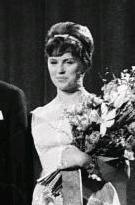
Grethe Ingmann
Grethe Ingmann
Main page
2087121

Grethe Ingmann

logo
Community Hub0 subscribers
Read side by side
from Wikipedia

Key Information

Grethe Ingmann (born Clemmensen; 17 June 1938 – 18 August 1990) was a Danish singer.

She started her career at 17, when she temporarily performed as a singer of the Malihini Hawaiians pop quartet. Soon after she sang with the Danish guitarist Jørn Grauengaard and his trio.

In 1955 she met her future husband, guitarist Jørgen Ingmann. The couple married in 1956 and performed as the duo Grethe og Jørgen Ingmann. Together they won the Eurovision Song Contest 1963 representing Denmark with the jazz waltz "Dansevise" (Dancing tune) with music by Otto Francker and lyrics by Sejr Volmer-Sørensen.[1][2] It was the first entry performed by a duo to win the Contest and also the first Scandinavian winner.

In 1965 she entered the German Schlager Contest with the song "Sommerwind". She dropped out in the preliminaries, but the song's English version, written by Johnny Mercer in 1966 and sung by Frank Sinatra, became an international hit.

Grethe and Jørgen Ingmann continued their musical career until they divorced in 1975. As a solo singer, Grethe participated in several Danish pre-selections for the Eurovision Song Contest, unsuccessfully. Notably, in 1979 she entered the Dansk Melodi Grand Prix with Bjarne Liller and the song "Alt er skønt", which tied for equal first at the end of the voting but placed second after a re-vote.[3]

The couple remarried in the 1980s. Grethe died of liver cancer on 18 August 1990, aged 52, becoming the first Eurovision winner to die.[4]

Awards and achievements
Preceded by Denmark in the Eurovision Song Contest
1963
Succeeded by
Preceded by Winner of the Eurovision Song Contest
1963
Succeeded by

References

[edit]
[edit]
Revisions and contributorsEdit on WikipediaRead on Wikipedia
from Grokipedia
'''Grethe Ingmann''' (née Kausgaard; 17 June 1938 – 18 August 1990) was a Danish singer born in Copenhagen, Denmark. She is known for winning the Eurovision Song Contest in 1963 together with her husband Jørgen Ingmann, performing the song "Dansevise" that secured Denmark's first victory in the competition. [1] [2] She began her career as a teenager, performing with various groups before teaming up with guitarist Jørgen Ingmann, whom she married in 1955. [3] [2] The duo's Eurovision triumph marked a high point in their career, with "Dansevise" becoming a notable entry in the contest's history. [1] They continued collaborating on music and television appearances in Denmark through the 1960s and into the 1970s, often featured in specials and programs showcasing their performances. [3] Grethe Ingmann also made occasional acting appearances in television productions during this period. [3] Following their divorce in 1975, Grethe Ingmann's public career tapered off. [2] She passed away on 18 August 1990 due to liver cancer. [3] Her legacy endures primarily through the historic Eurovision win and her contributions to Danish popular music in the mid-20th century. [2]

Early life

Birth and family background

Grethe Ingmann was born Grethe Clemmensen on 17 June 1938 in Copenhagen, Denmark. [4] [5] She grew up in Copenhagen alone with her mother during her childhood and early years. [5] Limited details are available on her wider family background prior to her professional life, though some sources note she had a half-brother who was a producer and band leader. [4] She was of Danish origin and remained connected to Copenhagen throughout her early life. [4] [5]

Early singing engagements

Grethe Ingmann, born Grethe Clemmensen, began her professional singing career in 1954 at the age of 16 when she replaced Inge Østergaard as singer in the Malihini Hawaiians pop quartet during the revue Bakkerevyen. [6] She made her debut as lead singer with the orchestra on 31 July 1954, impressing audiences with her performance. [7] Under her maiden name Grethe Clemmensen, she subsequently worked as a refrain singer and performed at the entertainment venue Landsbyen in Næstved. [6] On 1 September 1955, at age 17, she joined Jørn Grauengaard's trio as singer, appearing regularly at the Giraffen venue in Copenhagen. [6] During this time she demonstrated considerable talent as a jazz singer and took singing lessons from Johannes Wahl to further develop her skills. [6] Her reputation as a talented vocalist grew during these engagements with Grauengaard's group. [7] She met guitarist Jørgen Ingmann in 1955 while performing at Giraffen. [7]

Music career

Solo debut and initial collaborations

Grethe Ingmann, born Grethe Clemmensen, began her professional singing career in 1955 at the age of 17.[8][9] She made her debut as a temporary replacement vocalist with the Danish pop quartet Malihini Hawaiians, also known as Malihini-Kvintetten.[10][8] This brief engagement marked her entry into the music scene under her maiden name. Shortly afterward, she joined the trio and orchestra of Danish guitarist Jørn Grauengaard, performing and recording with them.[9][8] Her initial releases and credits from this period appeared as Grethe Clemmensen.[9] These early collaborations represented her pre-duo phase before she met Jørgen Ingmann later in 1955 and began their partnership.[9]

Duo with Jørgen Ingmann

Grethe Ingmann met guitarist Jørgen Ingmann in 1955, and the couple married the following year in 1956, at which time they formed the musical duo Grethe og Jørgen Ingmann, with Grethe adopting the surname Ingmann professionally. [11] The partnership combined Grethe's vocal style, rooted in pop and jazz, with Jørgen's accomplished guitar playing, often evoking the multi-tracked guitar-and-vocal sound of Les Paul and Mary Ford. [12] Beginning in 1956, the duo released a series of Danish-language singles and EPs on Metronome Records, including "Slentre Gennem Regn" (1957), "Dagbogen / Luna-lu" (1958), "Come Softly To Me / No Other Arms No Other Lips" (1959), and "I Vort Lille Skøre Paradis / Ya Ya" (1960), achieving modest local success in Denmark. [12] Together they produced a number of local hits during this period, establishing themselves as a popular act in their home country before their participation in the Eurovision Song Contest 1963. [13]

Eurovision Song Contest 1963

Grethe Ingmann, performing as part of the duo Grethe & Jørgen Ingmann, represented Denmark in the Eurovision Song Contest 1963 with the song "Dansevise". [14] The track was composed by Otto Francker and featured lyrics by Sejr Volmer-Sørensen. [14] It was selected as the Danish entry through the national final Melodi Grand Prix 1963, held on 24 February 1963. [14] The Eurovision final took place on 23 March 1963 at the BBC Television Centre in London, United Kingdom, with 16 countries participating. [15] Grethe & Jørgen Ingmann performed "Dansevise" in the eighth position, earning 42 points from the national juries and securing first place. [15] This marked Denmark's first victory in the Eurovision Song Contest, with Grethe Ingmann providing the lead vocals for the duo's performance. [14][15]

Post-Eurovision activities

After their victory at the Eurovision Song Contest in 1963 with "Dansevise", Grethe Ingmann and Jørgen Ingmann continued their collaborative career as a duo, with the subsequent decade representing the high point of their joint musical success. [8] Grethe Ingmann also pursued independent projects during this period, including participation in the Deutsche Schlager-Festspiele 1965, where she performed the German-language song "Der Sommerwind". [16] She released the Danish version "Sommervind" as a solo single that same year. [17] As a solo artist, Grethe Ingmann maintained occasional national pop success in Denmark. [9] She continued to engage with the Eurovision selection process in later years, most notably entering the 1979 Dansk Melodi Grand Prix alongside Bjarne Liller with the song "Alt er skønt". [18] The entry tied for first place in the initial voting with 82 points from eight regional juries but placed second after a re-vote, receiving 36 points to the winner's 51. [18] [19]

Acting career

Film and television credits

Grethe Ingmann's film and television credits were limited and primarily consisted of music-oriented television productions and a film contribution where she appeared or performed as a singer rather than in traditional dramatic acting roles.[3] In 1968, she featured in the TV movie Det vi ka' li', a rare studio live recording that showcased Grethe and Jørgen Ingmann performing 16 songs accompanied by a 15-member big band orchestra.[20] This appearance aligned with her ongoing duo work and emphasized her vocal performances. She is credited as a singer in the 1970 Danish film Nana, contributing vocally to the production without a narrative acting role.[3] Her 1974 TV movie Grethe og Jørgen Ingmann presented the duo in a live studio concert format, backed by Peder Kraghøj's orchestra and drawing from songs on their self-titled album.[21] These credits reflect her screen presence as an extension of her musical career rather than a separate acting pursuit.[3]

Personal life and death

Marriage and partnership

Grethe Ingmann married the guitarist Jørgen Ingmann in 1956. [22] [5] The couple had two children during their marriage and formed a close professional partnership as the duo Grethe & Jørgen Ingmann, blending their personal relationship with their shared musical career. [23] They performed together for many years, creating a significant overlap between their family life and artistic endeavors. [5] Their marriage ended in divorce in 1975. [23] Grethe Ingmann remarried in 1977 to a person she met in connection with the divorce. [23]

Illness and death

Grethe Ingmann died from liver cancer on 18 August 1990 at the age of 52. [3] [24] She had battled alcoholism for years prior to her death. [3] Grethe Ingmann was the first Eurovision Song Contest winner to die. [25]

Legacy

Grethe Ingmann's legacy remains closely tied to her role in Denmark's inaugural Eurovision Song Contest victory in 1963, when she and husband Jørgen Ingmann won with "Dansevise." [14] The song's triumph gave Denmark its first win in the contest and marked the first time a duo—specifically a married couple—claimed the title. [14] It also represented the first victory for any Scandinavian country in Eurovision history. [26] As the vocalist in the duo, Grethe earned recognition for her sophisticated pop and jazz-inflected style, which helped define the couple's sound and contributed to their status as notable figures in Danish music during the mid-20th century. While her solo career as a singer received some attention, her most enduring impact stems from this shared Eurovision success and the duo's contributions to popular music. "Dansevise" has continued to resonate, with revivals including the couple's performance at the 1981 "Songs of Europe" anniversary concert and the song's use in the opening sequence of the 2014 Eurovision Grand Final in Copenhagen. [14] Grethe Ingmann died in 1990, becoming the first Eurovision winner to pass away. [27] Her achievement with "Dansevise" continues to be celebrated as a landmark moment that elevated Denmark's presence in the Eurovision Song Contest and highlighted the appeal of Danish-language entries on an international stage.

References

User Avatar
No comments yet.