
Recent from talks
Griffintown
Knowledge base stats:
Talk channels stats:
Members stats:
Griffintown
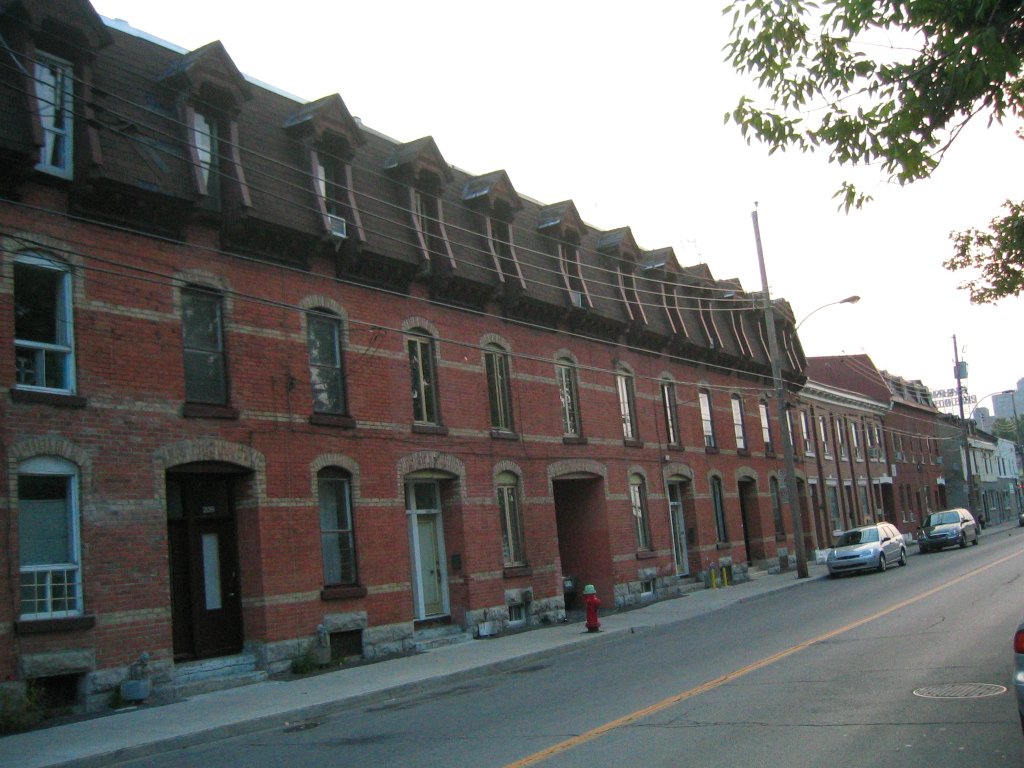
Griffintown is a historic neighbourhood of Montreal, Quebec, southwest of downtown. The area existed as a functional neighbourhood from the 1820s until the 1960s and was mainly populated by Irish immigrants and their descendants. Mostly depopulated since then, the neighbourhood has been undergoing redevelopment since the early 2010s.
Griffintown is the portion of the ward of St. Ann north of the Lachine Canal; the part south of the canal is now part of Pointe-Saint-Charles. This part of the ward was delimited by Notre-Dame Street to the north, the Bonaventure Expressway to the east, and a short segment of the city limit between Notre-Dame Street and the canal west of the St. Gabriel Locks to the west. It was the earliest and largest faubourg annexed to Old Montreal before the introduction of the tram car in the 1840s.
The name Griffintown was derived from Mary Griffin. Griffin illegally obtained the lease to the land from a business associate of Thomas McCord in 1799. She then commissioned land surveyor Louis Charland to subdivide the land and plan streets for the area in 1804. Griffin's husband, Robert, owned a soap factory in the area and went on to become the first clerk of the Bank of Montreal upon its formation in 1817.
Griffintown was first populated in the early nineteenth century mostly by Irish immigrant labourers. They worked on the Lachine Canal and in the industries surrounding it, the Victoria Bridge, railways, and the Port of Montreal.
The Irish community was centered on St. Ann's Catholic Church, which opened in 1854 at the corner of McCord (now Mountain Street) and Basin Streets, across from Gallery Square, which was named after the Gallery brothers, John Daniel Gallery, who ran a large and successful bakery and his brother Daniel Gallery who was an alderman of Montreal, Schools commissioner and a Liberal member of parliament.
By the early twentieth century, the Irish were being replaced by Jewish, Italian, Ukrainian, and Francophone communities, with the Irish becoming a minority group by 1941.
The Canadian National Railway elevated tracks approaching Montreal Central Station cut a wide swathe between Dalhousie and Nazareth Streets around 1930.
Post-war economic changes beginning in the 1950s led to the depopulation of "The Griff". The Lachine Canal lost its role as a major transport artery when it was replaced by the Saint Lawrence Seaway in 1959.
Hub AI
Griffintown AI simulator
(@Griffintown_simulator)
Griffintown
Griffintown is a historic neighbourhood of Montreal, Quebec, southwest of downtown. The area existed as a functional neighbourhood from the 1820s until the 1960s and was mainly populated by Irish immigrants and their descendants. Mostly depopulated since then, the neighbourhood has been undergoing redevelopment since the early 2010s.
Griffintown is the portion of the ward of St. Ann north of the Lachine Canal; the part south of the canal is now part of Pointe-Saint-Charles. This part of the ward was delimited by Notre-Dame Street to the north, the Bonaventure Expressway to the east, and a short segment of the city limit between Notre-Dame Street and the canal west of the St. Gabriel Locks to the west. It was the earliest and largest faubourg annexed to Old Montreal before the introduction of the tram car in the 1840s.
The name Griffintown was derived from Mary Griffin. Griffin illegally obtained the lease to the land from a business associate of Thomas McCord in 1799. She then commissioned land surveyor Louis Charland to subdivide the land and plan streets for the area in 1804. Griffin's husband, Robert, owned a soap factory in the area and went on to become the first clerk of the Bank of Montreal upon its formation in 1817.
Griffintown was first populated in the early nineteenth century mostly by Irish immigrant labourers. They worked on the Lachine Canal and in the industries surrounding it, the Victoria Bridge, railways, and the Port of Montreal.
The Irish community was centered on St. Ann's Catholic Church, which opened in 1854 at the corner of McCord (now Mountain Street) and Basin Streets, across from Gallery Square, which was named after the Gallery brothers, John Daniel Gallery, who ran a large and successful bakery and his brother Daniel Gallery who was an alderman of Montreal, Schools commissioner and a Liberal member of parliament.
By the early twentieth century, the Irish were being replaced by Jewish, Italian, Ukrainian, and Francophone communities, with the Irish becoming a minority group by 1941.
The Canadian National Railway elevated tracks approaching Montreal Central Station cut a wide swathe between Dalhousie and Nazareth Streets around 1930.
Post-war economic changes beginning in the 1950s led to the depopulation of "The Griff". The Lachine Canal lost its role as a major transport artery when it was replaced by the Saint Lawrence Seaway in 1959.
Recent media