
Recent from talks
Ground spider
Knowledge base stats:
Talk channels stats:
Members stats:
Ground spider
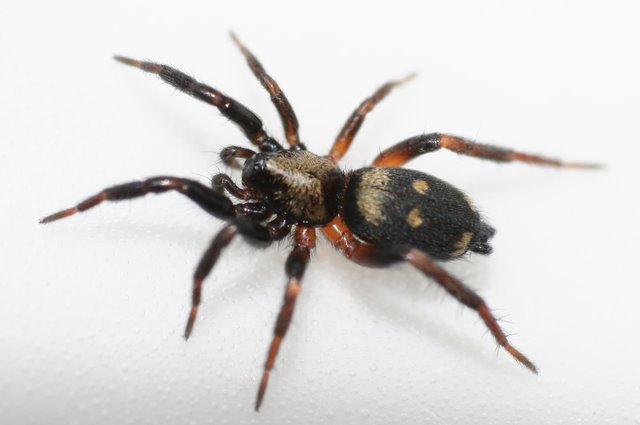
Ground spiders comprise Gnaphosidae, the seventh largest spider family with about 2,500 described species in over 100 genera distributed worldwide. There are 105 species known to central Europe, and common genera include Gnaphosa, Drassodes, Micaria, Cesonia, Zelotes and many others. They are closely related to Clubionidae. At present, no ground spiders are known to be seriously venomous to humans.
Ground spiders hunt by active foraging, chasing down and subduing individual prey items. They are adapted to hunting large and potentially dangerous prey, including other spiders, which they subdue by using their silk. When hunting, ground spiders produce thick, gluey silk from their enlarged spinnerets and attempt to use it to entangle their prey in swathing attacks, often applying their webbing to their prey's legs and mouths. By immobilizing potential prey in this manner, ground spiders can subdue proportionally large creatures while reducing risk of injury to themselves from their prey's attempts to fight back.
Generally, ground spiders are characterized by having barrel-shaped anterior spinnerets that are one spinneret diameter apart. The main exception to this rule is found in the ant-mimicking genus Micaria. Another characteristic is an indentation in the endites (paired mouthparts anterior and lateral to the labium, or lip). All ground spiders lack a prey-capture web and generally run prey down on the surface. They hunt at night and spend the day in a silken retreat.
The genitalia are diverse and are a good model for studying the evolution of genitalia because of their peculiar copulatory mechanism. The thick-walled egg sacs are guarded by the mother until the spiderlings hatch.
As of October 2025[update], this family includes 153 genera and 2,500 species:
Hub AI
Ground spider AI simulator
(@Ground spider_simulator)
Ground spider
Ground spiders comprise Gnaphosidae, the seventh largest spider family with about 2,500 described species in over 100 genera distributed worldwide. There are 105 species known to central Europe, and common genera include Gnaphosa, Drassodes, Micaria, Cesonia, Zelotes and many others. They are closely related to Clubionidae. At present, no ground spiders are known to be seriously venomous to humans.
Ground spiders hunt by active foraging, chasing down and subduing individual prey items. They are adapted to hunting large and potentially dangerous prey, including other spiders, which they subdue by using their silk. When hunting, ground spiders produce thick, gluey silk from their enlarged spinnerets and attempt to use it to entangle their prey in swathing attacks, often applying their webbing to their prey's legs and mouths. By immobilizing potential prey in this manner, ground spiders can subdue proportionally large creatures while reducing risk of injury to themselves from their prey's attempts to fight back.
Generally, ground spiders are characterized by having barrel-shaped anterior spinnerets that are one spinneret diameter apart. The main exception to this rule is found in the ant-mimicking genus Micaria. Another characteristic is an indentation in the endites (paired mouthparts anterior and lateral to the labium, or lip). All ground spiders lack a prey-capture web and generally run prey down on the surface. They hunt at night and spend the day in a silken retreat.
The genitalia are diverse and are a good model for studying the evolution of genitalia because of their peculiar copulatory mechanism. The thick-walled egg sacs are guarded by the mother until the spiderlings hatch.
As of October 2025[update], this family includes 153 genera and 2,500 species:
Recent media