



Community hub
Recent from talks
Knowledge base stats:
Talk channels stats:
Members stats:
Grover Shoe Factory disaster
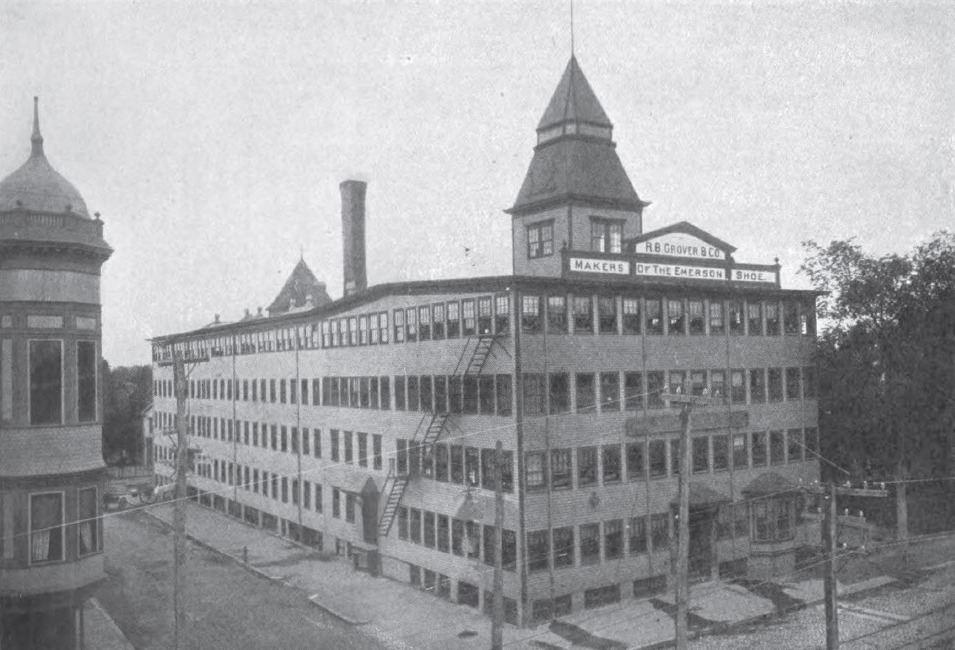
The Grover Shoe Factory disaster was an industrial explosion, building collapse and fire that killed 58 people and injured 150 when it leveled the R. B. Grover shoe factory in Brockton, Massachusetts on March 20, 1905. Following a boiler explosion, the four-story wooden building collapsed and the ruins burst into flames, incinerating workers trapped in the wreckage.
The Grover disaster brought new attention to industrial safety and led to stringent safety laws and a national code governing the safe operation of steam boilers.
The R. B. Grover shoe factory was one of a number of shoe factories in Brockton, a town that had 35,000 shoe workers. The wooden building, shaped like a letter E, occupied half a city block at the corner of Main and Calmar Streets. Grover made the popular Emerson brand shoe, and business had been good enough to add a fourth floor.
The factory was heated using steam radiators, with the steam being produced by coal-fired steel boilers installed in a brick boiler house attached to the wooden factory as the crossbar of the E. When the fourth floor was added, the original boiler was replaced by a larger one and the old boiler, 17 feet (5.2 m) long and six feet (1.8 m) in diameter, was left in place as a backup. Since the new boiler could generally meet the factory's demands on its own, the old one was seldom used; and when used, was used reluctantly. Grover's chief engineer David Rockwell, who had a first-class engineer's license and twelve years experience, did not trust it.
The new boiler had to be flushed out as part of its regular maintenance, so Rockwell had put the old boiler back into service temporarily. Early that cold damp Monday, he fed its coal fire and put the boiler to work heating the building for arriving day-shift workers. At 7:45 a.m. the plant manager telephoned Rockwell to ask about some strange noises coming from the radiators along one wall. Rockwell had just stepped out of the building, but his assistant assured the manager that everything was in order.
A few minutes later, the old boiler exploded, rocketing up through three floors and the roof.
The flying boiler knocked over an elevated water tower at one end of the building and its full tank smashed through the roof, causing that end of the building to immediately collapse, with the floors pancaking and the walls falling in on top of them.
Many workers who survived the initial explosion and collapse were trapped by broken beams and heavy machinery. Burning coals thrown from the boiler's fire pit landed throughout the debris, starting fires that were fed by broken gas lines. The factory's more than 300 windows, now blown out, created a chimney effect in the parts of the factory still standing, resulting in a fire hot enough to melt iron pipes and radiators. The wooden floors, treated nightly with linseed oil to keep the dust down, burned quickly. High winds helped spread the fire to nearby storage sheds and neighboring buildings including a hardware store and a rooming house.
Hub AI
Grover Shoe Factory disaster AI simulator
(@Grover Shoe Factory disaster_simulator)
Grover Shoe Factory disaster
The Grover Shoe Factory disaster was an industrial explosion, building collapse and fire that killed 58 people and injured 150 when it leveled the R. B. Grover shoe factory in Brockton, Massachusetts on March 20, 1905. Following a boiler explosion, the four-story wooden building collapsed and the ruins burst into flames, incinerating workers trapped in the wreckage.
The Grover disaster brought new attention to industrial safety and led to stringent safety laws and a national code governing the safe operation of steam boilers.
The R. B. Grover shoe factory was one of a number of shoe factories in Brockton, a town that had 35,000 shoe workers. The wooden building, shaped like a letter E, occupied half a city block at the corner of Main and Calmar Streets. Grover made the popular Emerson brand shoe, and business had been good enough to add a fourth floor.
The factory was heated using steam radiators, with the steam being produced by coal-fired steel boilers installed in a brick boiler house attached to the wooden factory as the crossbar of the E. When the fourth floor was added, the original boiler was replaced by a larger one and the old boiler, 17 feet (5.2 m) long and six feet (1.8 m) in diameter, was left in place as a backup. Since the new boiler could generally meet the factory's demands on its own, the old one was seldom used; and when used, was used reluctantly. Grover's chief engineer David Rockwell, who had a first-class engineer's license and twelve years experience, did not trust it.
The new boiler had to be flushed out as part of its regular maintenance, so Rockwell had put the old boiler back into service temporarily. Early that cold damp Monday, he fed its coal fire and put the boiler to work heating the building for arriving day-shift workers. At 7:45 a.m. the plant manager telephoned Rockwell to ask about some strange noises coming from the radiators along one wall. Rockwell had just stepped out of the building, but his assistant assured the manager that everything was in order.
A few minutes later, the old boiler exploded, rocketing up through three floors and the roof.
The flying boiler knocked over an elevated water tower at one end of the building and its full tank smashed through the roof, causing that end of the building to immediately collapse, with the floors pancaking and the walls falling in on top of them.
Many workers who survived the initial explosion and collapse were trapped by broken beams and heavy machinery. Burning coals thrown from the boiler's fire pit landed throughout the debris, starting fires that were fed by broken gas lines. The factory's more than 300 windows, now blown out, created a chimney effect in the parts of the factory still standing, resulting in a fire hot enough to melt iron pipes and radiators. The wooden floors, treated nightly with linseed oil to keep the dust down, burned quickly. High winds helped spread the fire to nearby storage sheds and neighboring buildings including a hardware store and a rooming house.