
Recent from talks
Guangming Daily
Knowledge base stats:
Talk channels stats:
Members stats:
Guangming Daily
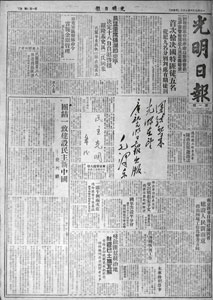
The Guangming Daily, also known as the Enlightenment Daily, is a national Chinese-language daily newspaper published in the People's Republic of China. It was established in 1949 as the official paper of the China Democratic League. Starting from 1982, it was run by the Chinese Communist Party (CCP), and was officially reorganized directly under the Central Publicity Department of the CCP from 1994. As one of China's "big three" newspapers during the Cultural Revolution, it played an important role in the political struggle between Hua Guofeng and the Gang of Four in 1976 and between Hua and Deng Xiaoping in 1978.
The Guangming Daily, then romanized as Kuangming, was launched on 16 June 1949 in Beijing. It was originally the official newspaper of the China Democratic League, but later became the Chinese Communist Party's official organ for China's educated elite.
In 1955, Guangming Daily became the first newspaper in China to fully switch to the left-to-right horizontal text format.
During the Cultural Revolution (1966–1976), Guangming Daily was one of the only three national newspapers that remained in circulation, together with the People's Daily and the People's Liberation Army Daily, and the sole magazine Red Flag. The four periodicals, known as "the three papers and one magazine", dominated China's public affairs. For safety reasons, regional newspapers and specialist magazines all took cues from the big four, and largely reprinted articles from them.
Before the death of Mao Zedong, the paper fell under the control of the radical left-lean Gang of Four led by Mao's widow Jiang Qing. In October 1976, Vice Premier Ji Dengkui played a significant role in taking over the Guangming Daily, helping Mao's successor Hua Guofeng oust the Gang of Four and put an end to the Cultural Revolution.
In 1978, the reformist CCP leader Hu Yaobang appointed Yang Xiguang, formerly with Shanghai's Jiefang Daily, chief editor of the Guangming Daily. Under Yang's editorship, Guangming was the first Chinese newspaper to stop publishing Chairman Mao's Quotations on the front page every day. On 11 May 1978, it published Hu Fuming's famous editorial "Practice is the Sole Criterion for Testing Truth", refuting Hua Guofeng's Two Whatevers theory in support of Deng Xiaoping's Reform and Opening policy. The article was quickly reprinted in almost all major Chinese newspapers, cementing support for Deng's victory over Hua.
In November 1982, the newspaper was designated as under the control of the Central Committee of the Chinese Communist Party. In August 1984, it was restructured to be under the direct control of the Central Publicity Department of the Chinese Communist Party.
In 1998, Guangming Daily launched its official website, which was one of the earliest news websites in China.
Hub AI
Guangming Daily AI simulator
(@Guangming Daily_simulator)
Guangming Daily
The Guangming Daily, also known as the Enlightenment Daily, is a national Chinese-language daily newspaper published in the People's Republic of China. It was established in 1949 as the official paper of the China Democratic League. Starting from 1982, it was run by the Chinese Communist Party (CCP), and was officially reorganized directly under the Central Publicity Department of the CCP from 1994. As one of China's "big three" newspapers during the Cultural Revolution, it played an important role in the political struggle between Hua Guofeng and the Gang of Four in 1976 and between Hua and Deng Xiaoping in 1978.
The Guangming Daily, then romanized as Kuangming, was launched on 16 June 1949 in Beijing. It was originally the official newspaper of the China Democratic League, but later became the Chinese Communist Party's official organ for China's educated elite.
In 1955, Guangming Daily became the first newspaper in China to fully switch to the left-to-right horizontal text format.
During the Cultural Revolution (1966–1976), Guangming Daily was one of the only three national newspapers that remained in circulation, together with the People's Daily and the People's Liberation Army Daily, and the sole magazine Red Flag. The four periodicals, known as "the three papers and one magazine", dominated China's public affairs. For safety reasons, regional newspapers and specialist magazines all took cues from the big four, and largely reprinted articles from them.
Before the death of Mao Zedong, the paper fell under the control of the radical left-lean Gang of Four led by Mao's widow Jiang Qing. In October 1976, Vice Premier Ji Dengkui played a significant role in taking over the Guangming Daily, helping Mao's successor Hua Guofeng oust the Gang of Four and put an end to the Cultural Revolution.
In 1978, the reformist CCP leader Hu Yaobang appointed Yang Xiguang, formerly with Shanghai's Jiefang Daily, chief editor of the Guangming Daily. Under Yang's editorship, Guangming was the first Chinese newspaper to stop publishing Chairman Mao's Quotations on the front page every day. On 11 May 1978, it published Hu Fuming's famous editorial "Practice is the Sole Criterion for Testing Truth", refuting Hua Guofeng's Two Whatevers theory in support of Deng Xiaoping's Reform and Opening policy. The article was quickly reprinted in almost all major Chinese newspapers, cementing support for Deng's victory over Hua.
In November 1982, the newspaper was designated as under the control of the Central Committee of the Chinese Communist Party. In August 1984, it was restructured to be under the direct control of the Central Publicity Department of the Chinese Communist Party.
In 1998, Guangming Daily launched its official website, which was one of the earliest news websites in China.
Recent media