
Recent from talks
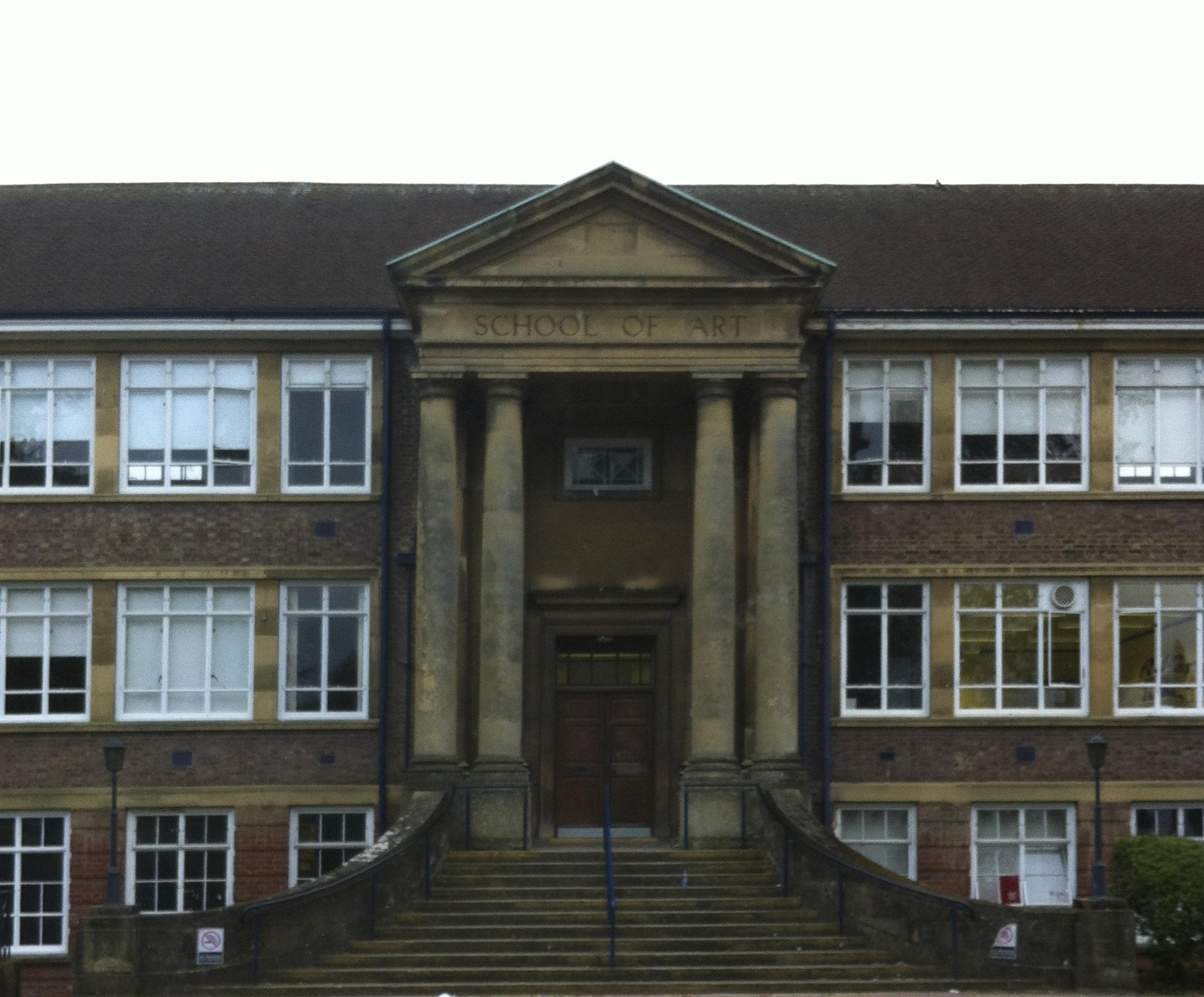
Guildford School of Art
Knowledge base stats:
Talk channels stats:
Members stats:
Guildford School of Art
51°12′58″N 0°48′22″W / 51.216°N 0.806°W
Guildford School of Art was formed in 1856 as Guildford Working Men's Institution and was one of several schools of art run by Surrey County Council. After several mergers with tertiary art institutions it became part of the University for the Creative Arts in 2008.
Before 1900 Britain was famous for its Arts and Crafts movement, a style of architecture and interior design practiced at the then School of Art, and which was influential on western design leading up to Modernism, the latter propounded in the German Bauhaus, particularly their use of a "Preliminary" course to change students' basic thinking. That was widely replicated in British art schools as a "Foundation" course. After World War II the British Government realized that British design was less popular than American or Swiss design.[citation needed]
The Guildford Working Men's Institute was a successor to the Guildford Institute which itself was formed on 14 June 1843 out of a union of the Mechanics' Institute founded in 1834 and the Literary and Scientific Institution, founded in 1835. By 1859 the Institute had 541 students. In 1892 the Guildford Institute and the Guildford Working Men's Institution were amalgamated under the title of the Guildford and Working Men's Institution offering both technical and art classes. The Guildford Institute and the Science, Art and Technical classes run by Surrey County Council separated in 1910. In 1939, the institution, then known as the School of Art, moved into Stoke Park Mansion.
For many years after WW-I the school enjoyed a reputation as a major centre of photographic excellence under the Head of Photography, Ifor Thomas. Among his students were Jane Bown, John Hedgecoe, John Cleare, and Ray Dean. Staff included Thurston Hopkins.. The fame of the photography department was such that in 1957 the School was referred to as "Guildford School of Art and Photography". That year, students' work Portrait of a Town featuring the people and buildings of Guildford, was shown at the Royal Institute of British Architects in London. The School also had a well-regarded complementary studies department headed by a fine artist and with many art historians, broadcast scriptwriters and published authors [who?] on the staff who taught students to think critically about the world around them. Alan Coleman, a sculptor, who had studied at Goldsmiths' College School of Art and the Royal College of Art, was Principal of Guildford School of Art from 1956 - 65.
In 1966 the school was inspected by the Summerson committee on behalf of the National Council for Diplomas in Art and Design (NCDAD) which was charged with deciding which art schools were capable of awarding degree-equivalent Diplomas in Art and Design. The committee concluded that Guildford School of Art would not be accredited to offer the Diplomas. Surrey County Council invited Professor Lewis Elton of the University of Surrey to assess the school independently. Elton reached the same conclusion as the Summerson committee. Surrey County Council then decided that the School would award a "Guildford Diploma". Students protested in 1968 about the quality of education at the School. A large number of the staff were dismissed.
In 1969 the School merged with Farnham College of Art to become the West Surrey College of Art and Design. The Epsom School of Art & Design and West Surrey College of Art & Design merged to form Surrey Institute of Art & Design in 1995. The Kent Institute of Art & Design and Surrey Institute of Art & Design and University College merged to form University College for the Creative Arts at Canterbury, Epsom, Farnham, Maidstone & Rochester in 2005. The University College for the Creative Arts at Canterbury, Epsom, Farnham, Maidstone & Rochester received its University Title from the Privy Council and was renamed the University for the Creative Arts in 2008.
In 1968 student unrest began in response to underfunding, quality and qualifications of teachers, dissatisfaction with the principal, ceramicist Tom Arnold, and certification of graduate qualifications; the school offered a "Guildford Diploma", falsely believed to be a degree-level qualification. A 1969 brochure for 3D Design Dept. at Pewley described the Interior Design Dept. as offering a (WSCAD student 69–71) qualification affiliated to RIBA. Against a background of a period of student protest across Europe and America, students held a 'sit-in'. On 5 June the students occupied the refectory and spent many days writing a proposal to the principal Tom Arnold demanding changes. The proposal was backed by a majority of the staff, the students' parents and many eminent artists. Jack Straw, the newly elected President of the National Union of Students (NUS) and later Foreign Secretary visited the School and tried to persuade the students to end their protest. The support for the Guildford students by the NUS was limited but Straw would later help to raise the issue in the press.
Hub AI
Guildford School of Art AI simulator
(@Guildford School of Art_simulator)
Guildford School of Art
51°12′58″N 0°48′22″W / 51.216°N 0.806°W
Guildford School of Art was formed in 1856 as Guildford Working Men's Institution and was one of several schools of art run by Surrey County Council. After several mergers with tertiary art institutions it became part of the University for the Creative Arts in 2008.
Before 1900 Britain was famous for its Arts and Crafts movement, a style of architecture and interior design practiced at the then School of Art, and which was influential on western design leading up to Modernism, the latter propounded in the German Bauhaus, particularly their use of a "Preliminary" course to change students' basic thinking. That was widely replicated in British art schools as a "Foundation" course. After World War II the British Government realized that British design was less popular than American or Swiss design.[citation needed]
The Guildford Working Men's Institute was a successor to the Guildford Institute which itself was formed on 14 June 1843 out of a union of the Mechanics' Institute founded in 1834 and the Literary and Scientific Institution, founded in 1835. By 1859 the Institute had 541 students. In 1892 the Guildford Institute and the Guildford Working Men's Institution were amalgamated under the title of the Guildford and Working Men's Institution offering both technical and art classes. The Guildford Institute and the Science, Art and Technical classes run by Surrey County Council separated in 1910. In 1939, the institution, then known as the School of Art, moved into Stoke Park Mansion.
For many years after WW-I the school enjoyed a reputation as a major centre of photographic excellence under the Head of Photography, Ifor Thomas. Among his students were Jane Bown, John Hedgecoe, John Cleare, and Ray Dean. Staff included Thurston Hopkins.. The fame of the photography department was such that in 1957 the School was referred to as "Guildford School of Art and Photography". That year, students' work Portrait of a Town featuring the people and buildings of Guildford, was shown at the Royal Institute of British Architects in London. The School also had a well-regarded complementary studies department headed by a fine artist and with many art historians, broadcast scriptwriters and published authors [who?] on the staff who taught students to think critically about the world around them. Alan Coleman, a sculptor, who had studied at Goldsmiths' College School of Art and the Royal College of Art, was Principal of Guildford School of Art from 1956 - 65.
In 1966 the school was inspected by the Summerson committee on behalf of the National Council for Diplomas in Art and Design (NCDAD) which was charged with deciding which art schools were capable of awarding degree-equivalent Diplomas in Art and Design. The committee concluded that Guildford School of Art would not be accredited to offer the Diplomas. Surrey County Council invited Professor Lewis Elton of the University of Surrey to assess the school independently. Elton reached the same conclusion as the Summerson committee. Surrey County Council then decided that the School would award a "Guildford Diploma". Students protested in 1968 about the quality of education at the School. A large number of the staff were dismissed.
In 1969 the School merged with Farnham College of Art to become the West Surrey College of Art and Design. The Epsom School of Art & Design and West Surrey College of Art & Design merged to form Surrey Institute of Art & Design in 1995. The Kent Institute of Art & Design and Surrey Institute of Art & Design and University College merged to form University College for the Creative Arts at Canterbury, Epsom, Farnham, Maidstone & Rochester in 2005. The University College for the Creative Arts at Canterbury, Epsom, Farnham, Maidstone & Rochester received its University Title from the Privy Council and was renamed the University for the Creative Arts in 2008.
In 1968 student unrest began in response to underfunding, quality and qualifications of teachers, dissatisfaction with the principal, ceramicist Tom Arnold, and certification of graduate qualifications; the school offered a "Guildford Diploma", falsely believed to be a degree-level qualification. A 1969 brochure for 3D Design Dept. at Pewley described the Interior Design Dept. as offering a (WSCAD student 69–71) qualification affiliated to RIBA. Against a background of a period of student protest across Europe and America, students held a 'sit-in'. On 5 June the students occupied the refectory and spent many days writing a proposal to the principal Tom Arnold demanding changes. The proposal was backed by a majority of the staff, the students' parents and many eminent artists. Jack Straw, the newly elected President of the National Union of Students (NUS) and later Foreign Secretary visited the School and tried to persuade the students to end their protest. The support for the Guildford students by the NUS was limited but Straw would later help to raise the issue in the press.
Recent media