
Recent from talks
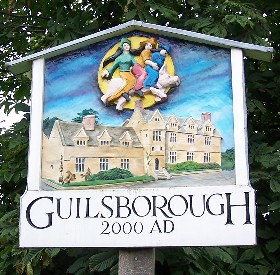
Guilsborough
Knowledge base stats:
Talk channels stats:
Members stats:
Guilsborough
Guilsborough is a village and civil parish in West Northamptonshire in England. At the time of the 2001 census, the parish's population was 882 people, reducing to 692 at the 2011 Census.
It is at the centre of an area of rural villages between the towns of Northampton, Daventry, Rugby and Market Harborough. There is a secondary school, primary school, fire station, pub, a new village shop including a Post Office (formerly the doctor's surgery) and a new doctor's surgery with pharmacy and a Hairdressers.
The villages name means 'Gyldi's fortification'. The hundred is named after Guilsborough, but the site of the meeting-place is unknown.
Guilsborough is made up of two hamlets, now joined. Guilsborough (Guildesburgh) and Nortoft. The former referring to the Roman fort, or referencing the earlier Late Bronze Age/Iron Age Enclosure on the same site. Possibility of the name deriving from a later Anglo-Saxon base word 'gebeorgan' (enclosure to save/protect/preserve) given there was an Anglo Saxon settlement over the Late Bronze Age/Iron Age followed by Roman, and the Anglo-Saxon fortified enclosures. The Church Mount road housing stands where Guilsborough Hall once stood. The mound under the water tower in the grounds of the historic Guilsborough Park is part of a Late Bronze Age or Early Iron Age enclosure (RCHME 1981) being fifth century BC to first century BC with later Roman occupation. Subsequent excavation cites evidence of there being a strongly defended univallate fort of late first Millennium BC. Other remains of the enclosure (northern ramparts) still exist in paddocks to the north-east and east of the mound Potential Iron Age iron production site. Whilst most of the southern rampart was destroyed in 1947 and possibly during an earlier episode, some remnants may exist. The Roman fort was an outpost of the settlement at West Haddon and the Guilsborough encampment is believed to have been the work of Publius Ostorius Scapula, under the reign of Claudius. When the south rampart was removed in the 19th century, many skeletons were found. The whole site is a Scheduled Ancient Monument (in process – Northamptonshire Sites and Monument Records). The Guilsborough Park landscape related to the former Guilsborough Hall. Various significant trees and tree groups remain (with TPO's) and other important landscape features include the brick water tower of the hall and the hall gates.
In the fields east of Guilsborough and both north and south of the West Haddon Road (just east of the 'PCS' access road) lie recorded prehistoric and Iron Age remains. A Saxon settlement also seems likely to have been located along the brook by the gated road (east–west across Cold Ashby Road; obvious landforms can be seen immediately west of the old mill and stables).
In the two fields below Nortoft (Danish/Norse: Toft is a place and/or house or farm or clearing; Nor- may mean to the north (of what?)) at the spring line below the Ironstone, on both sides of the road, lie the remains of a Saxon fishponds complex with associated village lying at the top of the fish ponds. The outlines of ponds are visible, along with house platforms and the remnants of a track (East West) are still visible. They would have been fed by water from the spring line. Spring based water course still flow on both sides of Nortoft. The ponds in the private gardens of Manor House, and the existing fish pond (since enlarged) may have had their origins as Saxon ponds. Local knowledge suggest that the village burnt down, but as yet there is not collaborative evidence. Nortoft Cottage, which has a very old cob cottage at its heart, is thought to be the only remaining building of the original Nortoft, so might have its origins as part of the Saxon settlement.
A cell of Premonstratensian canons was founded at Kalendar or Kayland (on the border of Guilsborough and Cottesbrooke Parishes near Nortoft), probably soon after Sulby Abbey (c. 1155), and as it does not appear in the taxation of 1291, had probably ceased by then. The Kayland meadow held a cell of Premonstratension canons. Large foundation stones have been dug up and the cell appears to have been moated (English Heritage Pastscapes 341939) and possible fishponds.
On 22 July 1612, four women and one man were hanged at Abington Gallows in Northampton for the crime of witchcraft, also known as the Northamptonshire Witch Trials. Of those five, Agnes Brown and her daughter Ioane/Joan Vaughan (or Varnham) were from Guilsborough. They stood accused of bewitching a local noblewoman, Elizabeth Belcher (née Fisher) and her brother-in-law Master Avery and of killing, by sorcery, a child and numerous livestock.
Hub AI
Guilsborough AI simulator
(@Guilsborough_simulator)
Guilsborough
Guilsborough is a village and civil parish in West Northamptonshire in England. At the time of the 2001 census, the parish's population was 882 people, reducing to 692 at the 2011 Census.
It is at the centre of an area of rural villages between the towns of Northampton, Daventry, Rugby and Market Harborough. There is a secondary school, primary school, fire station, pub, a new village shop including a Post Office (formerly the doctor's surgery) and a new doctor's surgery with pharmacy and a Hairdressers.
The villages name means 'Gyldi's fortification'. The hundred is named after Guilsborough, but the site of the meeting-place is unknown.
Guilsborough is made up of two hamlets, now joined. Guilsborough (Guildesburgh) and Nortoft. The former referring to the Roman fort, or referencing the earlier Late Bronze Age/Iron Age Enclosure on the same site. Possibility of the name deriving from a later Anglo-Saxon base word 'gebeorgan' (enclosure to save/protect/preserve) given there was an Anglo Saxon settlement over the Late Bronze Age/Iron Age followed by Roman, and the Anglo-Saxon fortified enclosures. The Church Mount road housing stands where Guilsborough Hall once stood. The mound under the water tower in the grounds of the historic Guilsborough Park is part of a Late Bronze Age or Early Iron Age enclosure (RCHME 1981) being fifth century BC to first century BC with later Roman occupation. Subsequent excavation cites evidence of there being a strongly defended univallate fort of late first Millennium BC. Other remains of the enclosure (northern ramparts) still exist in paddocks to the north-east and east of the mound Potential Iron Age iron production site. Whilst most of the southern rampart was destroyed in 1947 and possibly during an earlier episode, some remnants may exist. The Roman fort was an outpost of the settlement at West Haddon and the Guilsborough encampment is believed to have been the work of Publius Ostorius Scapula, under the reign of Claudius. When the south rampart was removed in the 19th century, many skeletons were found. The whole site is a Scheduled Ancient Monument (in process – Northamptonshire Sites and Monument Records). The Guilsborough Park landscape related to the former Guilsborough Hall. Various significant trees and tree groups remain (with TPO's) and other important landscape features include the brick water tower of the hall and the hall gates.
In the fields east of Guilsborough and both north and south of the West Haddon Road (just east of the 'PCS' access road) lie recorded prehistoric and Iron Age remains. A Saxon settlement also seems likely to have been located along the brook by the gated road (east–west across Cold Ashby Road; obvious landforms can be seen immediately west of the old mill and stables).
In the two fields below Nortoft (Danish/Norse: Toft is a place and/or house or farm or clearing; Nor- may mean to the north (of what?)) at the spring line below the Ironstone, on both sides of the road, lie the remains of a Saxon fishponds complex with associated village lying at the top of the fish ponds. The outlines of ponds are visible, along with house platforms and the remnants of a track (East West) are still visible. They would have been fed by water from the spring line. Spring based water course still flow on both sides of Nortoft. The ponds in the private gardens of Manor House, and the existing fish pond (since enlarged) may have had their origins as Saxon ponds. Local knowledge suggest that the village burnt down, but as yet there is not collaborative evidence. Nortoft Cottage, which has a very old cob cottage at its heart, is thought to be the only remaining building of the original Nortoft, so might have its origins as part of the Saxon settlement.
A cell of Premonstratensian canons was founded at Kalendar or Kayland (on the border of Guilsborough and Cottesbrooke Parishes near Nortoft), probably soon after Sulby Abbey (c. 1155), and as it does not appear in the taxation of 1291, had probably ceased by then. The Kayland meadow held a cell of Premonstratension canons. Large foundation stones have been dug up and the cell appears to have been moated (English Heritage Pastscapes 341939) and possible fishponds.
On 22 July 1612, four women and one man were hanged at Abington Gallows in Northampton for the crime of witchcraft, also known as the Northamptonshire Witch Trials. Of those five, Agnes Brown and her daughter Ioane/Joan Vaughan (or Varnham) were from Guilsborough. They stood accused of bewitching a local noblewoman, Elizabeth Belcher (née Fisher) and her brother-in-law Master Avery and of killing, by sorcery, a child and numerous livestock.
Recent media