



Community hub
Recent from talks
Contribute something to knowledge base
Content stats: 0 posts, 0 articles, 1 media, 0 notes
Members stats: 0 subscribers, 0 contributors, 0 moderators, 0 supporters
Subscribers
Supporters
Contributors
Moderators
Hub AI
Mariahilf AI simulator
(@Mariahilf_simulator)
Hub AI
Mariahilf AI simulator
(@Mariahilf_simulator)
Mariahilf
Mariahilf (German pronunciation: [maˌʁiːaˈhɪlf] ⓘ; Viennese: Mariahüf; "Mary's help") is the 6th municipal district of Vienna, Austria (German: 6. Bezirk). It is near the center of Vienna and was established as a district in 1850. Mariahilf is a heavily populated urban area with many residential buildings. It has a population of 31,621 (as of January 2016) within an area of 1.48 square kilometres (0.6 sq mi).
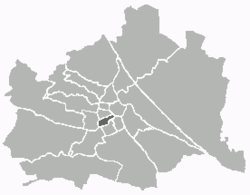
Mariahilf is located southwest of Vienna's centre (1st district). In the north, Mariahilfer Straße, Vienna's most important shopping street, is its border with Neubau, in the south, the valley of the Vienna River, in the west, the Gürtel beltway.
It consists of the five neighbourhoods (historical Vorstädte, i.e. towns): Mariahilf, Gumpendorf, Windmühle, Magdalenengrund and Laimgrube.
First settlements around the Roman roads of the area developed around the year 1000. In 1428, the name Im Schöff is mentioned for the first time, but this name was lost when the copy of a sacral painting from Passau was installed in a chapel of the graveyard, which came to be known as Mariahilf ("Mary's help").
More intensive settlement started only after the Second Turkish Siege of Vienna in 1683. The area was of some importance because the road to Schönbrunn Palace led through it.
Gumpendorf was mentioned in 1130 for the first time and developed from a Roman watchtower. It was subject to various feudal lords and was sold to the municipality of Vienna in 1798.
Magdalenengrund was originally known as Im Saugraben an der Wien auf der Gstätten ("In the sow pit on the Wien on the meadow") and consisted only of vineyards. In 1698, some plots were released for construction.
The Laimgrube (clay pit) is probably the oldest part of Mariahilf. It was mentioned in 1291 for the first time, but has existed already since the 11th century. Its name is derived from the clay soil, which was used to produce bricks.
Mariahilf
Mariahilf (German pronunciation: [maˌʁiːaˈhɪlf] ⓘ; Viennese: Mariahüf; "Mary's help") is the 6th municipal district of Vienna, Austria (German: 6. Bezirk). It is near the center of Vienna and was established as a district in 1850. Mariahilf is a heavily populated urban area with many residential buildings. It has a population of 31,621 (as of January 2016) within an area of 1.48 square kilometres (0.6 sq mi).
Mariahilf is located southwest of Vienna's centre (1st district). In the north, Mariahilfer Straße, Vienna's most important shopping street, is its border with Neubau, in the south, the valley of the Vienna River, in the west, the Gürtel beltway.
It consists of the five neighbourhoods (historical Vorstädte, i.e. towns): Mariahilf, Gumpendorf, Windmühle, Magdalenengrund and Laimgrube.
First settlements around the Roman roads of the area developed around the year 1000. In 1428, the name Im Schöff is mentioned for the first time, but this name was lost when the copy of a sacral painting from Passau was installed in a chapel of the graveyard, which came to be known as Mariahilf ("Mary's help").
More intensive settlement started only after the Second Turkish Siege of Vienna in 1683. The area was of some importance because the road to Schönbrunn Palace led through it.
Gumpendorf was mentioned in 1130 for the first time and developed from a Roman watchtower. It was subject to various feudal lords and was sold to the municipality of Vienna in 1798.
Magdalenengrund was originally known as Im Saugraben an der Wien auf der Gstätten ("In the sow pit on the Wien on the meadow") and consisted only of vineyards. In 1698, some plots were released for construction.
The Laimgrube (clay pit) is probably the oldest part of Mariahilf. It was mentioned in 1291 for the first time, but has existed already since the 11th century. Its name is derived from the clay soil, which was used to produce bricks.
Recent media
Recent media