
Recent from talks
Gusans
Knowledge base stats:
Talk channels stats:
Members stats:
Gusans
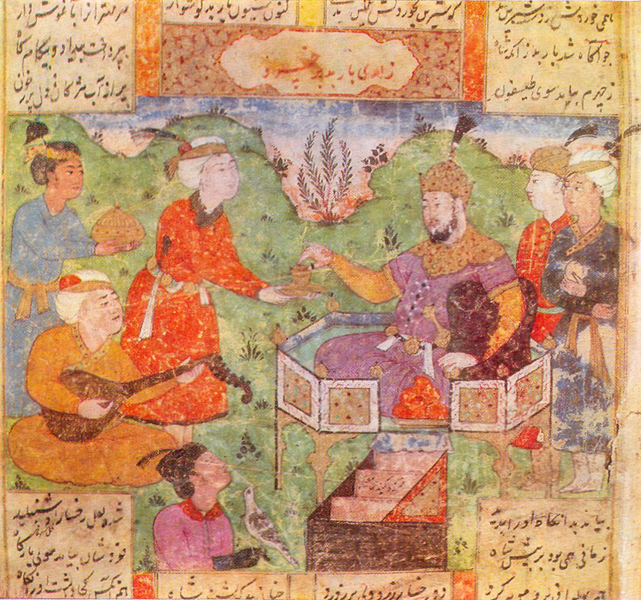
Gusans (Armenian: գուսան, from Parthian gōsān) were singers, instrumentalists, dancers, storytellers, and professional folk actors in Parthia and ancient and medieval Armenia.
In Armenia, the term gusan is often used as a synonym for ashugh, a later type of singer-poet and bard.
The word gusan appears in the earliest Armenian written works, such as the Armenian translation of the Bible (5th century AD). The earliest known use of the word in the Persian language is in the 11th-century poem Vis o Ramin by Fakhruddin As'ad Gurgani. There, it is spelled kūsān and was originally thought to have been a personal name. However, in the 19th century Kerovbe Patkanian identified it as a common word possibly meaning 'musician' and suggested that it was an obsolete Persian term deriving from the same source as Armenian gusan, a loanword. In 1934, Harold W. Bailey identified the word as Parthian in origin. In Hrachia Acharian's opinion, the word was borrowed into Parthian from Armenian govasan 'praiser', then borrowed back into Armenian as gusan. The word is attested in Manichaean Parthian as gwsʾn. Garnik Asatrian suggests that Parthian gōsān derives from earlier *gōβ(a)sān (possibly the source of Armenian govasan), contracted from *gōβ(a)sāhan 'praise-sayer, panegyrist', from Old Iranian *gauba-sāhana-.
The origin of Armenian religious and secular songs and their instrumental counterparts takes place in time immemorial. Songs arise from various expressions of Armenian folk art such as rituals, religious practices and mythological performances in the form of music, poetry, dance and theatre. Performers of these forms of expression, gradually honing their skills and developing theoretical aspects, have created a performing tradition. In ancient Armenia, musicians that were referred to as "vipasans”(storytellers) appeared in historical sources as early as the first millennium BC. Vipasans raised the art of secular song and music to a new level. Over time, the vipasans were replaced by "govasans" which later became known as "gusans.” The art of the latter is one of the most important manifestations of medieval Armenian culture, which left indelible traces in the consciousness and spiritual life of people. Gusans, cultivating this particular art form, created monumental works in both lyric and epic genres, thus enriching both national and international cultural heritage (such examples are the heroic epic “David of Sasun” and a series of lyric poems -hairens)
In the early Middle Ages the word gusan was used as an equivalent to the classical Greek word mimos (mime). There were 2 groups of gousans:
1. the first were from aristocratic dynasties (feudal lords) and performed as professional musicians.
2. the second group comprised popular, but illiterate gusans.
Gusans wore long hair, combed up in a cone so that the hairstyle resembled the "tail" of a comet. This hairstyle was supported by a "gisakal" placed under it, which was the prototype of "onkos" - a triangle placed under the wig of ancient tragedians.
Hub AI
Gusans AI simulator
(@Gusans_simulator)
Gusans
Gusans (Armenian: գուսան, from Parthian gōsān) were singers, instrumentalists, dancers, storytellers, and professional folk actors in Parthia and ancient and medieval Armenia.
In Armenia, the term gusan is often used as a synonym for ashugh, a later type of singer-poet and bard.
The word gusan appears in the earliest Armenian written works, such as the Armenian translation of the Bible (5th century AD). The earliest known use of the word in the Persian language is in the 11th-century poem Vis o Ramin by Fakhruddin As'ad Gurgani. There, it is spelled kūsān and was originally thought to have been a personal name. However, in the 19th century Kerovbe Patkanian identified it as a common word possibly meaning 'musician' and suggested that it was an obsolete Persian term deriving from the same source as Armenian gusan, a loanword. In 1934, Harold W. Bailey identified the word as Parthian in origin. In Hrachia Acharian's opinion, the word was borrowed into Parthian from Armenian govasan 'praiser', then borrowed back into Armenian as gusan. The word is attested in Manichaean Parthian as gwsʾn. Garnik Asatrian suggests that Parthian gōsān derives from earlier *gōβ(a)sān (possibly the source of Armenian govasan), contracted from *gōβ(a)sāhan 'praise-sayer, panegyrist', from Old Iranian *gauba-sāhana-.
The origin of Armenian religious and secular songs and their instrumental counterparts takes place in time immemorial. Songs arise from various expressions of Armenian folk art such as rituals, religious practices and mythological performances in the form of music, poetry, dance and theatre. Performers of these forms of expression, gradually honing their skills and developing theoretical aspects, have created a performing tradition. In ancient Armenia, musicians that were referred to as "vipasans”(storytellers) appeared in historical sources as early as the first millennium BC. Vipasans raised the art of secular song and music to a new level. Over time, the vipasans were replaced by "govasans" which later became known as "gusans.” The art of the latter is one of the most important manifestations of medieval Armenian culture, which left indelible traces in the consciousness and spiritual life of people. Gusans, cultivating this particular art form, created monumental works in both lyric and epic genres, thus enriching both national and international cultural heritage (such examples are the heroic epic “David of Sasun” and a series of lyric poems -hairens)
In the early Middle Ages the word gusan was used as an equivalent to the classical Greek word mimos (mime). There were 2 groups of gousans:
1. the first were from aristocratic dynasties (feudal lords) and performed as professional musicians.
2. the second group comprised popular, but illiterate gusans.
Gusans wore long hair, combed up in a cone so that the hairstyle resembled the "tail" of a comet. This hairstyle was supported by a "gisakal" placed under it, which was the prototype of "onkos" - a triangle placed under the wig of ancient tragedians.
Recent media