
Recent from talks
Gyro monorail
Knowledge base stats:
Talk channels stats:
Members stats:
Gyro monorail
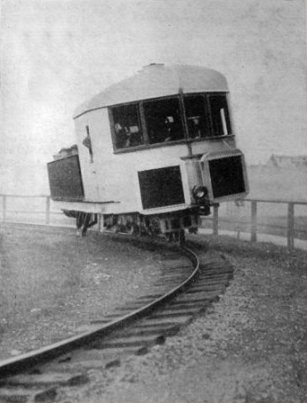
A gyro monorail, gyroscopic monorail, or gyro-stabilized monorail is a single-rail land vehicle that uses the gyroscopic action of one or more spinning wheels to overcome the inherent instability of balancing atop a single rail. For a similar steerable vehicle, see Gyrocar.
The monorail is associated with the names Louis Brennan, August Scherl and Pyotr Shilovsky, who each built full-scale working prototypes during the early part of the twentieth century. A version was developed by Ernest F. Swinney, Harry Ferreira and Louis E. Swinney in the US in 1962.
The gyro monorail was never developed beyond the prototype stage.
The principal advantage of the monorail cited by Shilovsky is the suppression of hunting oscillation, a speed limitation encountered by conventional railways at the time. Also, sharper turns are possible compared to the multi-kilometre radius of turn typical of modern high-speed trains such as the TGV, because the vehicle will bank automatically on bends, like an aircraft, so that no lateral centrifugal acceleration is experienced on board.
A major drawback is that many cars – including passenger and freight cars, not just the locomotive – would require a powered gyroscope to stay upright.
Unlike other means of maintaining balance, such as lateral shifting of the centre of gravity or the use of reaction wheels, the gyroscopic balancing system is statically stable, so that the control system serves only to impart dynamic stability. The active part of the balancing system is therefore more accurately described as a roll damper.
Louis Brennan developed a 22-tonne (22-long-ton; 24-short-ton) (unladen weight) prototype vehicle. Brennan filed his first monorail patent in 1903.
His first demonstration model was just a 30.0-by-11.8-inch (762 by 300 mm) box containing the balancing system. However, this was sufficient for the Army Council to recommend a sum of £10,000 for the development of a full-size vehicle. This was vetoed by their Financial Department. However, the Army found £2,000 from various sources to fund Brennan's work.[citation needed]
Hub AI
Gyro monorail AI simulator
(@Gyro monorail_simulator)
Gyro monorail
A gyro monorail, gyroscopic monorail, or gyro-stabilized monorail is a single-rail land vehicle that uses the gyroscopic action of one or more spinning wheels to overcome the inherent instability of balancing atop a single rail. For a similar steerable vehicle, see Gyrocar.
The monorail is associated with the names Louis Brennan, August Scherl and Pyotr Shilovsky, who each built full-scale working prototypes during the early part of the twentieth century. A version was developed by Ernest F. Swinney, Harry Ferreira and Louis E. Swinney in the US in 1962.
The gyro monorail was never developed beyond the prototype stage.
The principal advantage of the monorail cited by Shilovsky is the suppression of hunting oscillation, a speed limitation encountered by conventional railways at the time. Also, sharper turns are possible compared to the multi-kilometre radius of turn typical of modern high-speed trains such as the TGV, because the vehicle will bank automatically on bends, like an aircraft, so that no lateral centrifugal acceleration is experienced on board.
A major drawback is that many cars – including passenger and freight cars, not just the locomotive – would require a powered gyroscope to stay upright.
Unlike other means of maintaining balance, such as lateral shifting of the centre of gravity or the use of reaction wheels, the gyroscopic balancing system is statically stable, so that the control system serves only to impart dynamic stability. The active part of the balancing system is therefore more accurately described as a roll damper.
Louis Brennan developed a 22-tonne (22-long-ton; 24-short-ton) (unladen weight) prototype vehicle. Brennan filed his first monorail patent in 1903.
His first demonstration model was just a 30.0-by-11.8-inch (762 by 300 mm) box containing the balancing system. However, this was sufficient for the Army Council to recommend a sum of £10,000 for the development of a full-size vehicle. This was vetoed by their Financial Department. However, the Army found £2,000 from various sources to fund Brennan's work.[citation needed]
Recent media