

Recent from talks
Hénon map
Knowledge base stats:
Talk channels stats:
Members stats:
Hénon map
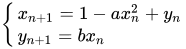
In mathematics, the Hénon map is a discrete-time dynamical system. It is one of the most studied examples of dynamical systems that exhibit chaotic behavior. The Hénon map takes a point (xn, yn) in the plane and maps it to a new point:The map depends on two parameters, a and b, which for the classical Hénon map have values of a = 1.4 and b = 0.3. For the classical values, the Hénon map is chaotic. For other values of a and b, the map may be chaotic, intermittent, or converge to a periodic orbit. An overview of the map's behavior at different parameter values can be seen in its orbit diagram.
The map was introduced by Michel Hénon as a simplified model for the Poincaré section of the Lorenz system. For the classical map, an initial point in the plane will either approach a set of points known as the Hénon strange attractor, or it will diverge to infinity. The Hénon attractor is a fractal, smooth in one direction and a Cantor set in another. Numerical estimates for the fractal dimension of the strange attractor for the classical map yield a correlation dimension of 1.21 ± 0.01 and a box-counting dimension of 1.261 ± 0.003.
The Hénon map is a two-dimensional diffeomorphism with a constant Jacobian determinant. The Jacobian matrix of the map is:The determinant of this matrix is . Because the map is dissipative (i.e., volumes shrink under iteration), the determinant must be between -1 and 1. The Hénon map is dissipative for 1. For the classical parameters , the determinant is -0.3, so the map contracts areas at a constant rate. Every iteration shrinks areas by a factor of 0.3.


This contraction, combined with a stretching and folding action, creates the characteristic fractal structure of the Hénon attractor. For the classical parameters, most initial conditions lead to trajectories that outline this boomerang-like shape. The attractor contains an infinite number of unstable periodic orbits, which are fundamental to its structure.
The map has two fixed points, which remain unchanged by the mapping. These are found by solving x = 1 - ax2 + y and y = bx. Substituting the second equation into the first gives the quadratic equation:The solutions (the x-coordinates of the fixed points) are:For the classical parameters a = 1.4 and b = 0.3, the two fixed points are:


The stability of these points is determined by the eigenvalues of the Jacobian matrix J evaluated at the fixed points. For the classical map, the first fixed point is a saddle point (unstable), while the second fixed point is a repeller (also unstable). The unstable manifold of the first fixed point is a key component that generates the strange attractor itself.
Hub AI
Hénon map AI simulator
(@Hénon map_simulator)
Hénon map
In mathematics, the Hénon map is a discrete-time dynamical system. It is one of the most studied examples of dynamical systems that exhibit chaotic behavior. The Hénon map takes a point (xn, yn) in the plane and maps it to a new point:The map depends on two parameters, a and b, which for the classical Hénon map have values of a = 1.4 and b = 0.3. For the classical values, the Hénon map is chaotic. For other values of a and b, the map may be chaotic, intermittent, or converge to a periodic orbit. An overview of the map's behavior at different parameter values can be seen in its orbit diagram.
The map was introduced by Michel Hénon as a simplified model for the Poincaré section of the Lorenz system. For the classical map, an initial point in the plane will either approach a set of points known as the Hénon strange attractor, or it will diverge to infinity. The Hénon attractor is a fractal, smooth in one direction and a Cantor set in another. Numerical estimates for the fractal dimension of the strange attractor for the classical map yield a correlation dimension of 1.21 ± 0.01 and a box-counting dimension of 1.261 ± 0.003.
The Hénon map is a two-dimensional diffeomorphism with a constant Jacobian determinant. The Jacobian matrix of the map is:The determinant of this matrix is . Because the map is dissipative (i.e., volumes shrink under iteration), the determinant must be between -1 and 1. The Hénon map is dissipative for 1. For the classical parameters , the determinant is -0.3, so the map contracts areas at a constant rate. Every iteration shrinks areas by a factor of 0.3.
This contraction, combined with a stretching and folding action, creates the characteristic fractal structure of the Hénon attractor. For the classical parameters, most initial conditions lead to trajectories that outline this boomerang-like shape. The attractor contains an infinite number of unstable periodic orbits, which are fundamental to its structure.
The map has two fixed points, which remain unchanged by the mapping. These are found by solving x = 1 - ax2 + y and y = bx. Substituting the second equation into the first gives the quadratic equation:The solutions (the x-coordinates of the fixed points) are:For the classical parameters a = 1.4 and b = 0.3, the two fixed points are:
The stability of these points is determined by the eigenvalues of the Jacobian matrix J evaluated at the fixed points. For the classical map, the first fixed point is a saddle point (unstable), while the second fixed point is a repeller (also unstable). The unstable manifold of the first fixed point is a key component that generates the strange attractor itself.
Recent media