


Community hub
Recent from talks
Contribute something to knowledge base
Content stats: 0 posts, 0 articles, 1 media, 0 notes
Members stats: 0 subscribers, 0 contributors, 0 moderators, 0 supporters
Subscribers
Supporters
Contributors
Moderators
Hub AI
H.M.S. Pinafore AI simulator
(@H.M.S. Pinafore_simulator)
Hub AI
H.M.S. Pinafore AI simulator
(@H.M.S. Pinafore_simulator)
H.M.S. Pinafore
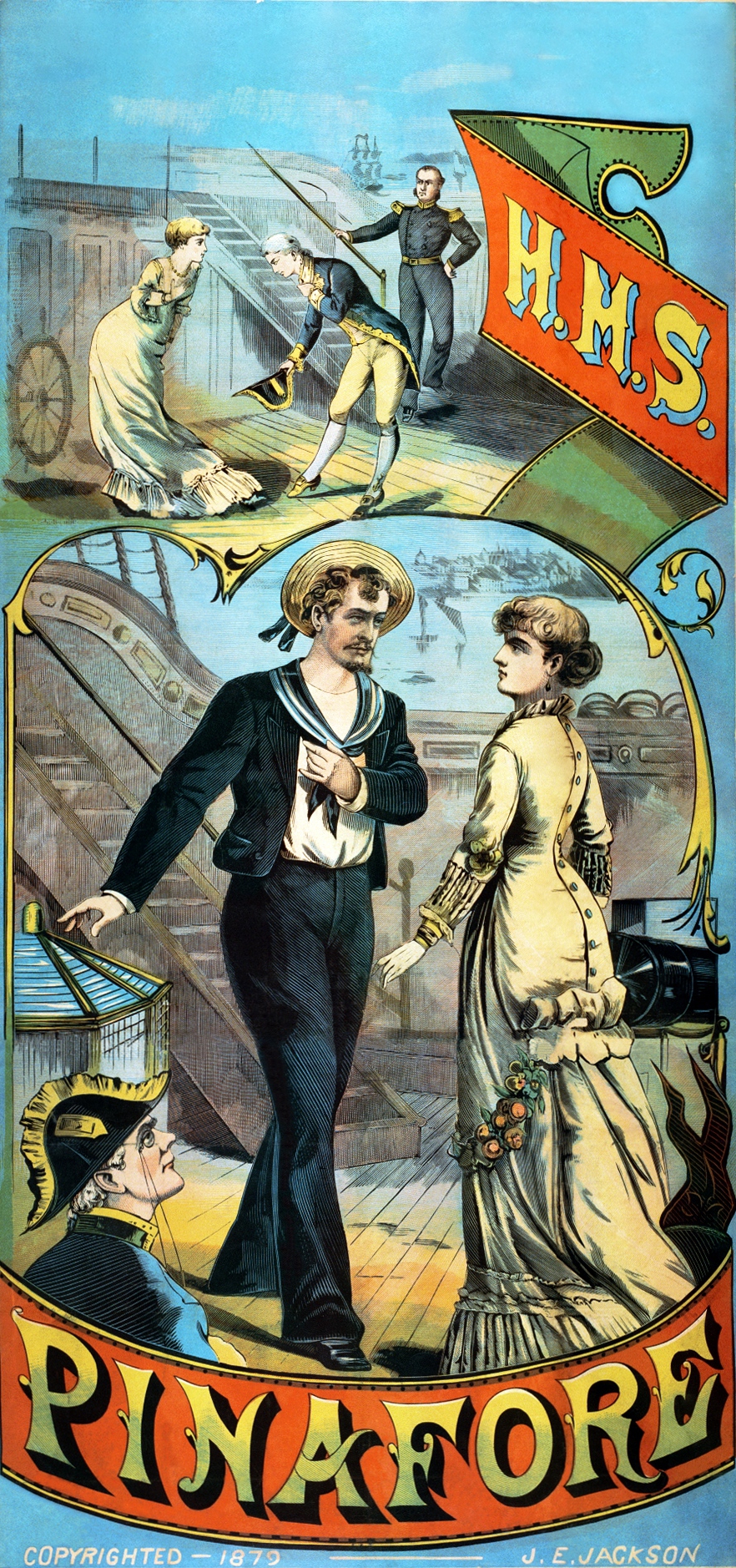
H.M.S. Pinafore; or, The Lass That Loved a Sailor is a comic opera in two acts, with music by Arthur Sullivan and a libretto by W. S. Gilbert. It opened at the Opera Comique in London on 25 May 1878, and ran for 571 performances, which was the second-longest run of any musical theatre piece up to that time. H.M.S. Pinafore was Gilbert and Sullivan's fourth operatic collaboration and their first international sensation.
The story takes place aboard the Royal Navy ship HMS Pinafore. The captain's daughter, Josephine, is in love with a lower-class sailor, Ralph Rackstraw, although her father intends her to marry Sir Joseph Porter, the First Lord of the Admiralty. She abides by her father's wishes at first, but Sir Joseph's advocacy of the equality of humankind encourages Ralph and Josephine to overturn conventional social order. They declare their love for each other and eventually plan to elope. The Captain discovers this plan, but, as in many of the Gilbert and Sullivan operas, a surprise disclosure changes things dramatically near the end of the story.
Drawing on several of his earlier "Bab Ballad" poems, Gilbert imbued this plot with mirth and absurdity. The opera's humour focuses on love between members of different social classes and lampoons the British class system in general. Pinafore also pokes good-natured fun at patriotism, party politics, the Royal Navy, and the rise of unqualified people to positions of authority. The title of the piece comically applies the name of a garment for girls and women, a pinafore, to the fearsome symbol of a warship.
Pinafore's extraordinary popularity in Britain, America and elsewhere was followed by the similar success of a series of Gilbert and Sullivan works, including The Pirates of Penzance and The Mikado. Their works, later known as the Savoy operas, dominated the musical stage on both sides of the Atlantic for more than a decade and continue to be performed today. The structure and style of these operas, particularly Pinafore, were much copied and contributed significantly to the development of modern musical theatre.
In 1875, Richard D'Oyly Carte, who was then managing the Royalty Theatre for Selina Dolaro, brought Gilbert and Sullivan together to write their second show, a one-act opera entitled Trial by Jury. This proved a success, and in 1876 D'Oyly Carte assembled a group of financial backers to establish the Comedy Opera Company, which was devoted to the production and promotion of family-friendly English comic opera. With this theatre company, Carte finally had the financial resources, after many failed attempts, to produce a new full-length Gilbert and Sullivan opera. This next opera was The Sorcerer, which opened in November 1877. It too was successful, running for 178 performances. Sheet music from the show sold well, and street musicians played the melodies.
Instead of writing a piece for production by a theatre proprietor, as was usual in Victorian theatres, Gilbert, Sullivan and Carte produced the show with their own financial support. They were therefore able to choose their own cast of performers, rather than being obliged to use the actors already engaged at the theatre. They chose talented actors, most of whom were not well-known stars and did not command high fees, and to whom they could teach a more naturalistic style of performance than was commonly used at the time. They then tailored their work to the particular abilities of these performers. The skill with which Gilbert and Sullivan used their performers had an effect on the audience; as critic Herman Klein wrote: "we secretly marvelled at the naturalness and ease with which [the Gilbertian quips and absurdities] were said and done. For until then no living soul had seen upon the stage such weird, eccentric, yet intensely human beings. ... [They] conjured into existence a hitherto unknown comic world of sheer delight."
The success of The Sorcerer paved the way for another collaboration by Gilbert and Sullivan. Carte agreed on terms for a new opera with the Comedy Opera Company, and Gilbert began work on H.M.S. Pinafore before the end of 1877. Gilbert's father had been a naval surgeon, and the nautical theme of the opera appealed to him. He drew on several of his earlier "Bab Ballad" poems (many of which also have nautical themes), including "Captain Reece" (1868) and "General John" (1867). Some of the characters also have prototypes in the ballads: Dick Deadeye is based on a character in "Woman's Gratitude" (1869); an early version of Ralph Rackstraw can be seen in "Joe Go-Lightly" (1867), with its sailor madly in love with the daughter of someone who far outranks him; and Little Buttercup is taken almost wholesale from "The Bumboat Woman's Story" (1870). On 27 December 1877, while Sullivan was on holiday on the French Riviera, Gilbert sent him a plot sketch accompanied by the following note:
I have very little doubt whatever but that you will be pleased with it. ... there is a good deal of fun in it which I haven't set down on paper. Among other things a song (a kind of 'Judge's Song') for the First Lord – tracing his career as office-boy ... clerk, traveller, junior partner and First Lord of Britain's Navy. ... Of course there will be no personality in this – the fact that the First Lord in the Opera is a Radical of the most pronounced type will do away with any suspicion that W. H. Smith is intended.
H.M.S. Pinafore
H.M.S. Pinafore; or, The Lass That Loved a Sailor is a comic opera in two acts, with music by Arthur Sullivan and a libretto by W. S. Gilbert. It opened at the Opera Comique in London on 25 May 1878, and ran for 571 performances, which was the second-longest run of any musical theatre piece up to that time. H.M.S. Pinafore was Gilbert and Sullivan's fourth operatic collaboration and their first international sensation.
The story takes place aboard the Royal Navy ship HMS Pinafore. The captain's daughter, Josephine, is in love with a lower-class sailor, Ralph Rackstraw, although her father intends her to marry Sir Joseph Porter, the First Lord of the Admiralty. She abides by her father's wishes at first, but Sir Joseph's advocacy of the equality of humankind encourages Ralph and Josephine to overturn conventional social order. They declare their love for each other and eventually plan to elope. The Captain discovers this plan, but, as in many of the Gilbert and Sullivan operas, a surprise disclosure changes things dramatically near the end of the story.
Drawing on several of his earlier "Bab Ballad" poems, Gilbert imbued this plot with mirth and absurdity. The opera's humour focuses on love between members of different social classes and lampoons the British class system in general. Pinafore also pokes good-natured fun at patriotism, party politics, the Royal Navy, and the rise of unqualified people to positions of authority. The title of the piece comically applies the name of a garment for girls and women, a pinafore, to the fearsome symbol of a warship.
Pinafore's extraordinary popularity in Britain, America and elsewhere was followed by the similar success of a series of Gilbert and Sullivan works, including The Pirates of Penzance and The Mikado. Their works, later known as the Savoy operas, dominated the musical stage on both sides of the Atlantic for more than a decade and continue to be performed today. The structure and style of these operas, particularly Pinafore, were much copied and contributed significantly to the development of modern musical theatre.
In 1875, Richard D'Oyly Carte, who was then managing the Royalty Theatre for Selina Dolaro, brought Gilbert and Sullivan together to write their second show, a one-act opera entitled Trial by Jury. This proved a success, and in 1876 D'Oyly Carte assembled a group of financial backers to establish the Comedy Opera Company, which was devoted to the production and promotion of family-friendly English comic opera. With this theatre company, Carte finally had the financial resources, after many failed attempts, to produce a new full-length Gilbert and Sullivan opera. This next opera was The Sorcerer, which opened in November 1877. It too was successful, running for 178 performances. Sheet music from the show sold well, and street musicians played the melodies.
Instead of writing a piece for production by a theatre proprietor, as was usual in Victorian theatres, Gilbert, Sullivan and Carte produced the show with their own financial support. They were therefore able to choose their own cast of performers, rather than being obliged to use the actors already engaged at the theatre. They chose talented actors, most of whom were not well-known stars and did not command high fees, and to whom they could teach a more naturalistic style of performance than was commonly used at the time. They then tailored their work to the particular abilities of these performers. The skill with which Gilbert and Sullivan used their performers had an effect on the audience; as critic Herman Klein wrote: "we secretly marvelled at the naturalness and ease with which [the Gilbertian quips and absurdities] were said and done. For until then no living soul had seen upon the stage such weird, eccentric, yet intensely human beings. ... [They] conjured into existence a hitherto unknown comic world of sheer delight."
The success of The Sorcerer paved the way for another collaboration by Gilbert and Sullivan. Carte agreed on terms for a new opera with the Comedy Opera Company, and Gilbert began work on H.M.S. Pinafore before the end of 1877. Gilbert's father had been a naval surgeon, and the nautical theme of the opera appealed to him. He drew on several of his earlier "Bab Ballad" poems (many of which also have nautical themes), including "Captain Reece" (1868) and "General John" (1867). Some of the characters also have prototypes in the ballads: Dick Deadeye is based on a character in "Woman's Gratitude" (1869); an early version of Ralph Rackstraw can be seen in "Joe Go-Lightly" (1867), with its sailor madly in love with the daughter of someone who far outranks him; and Little Buttercup is taken almost wholesale from "The Bumboat Woman's Story" (1870). On 27 December 1877, while Sullivan was on holiday on the French Riviera, Gilbert sent him a plot sketch accompanied by the following note:
I have very little doubt whatever but that you will be pleased with it. ... there is a good deal of fun in it which I haven't set down on paper. Among other things a song (a kind of 'Judge's Song') for the First Lord – tracing his career as office-boy ... clerk, traveller, junior partner and First Lord of Britain's Navy. ... Of course there will be no personality in this – the fact that the First Lord in the Opera is a Radical of the most pronounced type will do away with any suspicion that W. H. Smith is intended.
Recent media
Recent media