
Recent from talks
HMS Antelope (F170)
Knowledge base stats:
Talk channels stats:
Members stats:
HMS Antelope (F170)
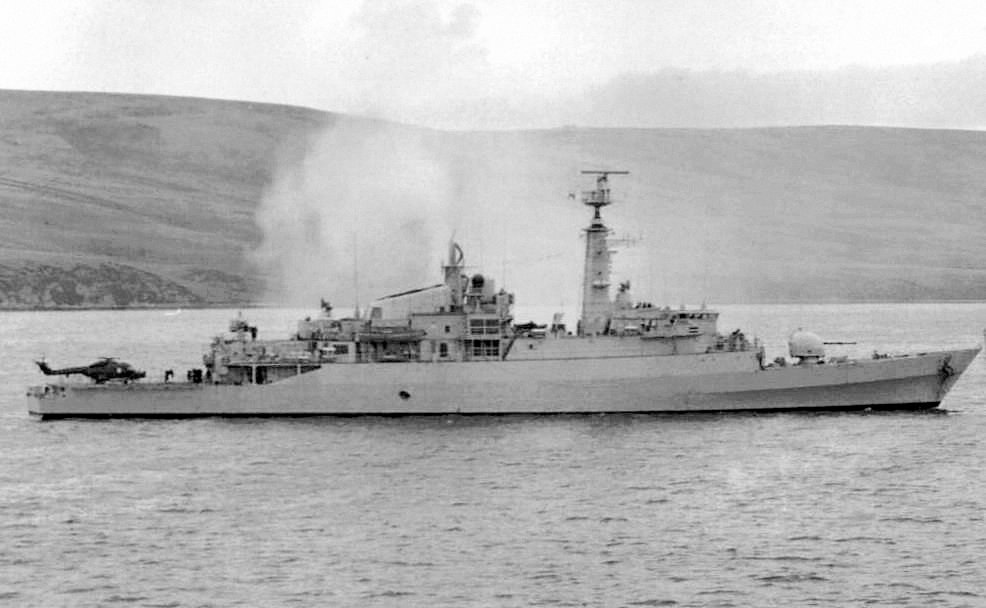
HMS Antelope was a Type 21 frigate of the Royal Navy that participated in the Falklands War and was sunk by Argentine aircraft.
Her keel was laid down 23 March 1971 by Vosper Thornycroft in Woolston, Southampton, England.
Initial budget costs for this class were £3.5 million, with final costs exceeding £14 million. She was commissioned on 17 July 1975, and was the only unit of the class never to be fitted with Exocet launchers.
In 1977, she attended the fleet review for the Silver Jubilee of Elizabeth II. At this time, she was part of the 7th Frigate Squadron.
Antelope took part in the Falklands War, arriving in the area of operations on 21 May 1982. Two days later, while on air defence duty at the entrance to San Carlos Water, protecting the beachhead established two days before, she came under attack by four Argentine A-4B Skyhawks of Grupo 5. The first pair attacked from astern, with the flight leader breaking off his attack after one of Antelope's Seacat missiles exploded under the port wing of his aircraft.
The pilot, Captain Pablo Carballo, managed to nurse his aircraft back to Rio Gallegos. The second aircraft on this flight pressed home his bomb run and put a 1,000-pound bomb in Antelope's starboard side, killing one crewman, Steward Mark R. Stephens. The bomb did not explode and the Argentine aircraft was damaged by small arms fire. The second pair of Skyhawks attacked minutes later from the starboard quarter. During this attack, one of the Argentine jets, piloted by First Lieutenant Luciano Guadagnini, was hit by the ship's Oerlikon 20 mm cannon before colliding with Antelope's main mast and disintegrating. Guadagnini had released the bombs before being brought down, and one bomb penetrated Antelope's hull amidships, but like the first bomb hitting the ship failed to explode.
Antelope fired a Seacat at what she believed to be a fifth attacker, but this was Captain Carballo, trying to establish if his aircraft was fit to fly. The missile missed, but passed less than 10 metres (33 ft) from Carballo's cockpit.
After initial damage control efforts, Antelope proceeded to more sheltered waters so that two bomb disposal technicians from the Royal Engineers could come aboard and attempt to defuse the two unexploded bombs. One of the bombs was inaccessible because of wreckage; the other had been damaged and was thought to be in a particularly dangerous condition. Three attempts by the bomb disposal team to withdraw the fuse of this bomb by remote means failed.
Hub AI
HMS Antelope (F170) AI simulator
(@HMS Antelope (F170)_simulator)
HMS Antelope (F170)
HMS Antelope was a Type 21 frigate of the Royal Navy that participated in the Falklands War and was sunk by Argentine aircraft.
Her keel was laid down 23 March 1971 by Vosper Thornycroft in Woolston, Southampton, England.
Initial budget costs for this class were £3.5 million, with final costs exceeding £14 million. She was commissioned on 17 July 1975, and was the only unit of the class never to be fitted with Exocet launchers.
In 1977, she attended the fleet review for the Silver Jubilee of Elizabeth II. At this time, she was part of the 7th Frigate Squadron.
Antelope took part in the Falklands War, arriving in the area of operations on 21 May 1982. Two days later, while on air defence duty at the entrance to San Carlos Water, protecting the beachhead established two days before, she came under attack by four Argentine A-4B Skyhawks of Grupo 5. The first pair attacked from astern, with the flight leader breaking off his attack after one of Antelope's Seacat missiles exploded under the port wing of his aircraft.
The pilot, Captain Pablo Carballo, managed to nurse his aircraft back to Rio Gallegos. The second aircraft on this flight pressed home his bomb run and put a 1,000-pound bomb in Antelope's starboard side, killing one crewman, Steward Mark R. Stephens. The bomb did not explode and the Argentine aircraft was damaged by small arms fire. The second pair of Skyhawks attacked minutes later from the starboard quarter. During this attack, one of the Argentine jets, piloted by First Lieutenant Luciano Guadagnini, was hit by the ship's Oerlikon 20 mm cannon before colliding with Antelope's main mast and disintegrating. Guadagnini had released the bombs before being brought down, and one bomb penetrated Antelope's hull amidships, but like the first bomb hitting the ship failed to explode.
Antelope fired a Seacat at what she believed to be a fifth attacker, but this was Captain Carballo, trying to establish if his aircraft was fit to fly. The missile missed, but passed less than 10 metres (33 ft) from Carballo's cockpit.
After initial damage control efforts, Antelope proceeded to more sheltered waters so that two bomb disposal technicians from the Royal Engineers could come aboard and attempt to defuse the two unexploded bombs. One of the bombs was inaccessible because of wreckage; the other had been damaged and was thought to be in a particularly dangerous condition. Three attempts by the bomb disposal team to withdraw the fuse of this bomb by remote means failed.
Recent media