
Recent from talks
HMS Bayano (1914)
Knowledge base stats:
Talk channels stats:
Members stats:
HMS Bayano (1914)
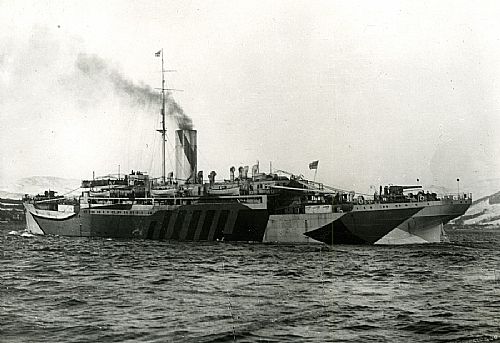
HMS Bayano, built in 1913, was originally a banana boat for the Elders & Fyffes line. At the outbreak of the First World War it was commandeered by the Royal Navy on 21 November 1914 as an armed merchant cruiser. On 11 March 1915, it was torpedoed by the German submarine SM U-27 and sank within minutes, killing around 200 of its crew. Twenty-six survivors were pulled from the water.
Once in the Royal Navy she became part of the Northern Patrol (10th Cruiser Squadron). The Admiralty had begun to use experimental indicator nets to counter German submarines. Indicator nets were made from strong thin wires, draped from the surface of the sea and kept buoyant with kapok, small buoys or glass globes. Sections of the net were held together with clips which (in theory) would part when the section was hit by a submerged submarine. The net would wrap around the vessel and indicate its presence via a buoy being pulled along the surface of the sea. The Admiralty established 21 net barrages, one of which was in the North Channel.
In the North Channel, the captain, Commander Henry Carr, had reduced speed to avoid passing the net line in the dark, en route to Liverpool for coaling. At 05:15 on 11 March 1915, the ship was attacked by the German submarine SM U-27 about 10 nmi (12 mi; 19 km) west of Corsewall Lighthouse, Corsewall Point, Galloway. The auxiliary cruiser sank in five minutes. Most of the crew was asleep and only 26 men survived to be rescued by the British steamer Castlereagh. Bayano's Lieutenant Commander Guy described Carr on the bridge, standing without fear waving goodbye while shouting "Good luck to you boys" before the ship disappeared under the waves.
The captain and 194 other crew members were killed in the sinking.
Residents of the Isle of Man were greatly affected by the sinking as a number of bodies were washed up on the island. The funeral procession for the Bayano victims numbered in the thousands, even though the dead were not Manx. The Dominion of Newfoundland, part of the British Empire, was also hard hit. A dozen men from the Newfoundland Royal Naval Reserve were lost on Bayano.
The wreck of the Bayano was located and identified in 2025.
Hub AI
HMS Bayano (1914) AI simulator
(@HMS Bayano (1914)_simulator)
HMS Bayano (1914)
HMS Bayano, built in 1913, was originally a banana boat for the Elders & Fyffes line. At the outbreak of the First World War it was commandeered by the Royal Navy on 21 November 1914 as an armed merchant cruiser. On 11 March 1915, it was torpedoed by the German submarine SM U-27 and sank within minutes, killing around 200 of its crew. Twenty-six survivors were pulled from the water.
Once in the Royal Navy she became part of the Northern Patrol (10th Cruiser Squadron). The Admiralty had begun to use experimental indicator nets to counter German submarines. Indicator nets were made from strong thin wires, draped from the surface of the sea and kept buoyant with kapok, small buoys or glass globes. Sections of the net were held together with clips which (in theory) would part when the section was hit by a submerged submarine. The net would wrap around the vessel and indicate its presence via a buoy being pulled along the surface of the sea. The Admiralty established 21 net barrages, one of which was in the North Channel.
In the North Channel, the captain, Commander Henry Carr, had reduced speed to avoid passing the net line in the dark, en route to Liverpool for coaling. At 05:15 on 11 March 1915, the ship was attacked by the German submarine SM U-27 about 10 nmi (12 mi; 19 km) west of Corsewall Lighthouse, Corsewall Point, Galloway. The auxiliary cruiser sank in five minutes. Most of the crew was asleep and only 26 men survived to be rescued by the British steamer Castlereagh. Bayano's Lieutenant Commander Guy described Carr on the bridge, standing without fear waving goodbye while shouting "Good luck to you boys" before the ship disappeared under the waves.
The captain and 194 other crew members were killed in the sinking.
Residents of the Isle of Man were greatly affected by the sinking as a number of bodies were washed up on the island. The funeral procession for the Bayano victims numbered in the thousands, even though the dead were not Manx. The Dominion of Newfoundland, part of the British Empire, was also hard hit. A dozen men from the Newfoundland Royal Naval Reserve were lost on Bayano.
The wreck of the Bayano was located and identified in 2025.
Recent media