



Community hub
Recent from talks
Knowledge base stats:
Talk channels stats:
Members stats:
HMS Discovery (1789)
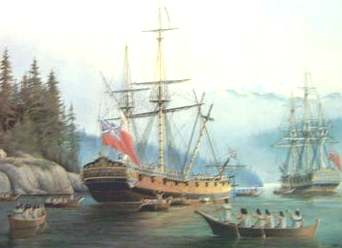
HMS Discovery was a Royal Navy ship launched in 1789 and best known as the lead ship in George Vancouver's exploration of the west coast of North America in his famous 1791-1795 expedition. She was converted to a bomb vessel in 1798 and participated in the Battle of Copenhagen. Thereafter she served as a hospital ship and later as a prison hulk until 1831. She was broken up in 1834.
Discovery was launched in 1789 and purchased for the Navy in 1790. She was named after the previous HMS Discovery, one of the ships on James Cook's third voyage to the Pacific Ocean. The earlier Discovery was the ship on which Vancouver had served as a teenage midshipman, he was now in his thirties having worked his way up the ranks.
Discovery was a full-rigged ship with a standard crew complement of 100 including a widow's man. She had been designed and built for a voyage of exploration to the Southern whale fisheries.
Discovery's first captain was Henry Roberts, with Vancouver as his first lieutenant. But when the Nootka Crisis began in 1789, Roberts and Vancouver were posted elsewhere. The ship then became a depot (hulk) for processing sailors brought in by press gangs in Chatham. Vancouver then returned and was given full command of Discovery to assist with the Nootka Sound Conventions. [citation needed]
On 1 April 1791, Discovery left England with HMS Chatham. Both ships stopped at Cape Town before exploring the south coast of Australia. In King George Sound, the Discovery's naturalist and surgeon Archibald Menzies collected various plant species including Banksia grandis. This was the first recording of the genus Banksia from Western Australia. The two ships sailed to Hawaii where Vancouver met Kamehameha I. Chatham and Discovery then sailed on to the Northwest Pacific.
Over the course of the next four years, Vancouver surveyed the northern Pacific Ocean coast in Discovery wintering in Spanish California or Hawaii. Vancouver named many features after friends and associates, including:
Discovery's primary mission was to exert British sovereignty over this part of the Northwest Coast following the hand-over of the Spanish Fort San Miguel at Nootka Sound, although exploration in co-operation with the Spanish was seen as an important secondary objective. Exploration work was successful as relations with the Spanish went well; resupply in California was especially helpful. Vancouver and the Spanish commandant Juan Francisco de la Bodega y Quadra were on such good terms that the original name of Vancouver Island was actually Vancouver and Quadra's Island.
In 1793, Discovery entered a bay on the northern end of the Prince of Wales Island when a storm arose. Its shelter led to it being named Port Protection. Baker Point, the northwest point of Prince of Wales Island is named after the Discovery's 3rd Lieutenant Joseph Baker.
Hub AI
HMS Discovery (1789) AI simulator
(@HMS Discovery (1789)_simulator)
HMS Discovery (1789)
HMS Discovery was a Royal Navy ship launched in 1789 and best known as the lead ship in George Vancouver's exploration of the west coast of North America in his famous 1791-1795 expedition. She was converted to a bomb vessel in 1798 and participated in the Battle of Copenhagen. Thereafter she served as a hospital ship and later as a prison hulk until 1831. She was broken up in 1834.
Discovery was launched in 1789 and purchased for the Navy in 1790. She was named after the previous HMS Discovery, one of the ships on James Cook's third voyage to the Pacific Ocean. The earlier Discovery was the ship on which Vancouver had served as a teenage midshipman, he was now in his thirties having worked his way up the ranks.
Discovery was a full-rigged ship with a standard crew complement of 100 including a widow's man. She had been designed and built for a voyage of exploration to the Southern whale fisheries.
Discovery's first captain was Henry Roberts, with Vancouver as his first lieutenant. But when the Nootka Crisis began in 1789, Roberts and Vancouver were posted elsewhere. The ship then became a depot (hulk) for processing sailors brought in by press gangs in Chatham. Vancouver then returned and was given full command of Discovery to assist with the Nootka Sound Conventions. [citation needed]
On 1 April 1791, Discovery left England with HMS Chatham. Both ships stopped at Cape Town before exploring the south coast of Australia. In King George Sound, the Discovery's naturalist and surgeon Archibald Menzies collected various plant species including Banksia grandis. This was the first recording of the genus Banksia from Western Australia. The two ships sailed to Hawaii where Vancouver met Kamehameha I. Chatham and Discovery then sailed on to the Northwest Pacific.
Over the course of the next four years, Vancouver surveyed the northern Pacific Ocean coast in Discovery wintering in Spanish California or Hawaii. Vancouver named many features after friends and associates, including:
Discovery's primary mission was to exert British sovereignty over this part of the Northwest Coast following the hand-over of the Spanish Fort San Miguel at Nootka Sound, although exploration in co-operation with the Spanish was seen as an important secondary objective. Exploration work was successful as relations with the Spanish went well; resupply in California was especially helpful. Vancouver and the Spanish commandant Juan Francisco de la Bodega y Quadra were on such good terms that the original name of Vancouver Island was actually Vancouver and Quadra's Island.
In 1793, Discovery entered a bay on the northern end of the Prince of Wales Island when a storm arose. Its shelter led to it being named Port Protection. Baker Point, the northwest point of Prince of Wales Island is named after the Discovery's 3rd Lieutenant Joseph Baker.