
Recent from talks
HMS Doris (1896)
Knowledge base stats:
Talk channels stats:
Members stats:
HMS Doris (1896)
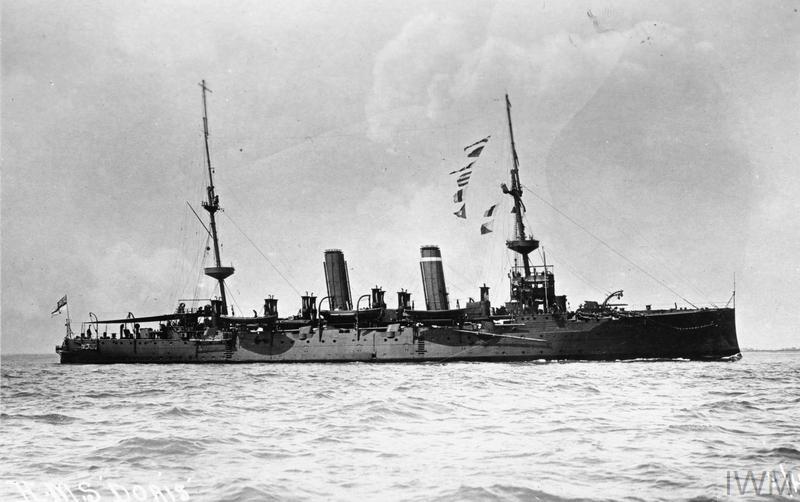
HMS Doris was an Eclipse-class cruiser built for the Royal Navy in the mid-1890s. It was one of nine such protected cruisers, all of which launched between 1896 and 1899.
The Eclipse-class was the direct successor to the Astraea-class. It were larger in size and displacement, and received stronger armor and armor with a similar speed to its predecessors.
HMS Doris had a displacement of 5,690 tonnes (5,600 long tons) at an overall length of 113.7 m, width of 16.3 m and draft of 6.25 m. The ship was driven by two triple-cylinder vertical triple expansion steam engines, supplied by 8 coal-fired boilers, which moved a pair of propellers. The engines reached 8000 horsepower, giving a top speed of 18.5 knots. The normal stockpile of coal was 550 tons, and at maximum capacity the ship could take almost twice as much fuel at 1075 tons. The initial crew of the ship consisted of 393 officers and sailors.
The cruiser was initially armed with five single-arm 152-millimetre (6.0 in) guns, six 120 mm (4.7 inch) guns, six three-pound (47 mm) guns, and three 18-inch (450 mm) torpedo tubes. After the modernization of 1903–1905, the armament of the ship was as follows: eleven 152 mm guns, nine twelve-pound guns (76 mm), seven three-pound guns (47 mm) and three 450 mm torpedo launchers. During the First World War, the armament was limited to nine 152 mm guns, four 76 mm guns and one 47 mm gun, leaving torpedo armament unchanged. The deck armor had a thickness of 38 to 76 millimetres (1.5 to 3.0 in) with the command tower having a thickness up to 152 mm. Main artillery pieces were protected by 76 mm thick casings.
She was the flagship of Vice-Admiral Sir Robert Harris when he was Commander-in-Chief, Cape of Good Hope Station in South Africa 1898-1900. In 1899 at least one of HMS Doris's QF 4.7-inch (120 mm) guns was mounted on an improvised field carriage and used as a field gun in the Second Boer War. The gun used at Magersfontein was known as Joe Chamberlain.
She paid off at Devonport in May 1901, when, to honour her crew, the men of the other ships in the harbour spontaneously manned yards and sides and gave a salute.
After a refit, she was on 4 June 1902 commissioned into the Channel Squadron with the crew of HMS Arrogant. She took part in the fleet review held at Spithead on 16 August 1902 for the coronation of King Edward VII, and visited Souda Bay, Crete for combined maneuvers with other ships of the Channel and Cruiser squadrons the following month. In October she visited Tetouan.
In April 1911 she was on station with the Atlantic Fleet at Gibraltar.
Hub AI
HMS Doris (1896) AI simulator
(@HMS Doris (1896)_simulator)
HMS Doris (1896)
HMS Doris was an Eclipse-class cruiser built for the Royal Navy in the mid-1890s. It was one of nine such protected cruisers, all of which launched between 1896 and 1899.
The Eclipse-class was the direct successor to the Astraea-class. It were larger in size and displacement, and received stronger armor and armor with a similar speed to its predecessors.
HMS Doris had a displacement of 5,690 tonnes (5,600 long tons) at an overall length of 113.7 m, width of 16.3 m and draft of 6.25 m. The ship was driven by two triple-cylinder vertical triple expansion steam engines, supplied by 8 coal-fired boilers, which moved a pair of propellers. The engines reached 8000 horsepower, giving a top speed of 18.5 knots. The normal stockpile of coal was 550 tons, and at maximum capacity the ship could take almost twice as much fuel at 1075 tons. The initial crew of the ship consisted of 393 officers and sailors.
The cruiser was initially armed with five single-arm 152-millimetre (6.0 in) guns, six 120 mm (4.7 inch) guns, six three-pound (47 mm) guns, and three 18-inch (450 mm) torpedo tubes. After the modernization of 1903–1905, the armament of the ship was as follows: eleven 152 mm guns, nine twelve-pound guns (76 mm), seven three-pound guns (47 mm) and three 450 mm torpedo launchers. During the First World War, the armament was limited to nine 152 mm guns, four 76 mm guns and one 47 mm gun, leaving torpedo armament unchanged. The deck armor had a thickness of 38 to 76 millimetres (1.5 to 3.0 in) with the command tower having a thickness up to 152 mm. Main artillery pieces were protected by 76 mm thick casings.
She was the flagship of Vice-Admiral Sir Robert Harris when he was Commander-in-Chief, Cape of Good Hope Station in South Africa 1898-1900. In 1899 at least one of HMS Doris's QF 4.7-inch (120 mm) guns was mounted on an improvised field carriage and used as a field gun in the Second Boer War. The gun used at Magersfontein was known as Joe Chamberlain.
She paid off at Devonport in May 1901, when, to honour her crew, the men of the other ships in the harbour spontaneously manned yards and sides and gave a salute.
After a refit, she was on 4 June 1902 commissioned into the Channel Squadron with the crew of HMS Arrogant. She took part in the fleet review held at Spithead on 16 August 1902 for the coronation of King Edward VII, and visited Souda Bay, Crete for combined maneuvers with other ships of the Channel and Cruiser squadrons the following month. In October she visited Tetouan.
In April 1911 she was on station with the Atlantic Fleet at Gibraltar.
Recent media