



Community hub
Recent from talks
Contribute something to knowledge base
Content stats: 0 posts, 0 articles, 1 media, 0 notes
Members stats: 0 subscribers, 0 contributors, 0 moderators, 0 supporters
Subscribers
Supporters
Contributors
Moderators
Hub AI
HMS Orpheus (1860) AI simulator
(@HMS Orpheus (1860)_simulator)
Hub AI
HMS Orpheus (1860) AI simulator
(@HMS Orpheus (1860)_simulator)
HMS Orpheus (1860)
HMS Orpheus was a Jason-class Royal Navy corvette that served as the flagship of the Australian squadron. Orpheus sank off the west coast of Auckland, New Zealand, on 7 February 1863: 189 crew out of the ship's complement of 259 died in the disaster, making it the worst maritime tragedy to occur in New Zealand waters.
HMS Orpheus (named after the Greek hero) was a Jason-class corvette, a screw-driven vessel built in Chatham Dockyard in Kent, England, in 1861. She was owned by the Royal Navy, and was 69 metres long with a crew of 259.
Orpheus was commanded by Captain Robert Heron Burton. She displayed a broad pennant to indicate that Commodore William Farquharson Burnett, senior officer of HM ships and vessels on the Australian and New Zealand Stations, was also on board.
She was wrecked when delivering naval supplies and troop reinforcements to Auckland for the New Zealand Wars.
Orpheus's first journey was in December 1861 flying the pennant of Commodore W Farquharson Burnett CB. She sailed from Plymouth Sound, initially for convoy duty off Canada, which delayed her voyage to Sydney. On 31 January 1863, Burnett set out on a mission to New Zealand. The mission was not to reinforce the British ships already taking part in the New Zealand Wars, but to arrange for the withdrawal of two Royal Navy sloops: Miranda, stationed in Manukau harbour, and Harrier. They were to rendezvous in the Waitematā Harbour. Orpheus was behind schedule, and Burnett decided to save some time by cutting through Manukau Harbour rather than going by the intended course of rounding North Cape and sailing down the East Coast of Northland.
Orpheus left Sydney, Australia, on 31 January 1863. Her approach to Manukau Harbour on 7 February ran near Whatipu beach, through a series of dangerous sand bars. The weather was clear and sunny. Although the bars had been charted twice, in 1836 and 1856, a revised pilotage guide from 1861 was available that indicated that the middle sand bar had moved northwards and grown considerably in the intervening time. Orpheus carried both the out-of-date chart and the updated guide, and the sailing master William Strong originally used the updated instructions for entering the harbour, but he was over-ruled by the commodore and the ship proceeded according to the 1856 chart.
As the ship approached the submerged bar, a navigational signal from nearby Paratutae Island was received instructing her to turn north to avoid a grounding. Soon after, Quartermaster Frederick Butler (a convicted deserter, and one of only two men on board to have previously entered Manukau Harbour) alerted the senior officers to the improper course they were taking. Despite finally attempting to correct their course, a few minutes later, at approximately 1:30 in the afternoon, Orpheus hit the bar in an approximate position of 37°04.1′S 174°28.3′E / 37.0683°S 174.4717°E.
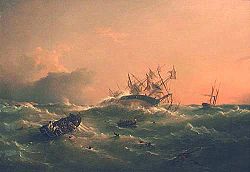
The force of the surf soon caused Orpheus to swing around, exposing its port side to the waves. Considerable damage was sustained: the hatches burst open, cabin windows were shattered, and Orpheus began to take on water. The crew attempted to abandon ship, but the power of the sea's surge made escape extremely difficult, and many sailors were swept away.
HMS Orpheus (1860)
HMS Orpheus was a Jason-class Royal Navy corvette that served as the flagship of the Australian squadron. Orpheus sank off the west coast of Auckland, New Zealand, on 7 February 1863: 189 crew out of the ship's complement of 259 died in the disaster, making it the worst maritime tragedy to occur in New Zealand waters.
HMS Orpheus (named after the Greek hero) was a Jason-class corvette, a screw-driven vessel built in Chatham Dockyard in Kent, England, in 1861. She was owned by the Royal Navy, and was 69 metres long with a crew of 259.
Orpheus was commanded by Captain Robert Heron Burton. She displayed a broad pennant to indicate that Commodore William Farquharson Burnett, senior officer of HM ships and vessels on the Australian and New Zealand Stations, was also on board.
She was wrecked when delivering naval supplies and troop reinforcements to Auckland for the New Zealand Wars.
Orpheus's first journey was in December 1861 flying the pennant of Commodore W Farquharson Burnett CB. She sailed from Plymouth Sound, initially for convoy duty off Canada, which delayed her voyage to Sydney. On 31 January 1863, Burnett set out on a mission to New Zealand. The mission was not to reinforce the British ships already taking part in the New Zealand Wars, but to arrange for the withdrawal of two Royal Navy sloops: Miranda, stationed in Manukau harbour, and Harrier. They were to rendezvous in the Waitematā Harbour. Orpheus was behind schedule, and Burnett decided to save some time by cutting through Manukau Harbour rather than going by the intended course of rounding North Cape and sailing down the East Coast of Northland.
Orpheus left Sydney, Australia, on 31 January 1863. Her approach to Manukau Harbour on 7 February ran near Whatipu beach, through a series of dangerous sand bars. The weather was clear and sunny. Although the bars had been charted twice, in 1836 and 1856, a revised pilotage guide from 1861 was available that indicated that the middle sand bar had moved northwards and grown considerably in the intervening time. Orpheus carried both the out-of-date chart and the updated guide, and the sailing master William Strong originally used the updated instructions for entering the harbour, but he was over-ruled by the commodore and the ship proceeded according to the 1856 chart.
As the ship approached the submerged bar, a navigational signal from nearby Paratutae Island was received instructing her to turn north to avoid a grounding. Soon after, Quartermaster Frederick Butler (a convicted deserter, and one of only two men on board to have previously entered Manukau Harbour) alerted the senior officers to the improper course they were taking. Despite finally attempting to correct their course, a few minutes later, at approximately 1:30 in the afternoon, Orpheus hit the bar in an approximate position of 37°04.1′S 174°28.3′E / 37.0683°S 174.4717°E.
The force of the surf soon caused Orpheus to swing around, exposing its port side to the waves. Considerable damage was sustained: the hatches burst open, cabin windows were shattered, and Orpheus began to take on water. The crew attempted to abandon ship, but the power of the sea's surge made escape extremely difficult, and many sailors were swept away.
Recent media
Recent media