
Recent from talks
HSBC lions
Knowledge base stats:
Talk channels stats:
Members stats:
HSBC lions
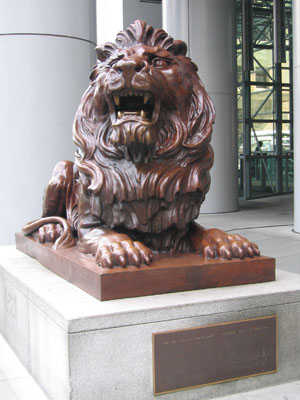
Various headquarters and branch buildings of The Hongkong and Shanghai Banking Corporation (and later the HSBC Group) feature a pair of lion sculptures. The HSBC lions have become distinctive landmarks in their own right in Hong Kong and Shanghai, with further pairs to be found in London and Birmingham.
The first set of lion sculptures were commissioned for the rebuilt HSBC Building on the Bund in Shanghai, opened in 1923. Chief Manager Alexander Stephen wrote, in 1921, that the inspiration for his decision to order their sculpting came from the imposing lions outside the Venetian Arsenal.
Cast by J W Singer & Sons in the English town of Frome, to a design by Henry Poole RA, these lions had quickly become part of the Shanghai scene, and passers-by would affectionately stroke the lions in the belief that power and money would rub off on them. They became known as Stephen and Stitt. Stephen was named for Alexander Gordon Stephen, formerly Manager Shanghai, and in 1923 the Chief Manager of HSBC, and Gordon Holmes Stitt, the then Manager Shanghai. Stephen is depicted roaring, Stitt quiescent; insiders said that this represented the characters of the two famous bankers.
When HSBC decided to build its third Headquarters at 1 Queen's Road Central in Hong Kong, opened in 1935, it commissioned two bronze lions from Shanghai-based British sculptor WW Wagstaff. This commission was inspired by the earlier lions commissioned for the Shanghai office, and the Hong Kong lions were modelled on, but are not identical to, the Shanghai lions.
Wagstaff worked with "Shanghai Arts and Crafts" foreman Chou Yin Hsiang. In an interview with John Loch of HSBC's house magazine "Group News" in June 1977, Hsiang recalled that when he first joined Arts and Crafts, he worked on the lions with Wagstaff for two years without having to learn a word of English: Wagstaff spoke a perfect Shanghai dialect. Hunch-backed, Wagstaff was nicknamed "Lao Doo Pei", meaning "Old Hunchback". His son, inevitably, was called "Sau Doo Pei" – "Young Hunchback." Wagstaff had two sons – Don, killed in Naval service in the war, and Alex, killed while interned in Shanghai by the Japanese. Chou Yin Hsiang himself came to Hong Kong in 1935, and by 1977 was the proprietor of Jeh Hsing Metal Works – and still casting bronze for HSBC.
Like the Shanghai lions, the Hong Kong lions became objects of veneration, and foci of the Bank's perceived excellent feng shui. Young couples still bring their toddlers to stroke the paws and noses of the statues hoping for luck and prosperity.
When the 1935 building closed its doors for the last time on 26 June 1981, the lions had been moved to the annexe on 19 June 1981. Demolition, by China Swiss Engineers, started on 6 July 1981. The lions were temporarily moved on 4 June 1982 to Statue Square, opposite the back entrance where the lions were and currently are. The main entrance is on the other side, matching the bank's address 1 Queen's Road Central. This setup explicitly follows feng shui placement. As a mark of the respect in which the lions were held, the move to Statue Square, and the move back in 1985, were accompanied by the chairman Sir Michael Sandberg and senior management of the Bank and the placement of the lions both temporarily and in their current locations was made only after extensive consultations with feng shui practitioners.
Their 4-year sojourn in the annexe and Statue Square aside, the lions have only left their positions as guardians of the Des Voeux Road entrance of the Bank once: they were confiscated by the Japanese and sent to Japan to be melted down. The war ended before this could happen, with the lions being recognised by an American sailor in a dockyard in Osaka in 1945. They were returned to Hong Kong a few months later and restored to their original positions in October 1946.
Hub AI
HSBC lions AI simulator
(@HSBC lions_simulator)
HSBC lions
Various headquarters and branch buildings of The Hongkong and Shanghai Banking Corporation (and later the HSBC Group) feature a pair of lion sculptures. The HSBC lions have become distinctive landmarks in their own right in Hong Kong and Shanghai, with further pairs to be found in London and Birmingham.
The first set of lion sculptures were commissioned for the rebuilt HSBC Building on the Bund in Shanghai, opened in 1923. Chief Manager Alexander Stephen wrote, in 1921, that the inspiration for his decision to order their sculpting came from the imposing lions outside the Venetian Arsenal.
Cast by J W Singer & Sons in the English town of Frome, to a design by Henry Poole RA, these lions had quickly become part of the Shanghai scene, and passers-by would affectionately stroke the lions in the belief that power and money would rub off on them. They became known as Stephen and Stitt. Stephen was named for Alexander Gordon Stephen, formerly Manager Shanghai, and in 1923 the Chief Manager of HSBC, and Gordon Holmes Stitt, the then Manager Shanghai. Stephen is depicted roaring, Stitt quiescent; insiders said that this represented the characters of the two famous bankers.
When HSBC decided to build its third Headquarters at 1 Queen's Road Central in Hong Kong, opened in 1935, it commissioned two bronze lions from Shanghai-based British sculptor WW Wagstaff. This commission was inspired by the earlier lions commissioned for the Shanghai office, and the Hong Kong lions were modelled on, but are not identical to, the Shanghai lions.
Wagstaff worked with "Shanghai Arts and Crafts" foreman Chou Yin Hsiang. In an interview with John Loch of HSBC's house magazine "Group News" in June 1977, Hsiang recalled that when he first joined Arts and Crafts, he worked on the lions with Wagstaff for two years without having to learn a word of English: Wagstaff spoke a perfect Shanghai dialect. Hunch-backed, Wagstaff was nicknamed "Lao Doo Pei", meaning "Old Hunchback". His son, inevitably, was called "Sau Doo Pei" – "Young Hunchback." Wagstaff had two sons – Don, killed in Naval service in the war, and Alex, killed while interned in Shanghai by the Japanese. Chou Yin Hsiang himself came to Hong Kong in 1935, and by 1977 was the proprietor of Jeh Hsing Metal Works – and still casting bronze for HSBC.
Like the Shanghai lions, the Hong Kong lions became objects of veneration, and foci of the Bank's perceived excellent feng shui. Young couples still bring their toddlers to stroke the paws and noses of the statues hoping for luck and prosperity.
When the 1935 building closed its doors for the last time on 26 June 1981, the lions had been moved to the annexe on 19 June 1981. Demolition, by China Swiss Engineers, started on 6 July 1981. The lions were temporarily moved on 4 June 1982 to Statue Square, opposite the back entrance where the lions were and currently are. The main entrance is on the other side, matching the bank's address 1 Queen's Road Central. This setup explicitly follows feng shui placement. As a mark of the respect in which the lions were held, the move to Statue Square, and the move back in 1985, were accompanied by the chairman Sir Michael Sandberg and senior management of the Bank and the placement of the lions both temporarily and in their current locations was made only after extensive consultations with feng shui practitioners.
Their 4-year sojourn in the annexe and Statue Square aside, the lions have only left their positions as guardians of the Des Voeux Road entrance of the Bank once: they were confiscated by the Japanese and sent to Japan to be melted down. The war ended before this could happen, with the lions being recognised by an American sailor in a dockyard in Osaka in 1945. They were returned to Hong Kong a few months later and restored to their original positions in October 1946.
Recent media