


Community hub
Recent from talks
Contribute something to knowledge base
Content stats: 0 posts, 0 articles, 1 media, 0 notes
Members stats: 0 subscribers, 0 contributors, 0 moderators, 0 supporters
Subscribers
Supporters
Contributors
Moderators
Hub AI
HSR-350x AI simulator
(@HSR-350x_simulator)
Hub AI
HSR-350x AI simulator
(@HSR-350x_simulator)
HSR-350x
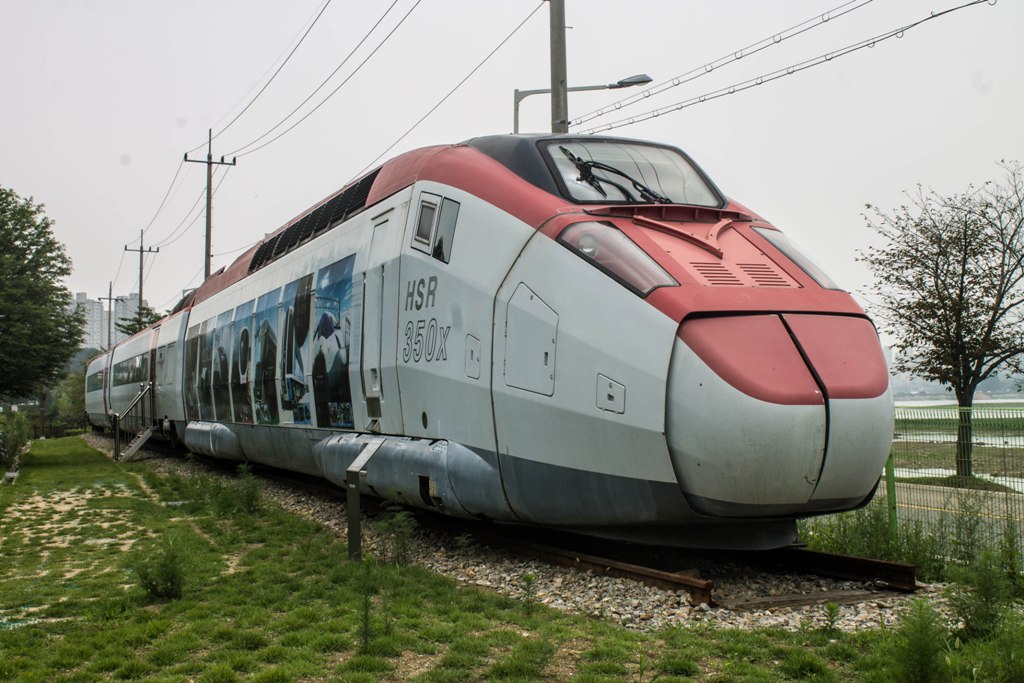
HSR-350x, alternatively called G7, KHST or NG-KTX, is a South Korean experimental high-speed train. It was developed and built in a joint project of government research institutes, universities and private companies that started in 1996, which aimed to reduce import dependence in high-speed rail technology. New components developed for the HSR-350x included motors, electronics, and the carbody of passenger cars. Test runs were conducted between 2002 and 2008. The experimental train achieved the South Korean rail speed record of 352.4 km/h (219.0 mph) in 2004. The HSR-350x was the basis for Korail's KTX-II (KTX-Sancheon) commercial high-speed trains.
When South Korea started its high-speed rail project, rolling stock and infrastructure was built in the framework of a technology transfer agreement between GEC-Alsthom (today Alstom), the main maker of French TGV high-speed trains, and South Korean companies. The first trains for Korea Train Express service, the KTX-I, were derived from the TGV Réseau, and built both by Alstom and Rotem (today Hyundai Rotem).
The technology transfer agreement did not provide for a complete control of manufacturing processes, and construction involved the import of parts. To increase the domestic added value, and to further improve the technology, in December 1996, South Korea's Ministry of Construction and Transportation (MOCT) started a project named G7 to develop domestic high-speed rail technology. The project involved 10 government research agencies, 16 universities and 35 private companies, and employed over a thousand people. The main partners were the Korea Railroad Research Institute (KRRI), the Korea Institute of Industrial Technology (KITECH), and rolling stock manufacturer Rotem.
Due to the strong interdependencies of vehicle and infrastructure parameters in high-speed rail technology, the G7 program first focused on the compatibility with other components like track, catenary, signalling, and train control. Sub-projects dealt with bridge design, improved pantograph design, and catenary in tunnels. Technologies used in high-speed line construction, including rails and catenary in tunnels, were adapted for use in conventional line upgrades, to enable the operation of KTX trains on such lines. The program also dealt with problems discovered during the operation of KTX-I trains, including a snaking movement of the articulated train around a speed of 150 km/h (93 mph) in winter, which was addressed by increasing wheel conicity.
The main element of the G7 project was the experimental high-speed train HSR-350x, developed on the basis of the technology transferred from GEC-Alsthom. With a design speed of 385 km/h (239 mph), the vehicle was meant as a prototype for commercial trains with a regular service top speed of 350 km/h (217 mph). The basic design and main components, as well as a mock-up of the initial design of the nose, was presented on December 17, 1999.
The costs of the G7 program were 210 billion won, or about US$208 million. Including testing, the entire development program cost 256.9 billion won.
The first running tests with HSR-350x were conducted in May 2002 up to a speed of 60 km/h (37 mph). The vehicle was then transported to Osong depot, on the finished test section of the Gyeongbu High Speed Railway (Gyeongbu HSR) between Cheonan-Asan and Daejeon, on June 28, 2002, and the first test run took place on August 19, 2002, with a top speed of 80 km/h (50 mph). In the first twelve months, the train covered 6,075 km (3,775 mi) in 44 test runs as top speed was increased in increments of 10 km/h (6 mph), until 301.9 km/h (187.6 mph) was achieved at 23:38 on August 1, 2003.
Further progress with the testing programme was slow, because line capacity on the finished test section of the Gyeongbu HSR was limited due to the priority of the commissioning tests of the KTX-I trains. After the launch of regular service on April 1, 2004, the Korea Rail Network Authority allowed test runs only in the night hours when there was no regular service on the line. The programme was also marred by technical problems, including a slip control problem which led to wheel abrasion, burned motor blocks, signalling troubles, braking system problems, and power car roll which led to the replacement of the suspension system. After test runs focusing on reliability, 310 km/h (193 mph) was passed on May 6, 2004, 324 km/h (201 mph) was reached on June 29, 2004.
HSR-350x
HSR-350x, alternatively called G7, KHST or NG-KTX, is a South Korean experimental high-speed train. It was developed and built in a joint project of government research institutes, universities and private companies that started in 1996, which aimed to reduce import dependence in high-speed rail technology. New components developed for the HSR-350x included motors, electronics, and the carbody of passenger cars. Test runs were conducted between 2002 and 2008. The experimental train achieved the South Korean rail speed record of 352.4 km/h (219.0 mph) in 2004. The HSR-350x was the basis for Korail's KTX-II (KTX-Sancheon) commercial high-speed trains.
When South Korea started its high-speed rail project, rolling stock and infrastructure was built in the framework of a technology transfer agreement between GEC-Alsthom (today Alstom), the main maker of French TGV high-speed trains, and South Korean companies. The first trains for Korea Train Express service, the KTX-I, were derived from the TGV Réseau, and built both by Alstom and Rotem (today Hyundai Rotem).
The technology transfer agreement did not provide for a complete control of manufacturing processes, and construction involved the import of parts. To increase the domestic added value, and to further improve the technology, in December 1996, South Korea's Ministry of Construction and Transportation (MOCT) started a project named G7 to develop domestic high-speed rail technology. The project involved 10 government research agencies, 16 universities and 35 private companies, and employed over a thousand people. The main partners were the Korea Railroad Research Institute (KRRI), the Korea Institute of Industrial Technology (KITECH), and rolling stock manufacturer Rotem.
Due to the strong interdependencies of vehicle and infrastructure parameters in high-speed rail technology, the G7 program first focused on the compatibility with other components like track, catenary, signalling, and train control. Sub-projects dealt with bridge design, improved pantograph design, and catenary in tunnels. Technologies used in high-speed line construction, including rails and catenary in tunnels, were adapted for use in conventional line upgrades, to enable the operation of KTX trains on such lines. The program also dealt with problems discovered during the operation of KTX-I trains, including a snaking movement of the articulated train around a speed of 150 km/h (93 mph) in winter, which was addressed by increasing wheel conicity.
The main element of the G7 project was the experimental high-speed train HSR-350x, developed on the basis of the technology transferred from GEC-Alsthom. With a design speed of 385 km/h (239 mph), the vehicle was meant as a prototype for commercial trains with a regular service top speed of 350 km/h (217 mph). The basic design and main components, as well as a mock-up of the initial design of the nose, was presented on December 17, 1999.
The costs of the G7 program were 210 billion won, or about US$208 million. Including testing, the entire development program cost 256.9 billion won.
The first running tests with HSR-350x were conducted in May 2002 up to a speed of 60 km/h (37 mph). The vehicle was then transported to Osong depot, on the finished test section of the Gyeongbu High Speed Railway (Gyeongbu HSR) between Cheonan-Asan and Daejeon, on June 28, 2002, and the first test run took place on August 19, 2002, with a top speed of 80 km/h (50 mph). In the first twelve months, the train covered 6,075 km (3,775 mi) in 44 test runs as top speed was increased in increments of 10 km/h (6 mph), until 301.9 km/h (187.6 mph) was achieved at 23:38 on August 1, 2003.
Further progress with the testing programme was slow, because line capacity on the finished test section of the Gyeongbu HSR was limited due to the priority of the commissioning tests of the KTX-I trains. After the launch of regular service on April 1, 2004, the Korea Rail Network Authority allowed test runs only in the night hours when there was no regular service on the line. The programme was also marred by technical problems, including a slip control problem which led to wheel abrasion, burned motor blocks, signalling troubles, braking system problems, and power car roll which led to the replacement of the suspension system. After test runs focusing on reliability, 310 km/h (193 mph) was passed on May 6, 2004, 324 km/h (201 mph) was reached on June 29, 2004.
Recent media
Recent media