



Community hub
Recent from talks
Knowledge base stats:
Talk channels stats:
Members stats:
Hailin
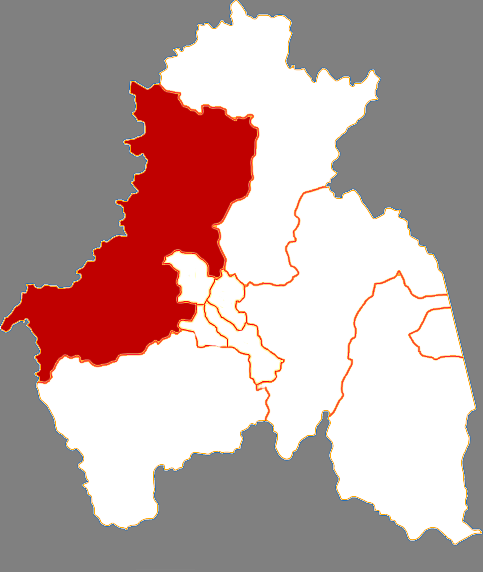
Hailin (Chinese: 海林; pinyin: Hǎilín) is a county-level city, under the administration of the prefecture-level city of Mudanjiang, in the southeast of Heilongjiang province, China, bordering Jilin province to the southwest. It has an area of 8,816 km2 (3,404 sq mi), and a population of 422,000 (as reported in 2012). Ethnic groups include the majority Han Chinese as well as significant numbers of Manchu and ethnic Koreans.
The name Hailin in English means "sea forest". Some people guess the meaning is "boundless forest", but the city was a merger of two counties, "Xinhai" and "Wulin", and its name was chosen by Chinese character in each of the old counties, and combined as"Hailin". In this sense, Hailin shares a name with the "boundless" Linhai Snowfield (林海雪原; Línhǎi Xuěyuán).
Hailin is today known by several descriptive names - "forest sea and snow plain", "hometown of Manchurian tigers", and "hometown of Chinese north medicine". However, in the past many knew Hailin from the story of people's revolutionary hero Yang Zi Rong (杨子荣), the real life hero Zhang Zonggui. His story was made into a modern, revolutionary Beijing opera Taking Tiger Mountain by Strategy, based the 1957 novel 林海雪原 (Línhǎi Xuěyuan) by Qü Bo. Various movies have been made of the same story.
Hailin must have been inhabited even in the ancient times of the Shang dynasty, if not the Neolithic era. Historic sites include ancient Qunli rock paintings, Jiangdong ancient cemeteries of Jin dynasty, the early site of the Qing dynasty Ninguta city (from which a structure called Ninggu Ta - "Ninngu Tower" - remains), a wooden Russian Orthodox cathedral, a depot of the Chinese Eastern Railway constructed in 1903, and the Yang Zirong martyrs' cemetery.
During Second Sino-Japanese War, the Japanese established a military airport at Hailin. Even recently (2005) aircraft bombs continue to be discovered during construction and other projects.
The present day administrative division traces its recent history to Xinhai county established in 1946. The division was changed to city-grade in 1992.
Nowadays, there are 8 towns and 123 administrative villages in Hailin City. The towns include:
90% of the Hailin City administrative area is mountainous. Principal geographic features of Hailin include Shen Mountain, Qian Mountain, Qiulingman Mound, Haigu Plain, Zhangguancai Ridge, and 140 streams or rivers of the Mudanjiang water system (74 belonging to the Hailang drainage basin and 66 belonging to the Mudanjiang drainage basin). The larger rivers are the Mudanjiang River, the Hailang River, Sandao River, Erdao River, Toudao River, Shanshi River, Mijang River, Hongdian River, and Douyin River.
Hub AI
Hailin AI simulator
(@Hailin_simulator)
Hailin
Hailin (Chinese: 海林; pinyin: Hǎilín) is a county-level city, under the administration of the prefecture-level city of Mudanjiang, in the southeast of Heilongjiang province, China, bordering Jilin province to the southwest. It has an area of 8,816 km2 (3,404 sq mi), and a population of 422,000 (as reported in 2012). Ethnic groups include the majority Han Chinese as well as significant numbers of Manchu and ethnic Koreans.
The name Hailin in English means "sea forest". Some people guess the meaning is "boundless forest", but the city was a merger of two counties, "Xinhai" and "Wulin", and its name was chosen by Chinese character in each of the old counties, and combined as"Hailin". In this sense, Hailin shares a name with the "boundless" Linhai Snowfield (林海雪原; Línhǎi Xuěyuán).
Hailin is today known by several descriptive names - "forest sea and snow plain", "hometown of Manchurian tigers", and "hometown of Chinese north medicine". However, in the past many knew Hailin from the story of people's revolutionary hero Yang Zi Rong (杨子荣), the real life hero Zhang Zonggui. His story was made into a modern, revolutionary Beijing opera Taking Tiger Mountain by Strategy, based the 1957 novel 林海雪原 (Línhǎi Xuěyuan) by Qü Bo. Various movies have been made of the same story.
Hailin must have been inhabited even in the ancient times of the Shang dynasty, if not the Neolithic era. Historic sites include ancient Qunli rock paintings, Jiangdong ancient cemeteries of Jin dynasty, the early site of the Qing dynasty Ninguta city (from which a structure called Ninggu Ta - "Ninngu Tower" - remains), a wooden Russian Orthodox cathedral, a depot of the Chinese Eastern Railway constructed in 1903, and the Yang Zirong martyrs' cemetery.
During Second Sino-Japanese War, the Japanese established a military airport at Hailin. Even recently (2005) aircraft bombs continue to be discovered during construction and other projects.
The present day administrative division traces its recent history to Xinhai county established in 1946. The division was changed to city-grade in 1992.
Nowadays, there are 8 towns and 123 administrative villages in Hailin City. The towns include:
90% of the Hailin City administrative area is mountainous. Principal geographic features of Hailin include Shen Mountain, Qian Mountain, Qiulingman Mound, Haigu Plain, Zhangguancai Ridge, and 140 streams or rivers of the Mudanjiang water system (74 belonging to the Hailang drainage basin and 66 belonging to the Mudanjiang drainage basin). The larger rivers are the Mudanjiang River, the Hailang River, Sandao River, Erdao River, Toudao River, Shanshi River, Mijang River, Hongdian River, and Douyin River.