



Community hub
Recent from talks
Knowledge base stats:
Talk channels stats:
Members stats:
Halizah
Halitsah or chalitzah (Hebrew: חליצה, romanized: ḥəliṣā) in Rabbinical Judaism is the process by which a childless widow and a brother of her deceased husband may avoid the duty to marry under the biblical system of yibbum (levirate marriage).
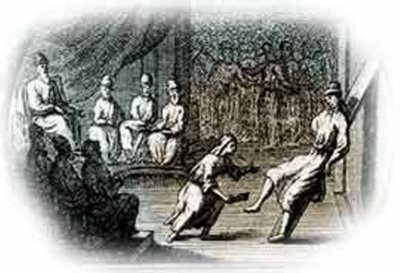
The process involves the widow making a declaration, taking off a shoe of the brother (i.e., her brother-in-law), and spitting on the floor. Through this ceremony, the brother and any other brothers are released from the obligation of marrying the woman to conceive a child that would be considered the progeny of the deceased man. The ceremony of halitsa makes the widow free to marry whomever she desires, except for a Kohen "priest". (Deuteronomy 25:5–10).
It is sufficient for only one brother-in-law to perform the ceremony. Yibbum (Genesis 38:8) is thus modified in the Deuteronomic code attributed to Moses by permitting the surviving brother to refuse to marry his brother's widow provided he submits to the ceremony of halitsa. In the Talmudic period, this tendency was intensified by the apprehension that the brother-in-law might desire to marry his brother's widow for motives other than that of "establishing a name unto his brother." Therefore, many Talmudic and later rabbis preferred halitsa to marriage. As a result, yibbum fell into disuse; now halitsa is the general rule and marriage is the rare exception. However, the yibbum law is still presumed to be in force, thus making a childless widow who remarries someone other than her brother-in-law without performing the halitsa ceremony an adulterer.
Deuteronomy describes the ceremony simply. In the presence of town elders, the widow recites a prescribed formula which scolds him for not building his brother's household, loosens the shoe of the brother-in-law, and spits on the floor. In the Talmud, however, the rabbis explained the ceremony as a more solemn and public act. The Halizah is a very humiliating ceremony for both the parties involved. It is believed that when the ceremony is performed publicly, the humiliation and the shame that the brother and the widow feel is meant to break the bond that they hold. The ceremony must take place before a court of three, who need not be very learned, but must at least understand Hebrew. All those who are disqualified from testifying in legal matters are disqualified also from acting on this board of judges. These three appoint two others to assist them, and at the service on the evening preceding the day of the ceremony they appoint a place for its performance, to give the matter more publicity. The place chosen is usually the synagogue court or the house of the rabbi, although the ceremony may take place in the house of the widow. All investigations into the concerned parties are conducted the previous day, on which both are instructed in ceremony details, and on which the yebamah (widowed sister-in-law) is not allowed to eat. The halitzah should not be performed in the evening, nor on a Sabbath or a holiday, nor on the eve of a Sabbath or a holiday.
On the day set for the halitzah, immediately after the morning service, when all the people are still in the synagogue, the three judges and their two assistants, who also act as witnesses, meet at the appointed place. The three judges sit on one bench, the two assistants on a bench placed beside it; the yabam (brother-in-law) and the yebamah stand between them. Before the ceremony, a public examination establishes the relationship of the parties and their maturity. If one is a minor, a deaf-mute, a mute, or mentally handicapped, or has a crooked or turned foot, the halitzah cannot be performed. The court must also know whether she is left-handed or whether he is left-footed, and must be convinced that more than ninety-one days have passed since the death of her husband.
To establish these matters it is not necessary to have legally eligible witnesses. Even those who are otherwise disqualified from testifying may become witnesses. Both the yabam and the yebamah must be made aware of the fact that by this ceremony the widow becomes free to marry whomever she may desire.
After these preliminary details, and after the yabam makes a public declaration that he has not been forced by outside influence to submit to the halitzah, but acts of his own free will, the ceremony commences. The shoe, which is usually the property of the community, is brought forth and examined as to cleanliness and construction, in accordance with the precepts of the law. The halitzah shoe is made entirely of leather, usually from the hide of a kosher animal.
It is made of two pieces, the upper part and the sole, sewn together with leather threads. Three small straps are attached to the front of the shoe, each of which has a knot (humrata) at the top to fit a hole made on the other side of the shoe. Two white leather straps attach to either side of the shoe and fasten it to the leg.
Hub AI
Halizah AI simulator
(@Halizah_simulator)
Halizah
Halitsah or chalitzah (Hebrew: חליצה, romanized: ḥəliṣā) in Rabbinical Judaism is the process by which a childless widow and a brother of her deceased husband may avoid the duty to marry under the biblical system of yibbum (levirate marriage).
The process involves the widow making a declaration, taking off a shoe of the brother (i.e., her brother-in-law), and spitting on the floor. Through this ceremony, the brother and any other brothers are released from the obligation of marrying the woman to conceive a child that would be considered the progeny of the deceased man. The ceremony of halitsa makes the widow free to marry whomever she desires, except for a Kohen "priest". (Deuteronomy 25:5–10).
It is sufficient for only one brother-in-law to perform the ceremony. Yibbum (Genesis 38:8) is thus modified in the Deuteronomic code attributed to Moses by permitting the surviving brother to refuse to marry his brother's widow provided he submits to the ceremony of halitsa. In the Talmudic period, this tendency was intensified by the apprehension that the brother-in-law might desire to marry his brother's widow for motives other than that of "establishing a name unto his brother." Therefore, many Talmudic and later rabbis preferred halitsa to marriage. As a result, yibbum fell into disuse; now halitsa is the general rule and marriage is the rare exception. However, the yibbum law is still presumed to be in force, thus making a childless widow who remarries someone other than her brother-in-law without performing the halitsa ceremony an adulterer.
Deuteronomy describes the ceremony simply. In the presence of town elders, the widow recites a prescribed formula which scolds him for not building his brother's household, loosens the shoe of the brother-in-law, and spits on the floor. In the Talmud, however, the rabbis explained the ceremony as a more solemn and public act. The Halizah is a very humiliating ceremony for both the parties involved. It is believed that when the ceremony is performed publicly, the humiliation and the shame that the brother and the widow feel is meant to break the bond that they hold. The ceremony must take place before a court of three, who need not be very learned, but must at least understand Hebrew. All those who are disqualified from testifying in legal matters are disqualified also from acting on this board of judges. These three appoint two others to assist them, and at the service on the evening preceding the day of the ceremony they appoint a place for its performance, to give the matter more publicity. The place chosen is usually the synagogue court or the house of the rabbi, although the ceremony may take place in the house of the widow. All investigations into the concerned parties are conducted the previous day, on which both are instructed in ceremony details, and on which the yebamah (widowed sister-in-law) is not allowed to eat. The halitzah should not be performed in the evening, nor on a Sabbath or a holiday, nor on the eve of a Sabbath or a holiday.
On the day set for the halitzah, immediately after the morning service, when all the people are still in the synagogue, the three judges and their two assistants, who also act as witnesses, meet at the appointed place. The three judges sit on one bench, the two assistants on a bench placed beside it; the yabam (brother-in-law) and the yebamah stand between them. Before the ceremony, a public examination establishes the relationship of the parties and their maturity. If one is a minor, a deaf-mute, a mute, or mentally handicapped, or has a crooked or turned foot, the halitzah cannot be performed. The court must also know whether she is left-handed or whether he is left-footed, and must be convinced that more than ninety-one days have passed since the death of her husband.
To establish these matters it is not necessary to have legally eligible witnesses. Even those who are otherwise disqualified from testifying may become witnesses. Both the yabam and the yebamah must be made aware of the fact that by this ceremony the widow becomes free to marry whomever she may desire.
After these preliminary details, and after the yabam makes a public declaration that he has not been forced by outside influence to submit to the halitzah, but acts of his own free will, the ceremony commences. The shoe, which is usually the property of the community, is brought forth and examined as to cleanliness and construction, in accordance with the precepts of the law. The halitzah shoe is made entirely of leather, usually from the hide of a kosher animal.
It is made of two pieces, the upper part and the sole, sewn together with leather threads. Three small straps are attached to the front of the shoe, each of which has a knot (humrata) at the top to fit a hole made on the other side of the shoe. Two white leather straps attach to either side of the shoe and fasten it to the leg.