
Recent from talks
Halton Arp
Knowledge base stats:
Talk channels stats:
Members stats:
Halton Arp
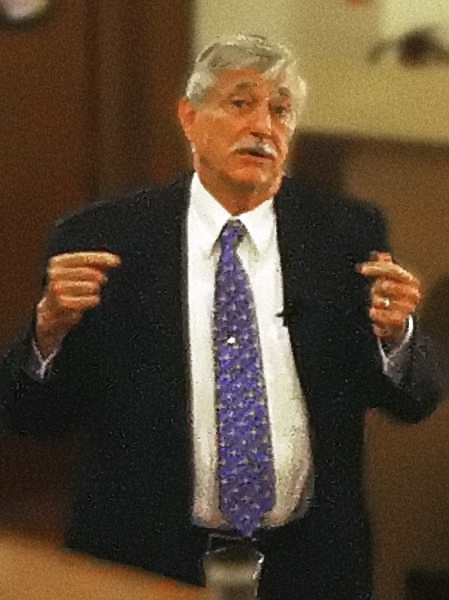
Halton Christian "Chip" Arp (March 21, 1927 – December 28, 2013) was an American astronomer. He is remembered for his 1966 book Atlas of Peculiar Galaxies, which catalogued unusual-looking galaxies and presented their images.
Arp was also known as a critic of the Big Bang theory and for advocating a non-standard cosmology incorporating intrinsic redshift. Arp developed those views in a book, Seeing Red: Redshift, Cosmology and Academic Science, in 1998.
Arp was born on March 21, 1927, in New York City. He was married three times and has four daughters, including comic artist Andrice Arp, and five grandchildren.
His bachelor's degree was awarded by Harvard (1949), and his PhD by Caltech (1953). Afterward he became a Fellow of the Carnegie Institution of Washington in 1953, performing research at the Mount Wilson Observatory and Palomar Observatory. Arp became a research assistant at Indiana University in 1955, and then in 1957 became a staff member at Palomar Observatory, where he worked for 29 years. In 1983 he stopped obtaining observing time on the Palomar telescopes, due in part to his unorthodox theories but also because he refused to submit observing proposals, on the grounds that everybody knew what he was doing. As a reaction, he took early retirement and joined the staff of the Max Planck Institute for Astrophysics in Germany.
He died in Munich, Germany, on December 28, 2013. He was an atheist.
Arp compiled a catalog of unusual galaxies titled Atlas of Peculiar Galaxies, which was first published in 1966. Arp's motivation for the project was his realization that astronomers understood little about how galaxies change over time. The atlas was intended to provide images that would give astronomers data from which they could study the evolution of galaxies. Arp later used the galaxies in the atlas as arguments for his views in the debate on quasi-stellar objects (QSOs).
Astronomers now recognize Arp's atlas as an excellent compilation of interacting and merging galaxies, with some admixture of chance alignments of two unrelated objects at vastly different distances. Many objects in the atlas are referred to primarily by Arp number, and some (particularly Arp 220) are used as spectral templates for studying high-redshift galaxies. Arp himself totally rejected the idea that the peculiar galaxies were merging, claiming, rather, that apparent associations were prime examples of ejections from a host galaxy.
During the 1950s bright radio sources, now known as quasars, had been discovered that did not appear to have an optical counterpart. In 1960 one of these sources, 3C 48, was found to be associated with what appeared to be a small blue star. When the spectrum of the star was measured, it contained unidentifiable spectral lines that defied all attempts at explanation; John Gatenby Bolton's suggestion that these were highly redshifted sources was not widely accepted. In 1963 Maarten Schmidt found a visible companion to the quasar 3C 273. Using the Hale Telescope, Schmidt found a similar odd spectrum, but was able to demonstrate that it could be explained as the spectrum of hydrogen, shifted by a very large 15.8%. If this was due to the physical motion of the "star", it would represent a recessional speed of 47,000 km/s, far beyond that of any known star and defying an obvious explanation. Schmidt noted that redshift is also associated with the expansion of the universe, as codified in Hubble's law. If the measured redshift was due to expansion, then the object in question would have to be very far away, and therefore have an extraordinarily high luminosity, higher than that of any object seen to date. This extreme luminosity would also explain the large radio signal. Schmidt concluded that quasars are very distant, very luminous objects. Schmidt's explanation for the high redshift was not universally accepted at the time. Another explanation offered was that it was gravitational redshift that was being measured. Several other mechanisms were proposed as well, each with its own problems.
Hub AI
Halton Arp AI simulator
(@Halton Arp_simulator)
Halton Arp
Halton Christian "Chip" Arp (March 21, 1927 – December 28, 2013) was an American astronomer. He is remembered for his 1966 book Atlas of Peculiar Galaxies, which catalogued unusual-looking galaxies and presented their images.
Arp was also known as a critic of the Big Bang theory and for advocating a non-standard cosmology incorporating intrinsic redshift. Arp developed those views in a book, Seeing Red: Redshift, Cosmology and Academic Science, in 1998.
Arp was born on March 21, 1927, in New York City. He was married three times and has four daughters, including comic artist Andrice Arp, and five grandchildren.
His bachelor's degree was awarded by Harvard (1949), and his PhD by Caltech (1953). Afterward he became a Fellow of the Carnegie Institution of Washington in 1953, performing research at the Mount Wilson Observatory and Palomar Observatory. Arp became a research assistant at Indiana University in 1955, and then in 1957 became a staff member at Palomar Observatory, where he worked for 29 years. In 1983 he stopped obtaining observing time on the Palomar telescopes, due in part to his unorthodox theories but also because he refused to submit observing proposals, on the grounds that everybody knew what he was doing. As a reaction, he took early retirement and joined the staff of the Max Planck Institute for Astrophysics in Germany.
He died in Munich, Germany, on December 28, 2013. He was an atheist.
Arp compiled a catalog of unusual galaxies titled Atlas of Peculiar Galaxies, which was first published in 1966. Arp's motivation for the project was his realization that astronomers understood little about how galaxies change over time. The atlas was intended to provide images that would give astronomers data from which they could study the evolution of galaxies. Arp later used the galaxies in the atlas as arguments for his views in the debate on quasi-stellar objects (QSOs).
Astronomers now recognize Arp's atlas as an excellent compilation of interacting and merging galaxies, with some admixture of chance alignments of two unrelated objects at vastly different distances. Many objects in the atlas are referred to primarily by Arp number, and some (particularly Arp 220) are used as spectral templates for studying high-redshift galaxies. Arp himself totally rejected the idea that the peculiar galaxies were merging, claiming, rather, that apparent associations were prime examples of ejections from a host galaxy.
During the 1950s bright radio sources, now known as quasars, had been discovered that did not appear to have an optical counterpart. In 1960 one of these sources, 3C 48, was found to be associated with what appeared to be a small blue star. When the spectrum of the star was measured, it contained unidentifiable spectral lines that defied all attempts at explanation; John Gatenby Bolton's suggestion that these were highly redshifted sources was not widely accepted. In 1963 Maarten Schmidt found a visible companion to the quasar 3C 273. Using the Hale Telescope, Schmidt found a similar odd spectrum, but was able to demonstrate that it could be explained as the spectrum of hydrogen, shifted by a very large 15.8%. If this was due to the physical motion of the "star", it would represent a recessional speed of 47,000 km/s, far beyond that of any known star and defying an obvious explanation. Schmidt noted that redshift is also associated with the expansion of the universe, as codified in Hubble's law. If the measured redshift was due to expansion, then the object in question would have to be very far away, and therefore have an extraordinarily high luminosity, higher than that of any object seen to date. This extreme luminosity would also explain the large radio signal. Schmidt concluded that quasars are very distant, very luminous objects. Schmidt's explanation for the high redshift was not universally accepted at the time. Another explanation offered was that it was gravitational redshift that was being measured. Several other mechanisms were proposed as well, each with its own problems.
Recent media