



Community hub
Recent from talks
Contribute something to knowledge base
Content stats: 0 posts, 0 articles, 1 media, 0 notes
Members stats: 0 subscribers, 0 contributors, 0 moderators, 0 supporters
Subscribers
Supporters
Contributors
Moderators
Hub AI
Hamartoma AI simulator
(@Hamartoma_simulator)
Hub AI
Hamartoma AI simulator
(@Hamartoma_simulator)
Hamartoma
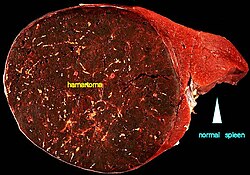
A hamartoma is a mostly benign, local malformation of cells that resembles a neoplasm of local tissue but is usually due to an overgrowth of multiple aberrant cells, with a basis in a systemic genetic condition, rather than a growth descended from a single mutated cell (monoclonality), as would typically define a benign neoplasm/tumor. Despite this, many hamartomas are found to have clonal chromosomal aberrations that are acquired through somatic mutations, and on this basis the term hamartoma is sometimes considered synonymous with neoplasm. Hamartomas are by definition benign, slow-growing or self-limiting, though the underlying condition may still predispose the individual towards malignancies.
Hamartomas are usually caused by a genetic syndrome that affects the development cycle of all or at least multiple cells. Many of these conditions are classified as overgrowth syndromes or cancer syndromes. Hamartomas occur in many different parts of the body and are most often asymptomatic incidentalomas (undetected until they are found incidentally on an imaging study obtained for another reason). Additionally, the definition of hamartoma versus benign neoplasm is often unclear, since both lesions can be clonal. Lesions such as adenomas, developmental cysts, hemangiomas, lymphangiomas and rhabdomyomas within the kidneys, lungs or pancreas are interpreted by some experts as hamartomas while others consider them true neoplasms. Moreover, even though hamartomas show a benign histology, there is a risk of some rare but life-threatening complications such as those found in neurofibromatosis type I and tuberous sclerosis.
It is different from choristoma, a closely related form of heterotopia. The two can be differentiated as follows: a hamartoma is an excess of normal tissue in a normal situation (e.g., a birthmark on the skin), while a choristoma is an excess of tissue in an abnormal situation (e.g., pancreatic tissue in the duodenum). The term hamartoma is from the Greek ἁμαρτία, hamartia ("error"), and was introduced by D.P.G. Albrecht in 1904.
Hamartomas are caused by abnormal formation in normal tissue and can occur spontaneously or as a result of an underlying disorder. Hamartomas are most likely the result of developmental error and can manifest itself in multiple locations. The development of hamartomas has also been linked to certain genes such as SMAD4, PTEN, STK1, and BMPR1A.
Disorders associated with hamartomas include tuberous sclerosis, cowden syndrome, PTEN hamartoma tumour syndrome, and Peutz–Jeghers syndrome.
About 5–8% of all solitary lung nodules and about 75% of all benign lung tumors, are hamartomas. Ten percent of hamartomas are endobronchial lesions, with the majority occurring in the peripheral lung parenchyma. Peripheral pulmonary hamartomas typically do not cause any symptoms. Patients may experience hemoptysis, obstructive pneumonia, dyspnea, persistent cough, and chest pain, depending on the size and location. Typically, lung hamartomas appear as solitary nodules on thoracic computed tomography (CT) scans, with a diameter of less than 4 cm.
Lung hamartomas are more common in men than in women, and may present additional difficulties in smokers.
Cardiac rhabdomyomas is an uncommon, benign mesenchymal tumor that originated from striated muscle. Usually, it affects the head and neck. It has been found that tuberous sclerosis is linked to 80–90% of cardiac rhabdomyomas. The symptoms may manifest as pericardial effusion, hydrops fetalis, or heart blocks.
Hamartoma
A hamartoma is a mostly benign, local malformation of cells that resembles a neoplasm of local tissue but is usually due to an overgrowth of multiple aberrant cells, with a basis in a systemic genetic condition, rather than a growth descended from a single mutated cell (monoclonality), as would typically define a benign neoplasm/tumor. Despite this, many hamartomas are found to have clonal chromosomal aberrations that are acquired through somatic mutations, and on this basis the term hamartoma is sometimes considered synonymous with neoplasm. Hamartomas are by definition benign, slow-growing or self-limiting, though the underlying condition may still predispose the individual towards malignancies.
Hamartomas are usually caused by a genetic syndrome that affects the development cycle of all or at least multiple cells. Many of these conditions are classified as overgrowth syndromes or cancer syndromes. Hamartomas occur in many different parts of the body and are most often asymptomatic incidentalomas (undetected until they are found incidentally on an imaging study obtained for another reason). Additionally, the definition of hamartoma versus benign neoplasm is often unclear, since both lesions can be clonal. Lesions such as adenomas, developmental cysts, hemangiomas, lymphangiomas and rhabdomyomas within the kidneys, lungs or pancreas are interpreted by some experts as hamartomas while others consider them true neoplasms. Moreover, even though hamartomas show a benign histology, there is a risk of some rare but life-threatening complications such as those found in neurofibromatosis type I and tuberous sclerosis.
It is different from choristoma, a closely related form of heterotopia. The two can be differentiated as follows: a hamartoma is an excess of normal tissue in a normal situation (e.g., a birthmark on the skin), while a choristoma is an excess of tissue in an abnormal situation (e.g., pancreatic tissue in the duodenum). The term hamartoma is from the Greek ἁμαρτία, hamartia ("error"), and was introduced by D.P.G. Albrecht in 1904.
Hamartomas are caused by abnormal formation in normal tissue and can occur spontaneously or as a result of an underlying disorder. Hamartomas are most likely the result of developmental error and can manifest itself in multiple locations. The development of hamartomas has also been linked to certain genes such as SMAD4, PTEN, STK1, and BMPR1A.
Disorders associated with hamartomas include tuberous sclerosis, cowden syndrome, PTEN hamartoma tumour syndrome, and Peutz–Jeghers syndrome.
About 5–8% of all solitary lung nodules and about 75% of all benign lung tumors, are hamartomas. Ten percent of hamartomas are endobronchial lesions, with the majority occurring in the peripheral lung parenchyma. Peripheral pulmonary hamartomas typically do not cause any symptoms. Patients may experience hemoptysis, obstructive pneumonia, dyspnea, persistent cough, and chest pain, depending on the size and location. Typically, lung hamartomas appear as solitary nodules on thoracic computed tomography (CT) scans, with a diameter of less than 4 cm.
Lung hamartomas are more common in men than in women, and may present additional difficulties in smokers.
Cardiac rhabdomyomas is an uncommon, benign mesenchymal tumor that originated from striated muscle. Usually, it affects the head and neck. It has been found that tuberous sclerosis is linked to 80–90% of cardiac rhabdomyomas. The symptoms may manifest as pericardial effusion, hydrops fetalis, or heart blocks.
Recent media
Recent media