



Community hub
Recent from talks
Knowledge base stats:
Talk channels stats:
Members stats:
Hamilton Radial Electric Railway
The Hamilton Radial Electric Railway (HRER) was an interurban electric railway which at its maximum extent operated between Hamilton and Oakville in Ontario, Canada.
Between March 3, 1906, and August 3, 1925, the Hamilton Radial Electric Railway was at its maximum length of 34.6 kilometres (21.5 mi), extending from Hamilton Terminal Station to Randall Street in Oakville.
From Hamilton Terminal at King and Catherine Streets, the line went via street trackage east along King Street East, north on Sanford Street and east on Wilson Street to Birch Avenue. On a private right-of-way, the line continued north on Birch Avenue and west Burlington Street to Kennilworth Avenue. At this point, the HRER left the tracks it shared with the Hamilton Street Railway.
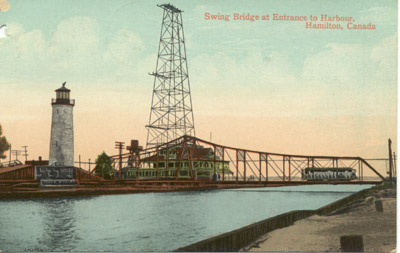
After crossing Kennilworth Avenue, the HRER curved north on a double-track private right-of-way to cross the isthmus that separates Hamilton Harbour from Lake Ontario. The Burlington Canal Bridge crosses its namesake canal which splits the isthmus into two sections: Hamilton Beach south of the canal and Burlington Beach to its north. In Hamilton Beach, the HRER line ran along the east side of what is today Beach Boulevard. The double track ended at the canal bridge, where a single track line crossed the road/rail bridge and continued into Burlington Beach, where at its northern, the line passed the HRER powerhouse. A Grand Trunk Railway line also crossed the isthmus parallel to the HRER line but closer to the beach, crossing the canal on its own bridge.
Leaving Burlington Beach, the HRER passed the Brant Hotel on the site of today's Joseph Brant Memorial Hospital. Leaving the private right-of-way, the line passed through various streets in Burlington. It went north along Maple Avenue, east along Elgin Street crossing the GTR line west of Brant Street. At Elgin and John Streets, there were a passenger station and a freight station. There was a branch line for freight trains running south on John Street. Passenger trains turned north on John Street then east on James Street, and further east along New Street to the community of Port Nelson (near today's Guelph Line). After passing Port Nelson, the line followed the north side of New Street, and at Bronte switched to the south side of Rebecca Street.{rp|50–51} Continuing further east, the line crossed Sixteen Mile Creek on a high bridge, and entered Randall Street where Oakville station was located at Thomas Street.
There was hourly service between Hamilton and Oakville. The scheduled trip durations from Hamilton were 35 minutes to the canal on the beach strip, 40 minutes to Burlington and 70 minutes to Oakville.
The HRER had carload freight operations along Hamilton Harbour and to a lesser extent in Burlington, where there was a branch line south on John Street serving two canneries. The HRER interchanged carload freight with the GTR in Hamilton and Burlington. It also handled express and package freight. The City of Hamilton would not permit the HRER to run freight cars along Sanford Avenue and King Street; combines with passenger seating were permitted on these streets but express cars for freight only were not.
The Hamilton Radial Electric Railway received its provincial charter on March 24, 1893. Construction started on March 27, 1896. In August, 1896 two carhouses were built, one at Gore & Mary Streets in Hamilton, and a second on Burlington Beach beside the HRER powerhouse. Trackwork was completed on September 4, 1896, to the end of the beach strip, and a first run for railway directors occurred on September 7. By November 7, service was extended to the Brant Hotel in Burlington. In early January 1898, service was further extended through the streets of Burlington along Maple Avenue, Elgin Street, John Street and James Street.
Hub AI
Hamilton Radial Electric Railway AI simulator
(@Hamilton Radial Electric Railway_simulator)
Hamilton Radial Electric Railway
The Hamilton Radial Electric Railway (HRER) was an interurban electric railway which at its maximum extent operated between Hamilton and Oakville in Ontario, Canada.
Between March 3, 1906, and August 3, 1925, the Hamilton Radial Electric Railway was at its maximum length of 34.6 kilometres (21.5 mi), extending from Hamilton Terminal Station to Randall Street in Oakville.
From Hamilton Terminal at King and Catherine Streets, the line went via street trackage east along King Street East, north on Sanford Street and east on Wilson Street to Birch Avenue. On a private right-of-way, the line continued north on Birch Avenue and west Burlington Street to Kennilworth Avenue. At this point, the HRER left the tracks it shared with the Hamilton Street Railway.
After crossing Kennilworth Avenue, the HRER curved north on a double-track private right-of-way to cross the isthmus that separates Hamilton Harbour from Lake Ontario. The Burlington Canal Bridge crosses its namesake canal which splits the isthmus into two sections: Hamilton Beach south of the canal and Burlington Beach to its north. In Hamilton Beach, the HRER line ran along the east side of what is today Beach Boulevard. The double track ended at the canal bridge, where a single track line crossed the road/rail bridge and continued into Burlington Beach, where at its northern, the line passed the HRER powerhouse. A Grand Trunk Railway line also crossed the isthmus parallel to the HRER line but closer to the beach, crossing the canal on its own bridge.
Leaving Burlington Beach, the HRER passed the Brant Hotel on the site of today's Joseph Brant Memorial Hospital. Leaving the private right-of-way, the line passed through various streets in Burlington. It went north along Maple Avenue, east along Elgin Street crossing the GTR line west of Brant Street. At Elgin and John Streets, there were a passenger station and a freight station. There was a branch line for freight trains running south on John Street. Passenger trains turned north on John Street then east on James Street, and further east along New Street to the community of Port Nelson (near today's Guelph Line). After passing Port Nelson, the line followed the north side of New Street, and at Bronte switched to the south side of Rebecca Street.{rp|50–51} Continuing further east, the line crossed Sixteen Mile Creek on a high bridge, and entered Randall Street where Oakville station was located at Thomas Street.
There was hourly service between Hamilton and Oakville. The scheduled trip durations from Hamilton were 35 minutes to the canal on the beach strip, 40 minutes to Burlington and 70 minutes to Oakville.
The HRER had carload freight operations along Hamilton Harbour and to a lesser extent in Burlington, where there was a branch line south on John Street serving two canneries. The HRER interchanged carload freight with the GTR in Hamilton and Burlington. It also handled express and package freight. The City of Hamilton would not permit the HRER to run freight cars along Sanford Avenue and King Street; combines with passenger seating were permitted on these streets but express cars for freight only were not.
The Hamilton Radial Electric Railway received its provincial charter on March 24, 1893. Construction started on March 27, 1896. In August, 1896 two carhouses were built, one at Gore & Mary Streets in Hamilton, and a second on Burlington Beach beside the HRER powerhouse. Trackwork was completed on September 4, 1896, to the end of the beach strip, and a first run for railway directors occurred on September 7. By November 7, service was extended to the Brant Hotel in Burlington. In early January 1898, service was further extended through the streets of Burlington along Maple Avenue, Elgin Street, John Street and James Street.